

Introduction
Teaching a child to pray (Salah) is one of the most important gifts a parent can give: it builds spiritual habits, discipline, and a connection with Allah. This guide gives you a practical, realistic plan you can use at home — age-by-age goals, exact scripts you can say with your child, troubleshooting tips, and a simple 4-week plan you can implement immediately.
Who this is for?
Parents and caregivers of young children (toddlers to pre-teens), teachers at weekend schools, and anyone who wants a gentle, effective approach to help kids adopt the habit of praying regularly. Notes for children with sensory or learning differences appear where helpful.
Key principles:
- Model first: Children copy adults. When they see you pray regularly, they are far more likely to join.
- Small steps: Start with presence and short participation before expecting full performance.
- Consistency beats intensity: Daily little reminders > infrequent long lessons.
- Positive reinforcement: Praise, charts, and connection (not punishment) work best.
- Make it meaningful: Teach simple meanings so prayer is not just motion.
Age-appropriate expectations (quick guide)
- Ages 0–3: Introduce the idea. Let them watch, play with a small prayer rug, hear the azan and takbeer. Expect short attention.
- Ages 3–5: Can imitate standing, bowing, and sitting. Start simple phrases and short surahs/duas. Aim to participate for parts of the prayer.
- Ages 6–9: Can learn full positions and begin reciting short surahs with transliteration. Encourage joining family prayers.
- Ages 10+: Work on fluency and understanding meaning; encourage independent performance and responsibility.
Phase-by-phase practical plan
Phase 1 — Early exposure (0–3 years)
Goal: Familiarity and positive association.
Actions:
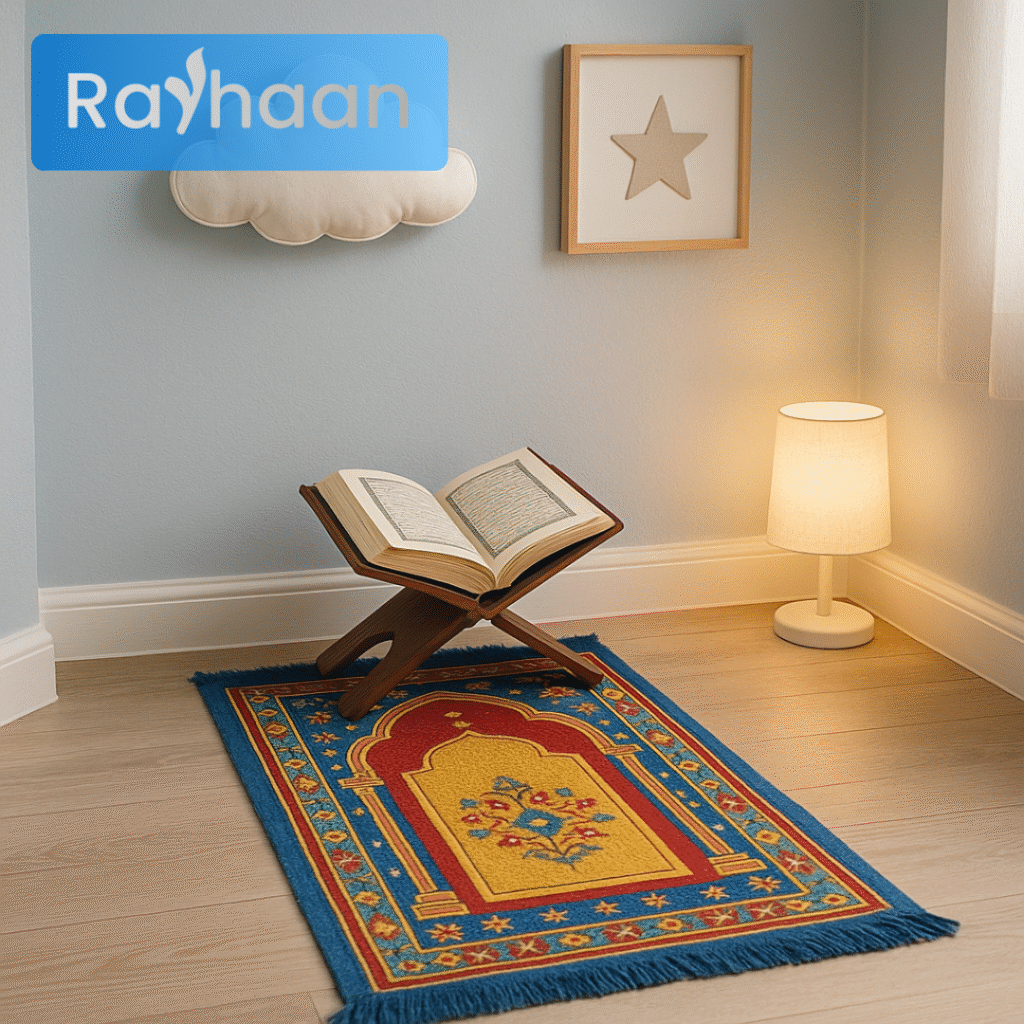
- Have a child-sized prayer rug and a small soft copy of a Muslim book or illustrated dua cards near it.
- Let the child watch you pray; narrate simply: “Now mummy/daddy talks to Allah.”
- Play azan quietly in the home before prayer time as a cue.
- Praise any interest: “MashAllah, you sat so still!”
Phase 2 — Join and imitate (3–5 years)
Goal: Imitation of basic movements and short participation.
Actions:
- Teach the takbeer: model “Allahu Akbar” and encourage them to say it with you.
- Teach 1–2 positions to imitate (standing, bowing). Use a short rhyme or song to remember order.
- Use 1-line recitations: short tasbeeh (“SubhanAllah”) or short surah like Al-Ikhlas (in transliteration) — 1–2 lines to start.
- Use frequent praise and a sticker chart for every time they try.

Phase 3 — Practice & structure (6–9 years)
Goal: Ability to perform short Salah with help; understand basics.
Actions:
- Teach wudu step-by-step with a picture chart and practice together.
- Teach a simple 2-rakah prayer: takbeer, short recitation (Al-Fatiha + short surah), ruku, sujood, tashahhud (use transliteration if necessary).
- Start a weekly goal: join family for Fajr (weekends) or Maghrib every day for a week — reward non-material (extra storytime).
- Teach short meanings: “Ruku = we bow to show respect to Allah.”
Phase 4 — Independence & meaning (10+ years)
Goal: Consistent performance and understanding.
Actions:
- Help them set personal goals (e.g., pray five times a week) and track progress.
- Practice full Salah independently; correct gently.
- Discuss why we pray, the power of dua, and how Salah helps in daily life.
- Encourage them to lead a short family dua or lead the prayer occasionally.
- Help them set personal goals (e.g., pray five times a week) and track progress.
How to teach the basics — simple scripts & tools.
Wudu (simple script)
Use a 4-step visual chart for young kids:
- Wash hands 3x and say “Bismillah.”
- Rinse mouth and nose (demonstrate).
- Wash face, arms to elbows, wipe head&ears, wash feet.
- Say a short dua: “O Allah, make me clean and ready.”
(Turn steps into a song or rhyme — children remember melodies well.)

Positions & short script for practice prayer (for parents to say aloud)
- Stand: “We stand and say ‘Allahu Akbar’ (big hands together).”
- Qiyam (recite): “In the name of Allah — Al-Fatiha (you can start with transliteration).”
- Ruku: “We bow and say, ‘Subhana Rabbiyal Azeem’ (3x).”
- Sujood: “We go down (touch the floor) and say ‘Subhana Rabbiyal A’la’ (3x).”
- Tashahhud (sitting): “We sit and say the short tashahhud.”
(Use very short transliteration lines at first; add Arabic gradually.)
Recommended short surahs to teach first
- Al-Ikhlas, Al-Falaq, An-Nas, Al-Kawthar — short, easy to memorize.
(Teach transliteration + meaning in simple English.)
( our Quran memorization course can help! book free trial NOW)
Routine & habit hacks
- Anchor to an existing habit: e.g., right after brushing teeth (Fajr), before dinner (Maghrib).
- Set a household signal: gentle chime or azan recording 5 minutes before prayer.
- Create a special prayer corner: child cushion, small shelf with dua cards, soft light.
- Use visual schedule: pictures showing “Wudu → Pray → Dua.”
- Praise specific behaviors: “I like how you stood so quietly — MashAllah.”
Rewards, charts & intrinsic motivation
- Sticker chart: give a sticker each time the child does a part of the prayer; after X stickers, choose a family reward (story, picnic).
- Salah tokens: collect tokens for acts of worship (sadaqah jar, storytime coupons).
- Move from external to internal: after the habit is stable, shift focus to meaning — celebrate that praying is talking to Allah and helps in hard times.
Avoid: Bribing with sweets or money long-term. Rewards should encourage habit-building, not become the only motive.
Troubleshooting (common issues)
- Refusal/avoidance: reduce pressure; join them with a playful game: “Who can say takbeer the loudest?” Praise even tiny steps.
- Easily distracted: shorten the goal (e.g., “today we just teach takbeer and standing”). Use a timer (1–3 minutes) and gradually increase.
- Forgetting: use consistent cues (sound, lights), and keep dua cards in visible places.
- Sibling comparison: keep rewards individual; praise personal progress, not competition.
- Regressions (sleepiness, travel): allow flexibility; use travel prayer charts and audio recitations.
Special note — children with sensory or learning differences
(From experience teaching neurodiverse learners)
- Use visual schedules, social stories and short sensory-friendly mats.
- Allow movement breaks; standing/sitting may need to be adapted.
- Teach one small piece at a time and use consistent routines (same place, same cues).
- Use tactile aids: a soft mat, a small worry stone to hold during prayer.
- Consider shorter, more frequent practice sessions. Celebrate any progress.
You can now download our FREE Salah progress chart for kids HERE
Sample 4-week lesson plan (ready to use)
Week 1 — Observe & Build interest
- Day 1–3: Play azan at prayer times; show the prayer rug; let child sit with you.
- Day 4–7: Teach takbeer and one position (stand → bow). Use stickers for each attempt.
Week 2 — Simple participation
- Teach wudu with a picture chart; practice wudu twice together.
- Teach a short surah (Al-Ikhlas) line by line. Encourage saying takbeer + ruku.
Week 3 — Practice a short 2-rakah
- Practice a mini prayer together: takbeer, short recitation (Al-Ikhlas), ruku, sujood, tashahhud. Repeat daily.
- Start a “5-times this week” family attendance goal for one prayer (Maghrib or Isha).
Week 4 — Lead & reflect
- Let the child lead part of the family prayer (e.g., takbeer + recitation).
- Talk about what they liked, what’s hard, and celebrate progress.
- Introduce a small personal goal for next month (e.g., pray 3 times weekly alone).
Scripts — what to say (examples)
- If they miss a prayer: “It’s okay, let’s try together next time. We keep trying.”
- “Let’s do prayer together — I’ll show you and you can copy me.”
- “Allahu Akbar — we start; this means Allah is the Greatest.”
- “MashAllah! You went down to sujood so nicely — that was beautiful.”
A final message:
Teaching Salah is a marathon, not a sprint. Celebrate tiny wins, keep the atmosphere loving and calm, and remember that consistency and modeling are more powerful than perfection. Small daily steps make faith a normal part of family life.