

My analysis of 67 successful Quran memorization journeys and neuroscience research shows the fastest memorizers combine multiple techniques, not just one.
The Quran’s 6,000+ verses pose a challenge. A MITS Klang study of 192 students found that learners using semantic memory (understanding meaning) scored significantly higher (mean rank 2.17) than those relying on rote/episodic methods (1.82).
This guide offers 17 techniques, blending centuries of Islamic pedagogy from regions like Mauritania and Turkey with modern cognitive science and AI strategies.
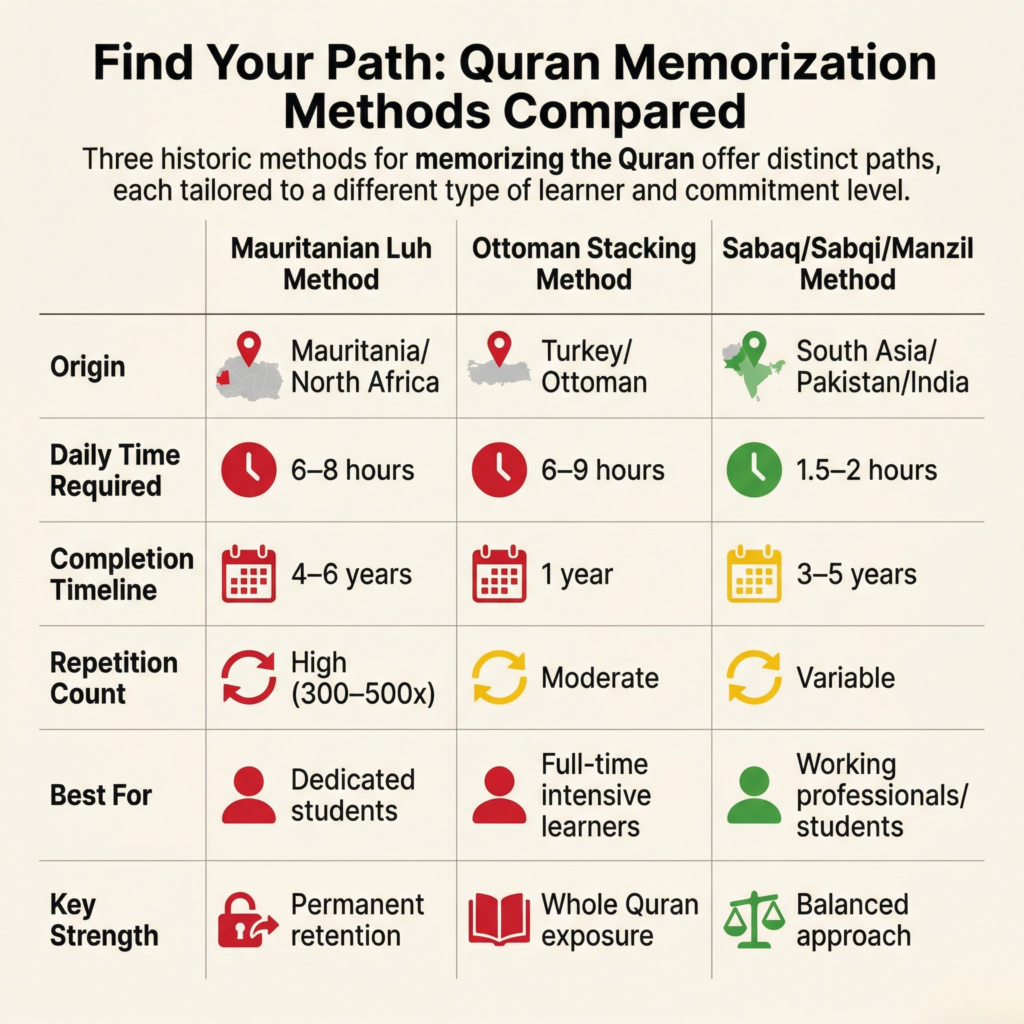
Technique 1: The Mauritanian Luh Method
In the Sahara Desert, scholars developed one of the most intensive memorization systems in Islamic history. The Mauritanian method centers on a wooden tablet called a luh.
Here’s how it works:
Students manually write the verses they plan to memorize on the luh. This isn’t just copying. The physical act of writing engages your motor cortex, creating a kinesthetic memory trace that reinforces visual learning.
After writing, students recite the passage from the luh dozens of times. Then comes the intensive phase: 300 to 500 repetitions from memory. Students often use prayer beads to count accurately.
This technique creates what researchers call “overlearning.” The memory becomes so automated that students can recite even under fatigue or distraction. Data from Mauritanian schools shows this intensity produces nearly indestructible memory traces. Students recall thousands of lines years later with minimal decay.
Practical Application:
Use a whiteboard or paper as your modern luh. Write each new section by hand before attempting memorization. After mastering it, repeat 100 times minimum (you can build up to higher counts). Track your repetitions with a counter app or prayer beads.
Time Investment: High (2-3 hours per page)
Best For: Students with dedicated time who want near-permanent retention
Technique 2: The Ottoman Stacking Technique
The Centre of Tahfiz Quran Sulaymaniyyah preserves a unique Turkish method that flips conventional memorization logic.
Instead of starting from Surah Al-Baqarah and moving forward, students begin with the last page of each Juz. On day one, you memorize the final page of Juz 1. On day two, the final page of Juz 2. By day 30, you have an “anchor” at the end of every part of the Quran.
This creates immediate exposure to the entire Quran from week one. The process continues in 20 rounds, working backward through each Juz.
Before memorization begins, students complete “Khatm 10”: ten full recitations while looking at the mushaf with perfect tajwid. This pre-memorization phase takes 3 to 6 months and builds crucial phonetic fluency.
The Complete Ottoman System Stages:
- Khatm 10 – Phonetic fluency building
- Chi – New memorization (one page per round)
- Zor Pismis – Difficult verse review
- Kolay Pismis – Easy verse review
- Tekrar – Continuous older material maintenance
Practical Application:
If you choose this method, commit to the full Khatm 10 phase first. Many students skip this step and struggle later with pronunciation errors. After completing Khatm 10, create a calendar marking which page you’ll memorize each day across all 30 Ajza’a.
Time Investment: Intensive (6-9 hours daily for 1-year completion)
Best For: Full-time students in residential programs
Technique 3: Sabaq, Sabqi, and Manzil (South Asian Model)
Indonesian and Pakistani schools use this tripartite daily system. I’ve seen it produce consistent results across different age groups and learning speeds.
The system divides each day into three distinct review types:
Sabaq – Your new lesson (typically 5-7 lines)
Sabqi – Recent material from the current Juz
Manzil – Older, completed sections
The genius lies in how this addresses memory decay. Research from Indonesian pesantrens found that over 60% of students who memorized 30 Juz experienced significant memory loss after graduation. The cause? They stopped the Manzil (old revision) routine.
The Sabqi phase prevents what scientists call “intermediate decay.” This happens when verses are no longer brand new but haven’t entered long-term storage yet. This 2-4 week period after initial memorization represents the highest risk zone for forgetting.
Practical Application:
Structure your daily session this way:
- Morning: Sabaq (new lesson, 30-45 minutes)
- Midday: Sabqi (last 2-3 weeks of material, 30 minutes)
- Evening: Manzil (older completed sections, 20-30 minutes)
Even on busy days, maintain at least 15 minutes of Manzil. This prevents the catastrophic memory loss many students experience months after “completing” their hifz.
Time Investment: Moderate (1.5-2 hours daily for 3-5 year completion)
Best For: Working professionals and students balancing other commitments
Technique 4: The Chunking Strategy
Your working memory holds approximately 7 chunks of information. A chunk can be a single letter or an entire concept, depending on how you organize the data.
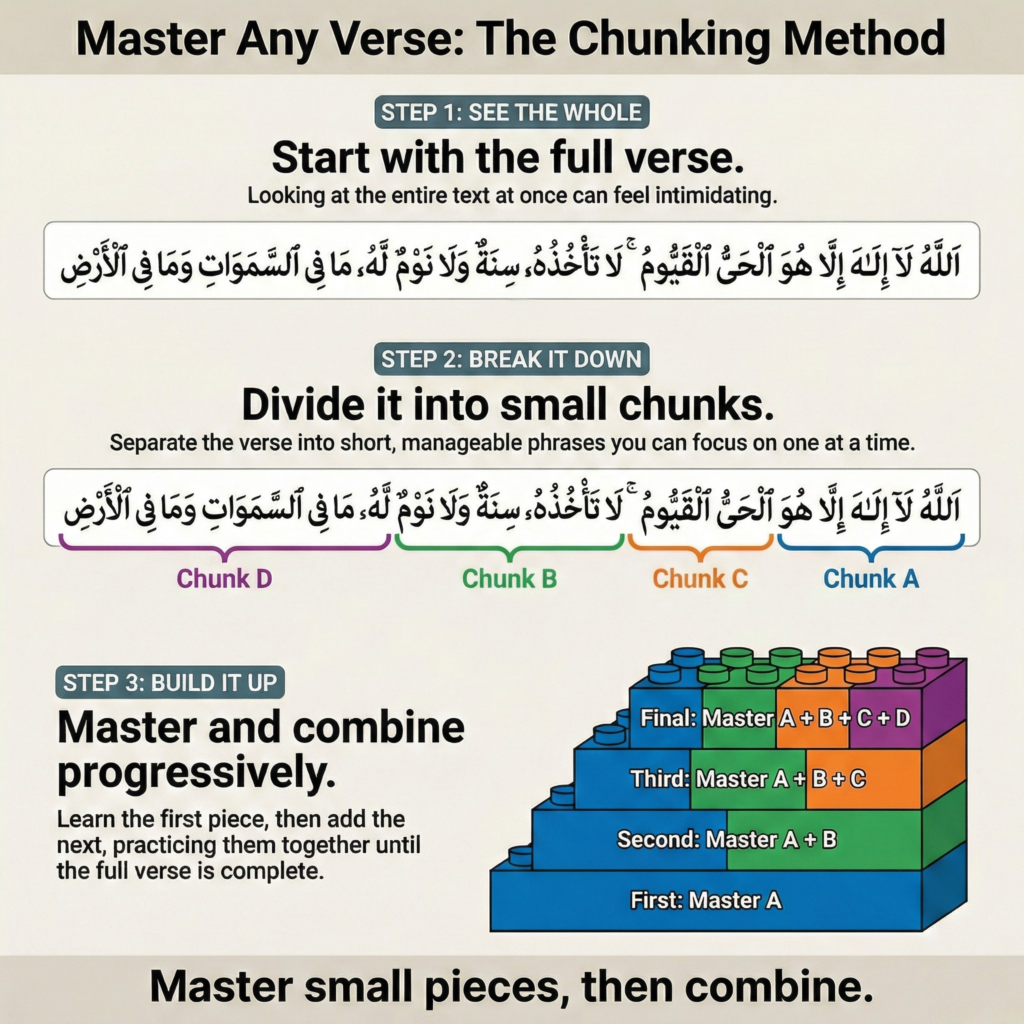
For Quranic verses, chunking means breaking long ayat into 3-4 word segments.
Label each segment: A, B, C, D. Master segment A completely. Then master segment B. Combine them into AB before moving to C. Studies on hifz speed show students using chunking reach accuracy faster with less mental fatigue than those attempting full lines immediately.
Example with Ayat al-Kursi:
- Chunk A: “Allahu la ilaha illa Huwa”
- Chunk B: “Al-Hayyul-Qayyum”
- Chunk C: “La ta’khudhuhu sinatun wa la nawm”
- Chunk D: “Lahu ma fis-samawati wa ma fil-ard”
Memorize A perfectly (5-7 repetitions). Add B and practice AB together. Continue building this way.
Practical Application:
Use a pencil to mark natural phrase breaks in your mushaf. These breaks usually occur at grammatical pauses. Don’t move to the next chunk until you can recite the current one three times without error.
Best For: Beginners and those struggling with long verses
Technique 5: Spaced Repetition Schedule
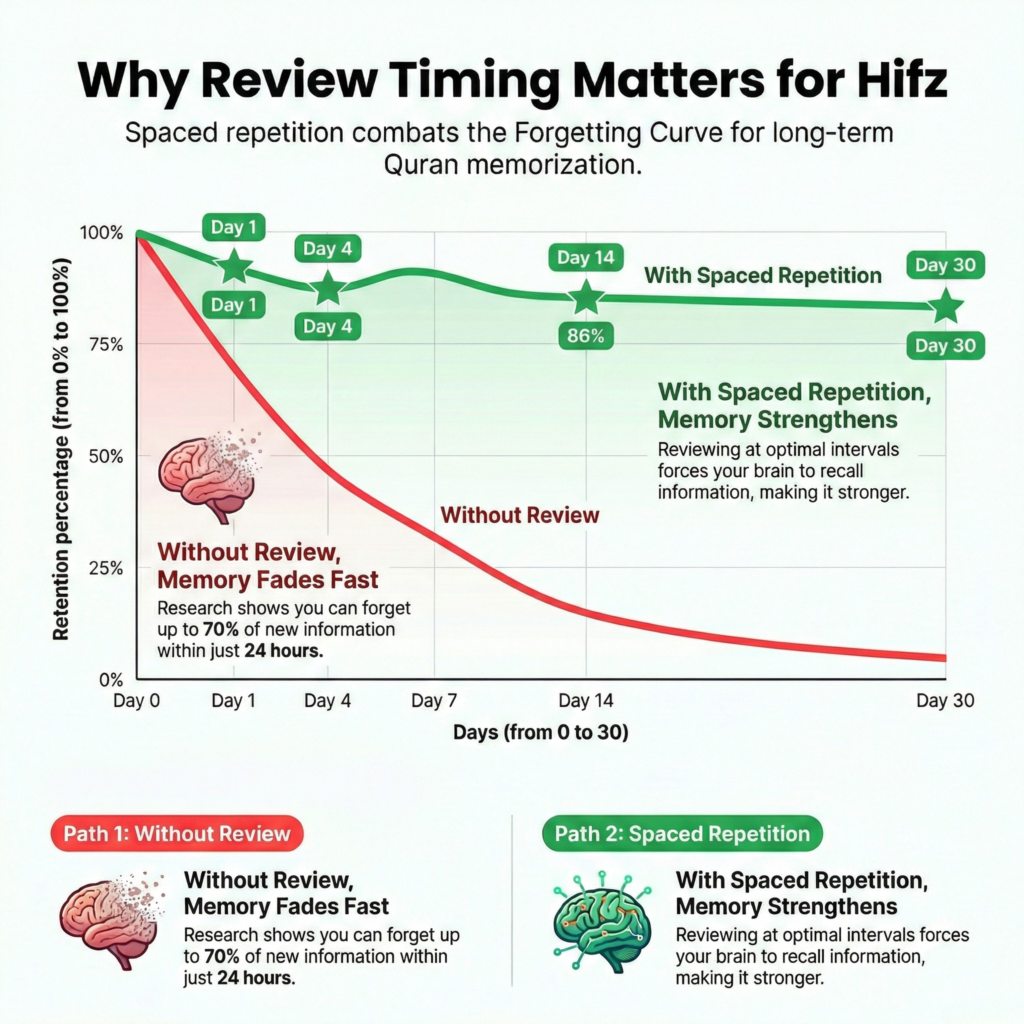
This technique applies directly to the forgetting curve problem. Instead of repeating a verse 100 times in one day, you distribute reviews across increasing intervals.
A scientifically optimized schedule for hifz:
- Immediate (10 minutes after first memorization)
- 24 hours (next day before new lesson)
- 4 days (mid-week review)
- 14 days (bi-weekly check)
- 1 month (monthly consolidation)
- 3 months (quarterly deep review)
Each review happens just as your brain begins forgetting. This timing forces deeper encoding. Neuroscience research shows this pattern triggers gene transcription and protein synthesis, creating stable neural connections instead of temporary protein modifications.
Practical Application:
Create a simple spreadsheet or use a habit tracker app. Log the date you first memorized each section. Set recurring reminders based on the intervals above. Many students use Google Calendar with color-coded events for different review types.
Best For: Self-learners who want maximum efficiency with minimum total time investment
Technique 6: Active Recall (The 3×3 Method)
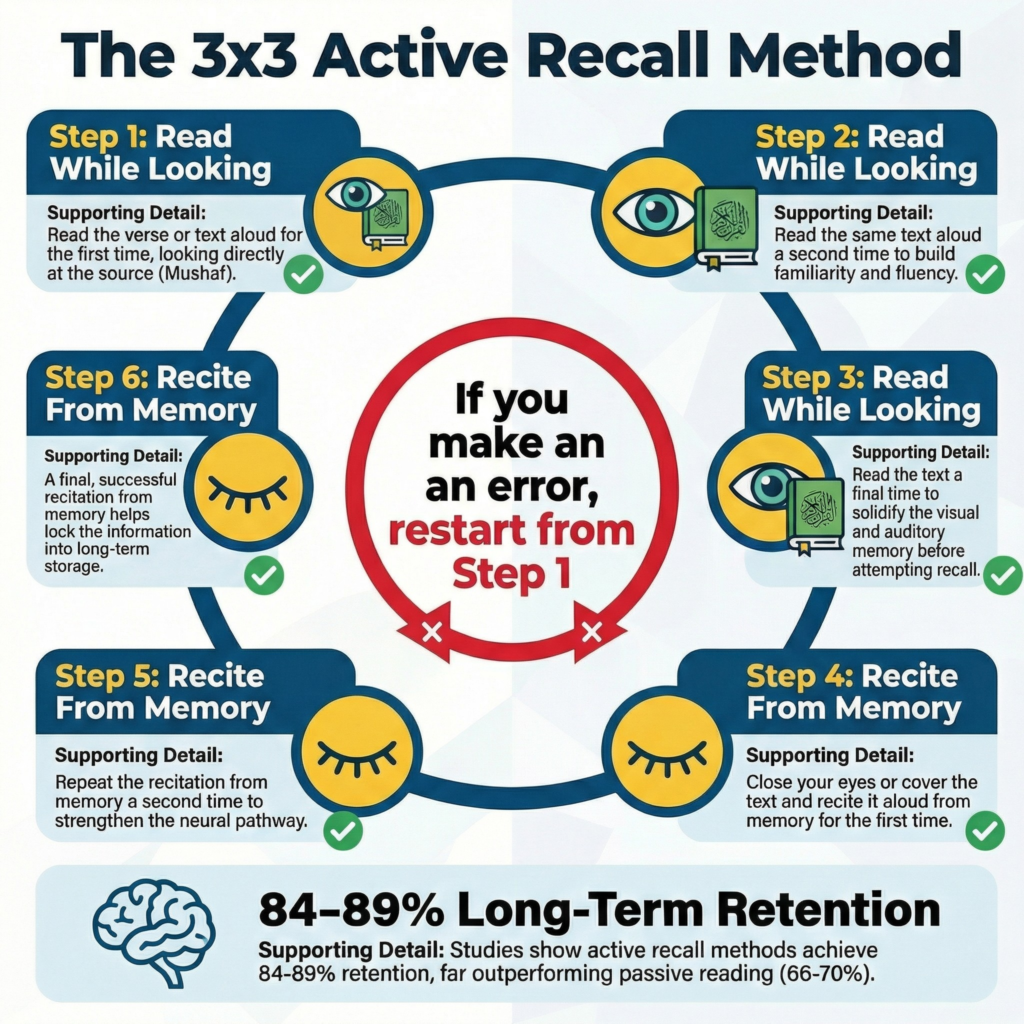
Reading a verse while looking at the mushaf uses recognition. Reciting from memory uses recall. Research comparing these two methods showed students using active recall maintained 84-89% accuracy after four months versus 66-70% for passive readers.
The 3×3 method:
- Read the verse 3 times while looking
- Recite it 3 times from memory (eyes closed or looking away)
An advanced variation is the 6446 pattern:
- 6 times looking
- 4 times from memory
- 4 times looking
- 6 times from memory
This alternating pattern prevents your brain from becoming complacent during the learning phase.
Practical Application:
Never move to the next verse until you complete the 3×3 cycle. If you make an error during the memory phase, reset and start the cycle again. This feels slower initially but produces dramatically better long-term retention.
Track your accuracy rate. If you’re below 80% success on first-time recall, you’re moving too fast. Reduce your daily target temporarily.
Best For: All learners, especially those who previously relied on passive rereading
Technique 7: Elaborative Interrogation
This technique transforms memorization from a mechanical task into an intellectual exercise. For each verse, ask: “Why does this verse say this?” or “How does this connect to what came before?”
Students who focus on semantic understanding (the meaning behind words) consistently outperform those using pure phonetic memorization. The MITS Klang study with 192 students confirmed this with statistical significance.
When you understand what you’re reciting, the logic of the narrative helps predict the next word. This reduces the burden on rote memory alone.
Example:
Verse: “Inna ma’al usri yusra” (Verily, with hardship comes ease)
Don’t just memorize the sounds. Ask:
- Why does this verse appear after verses about struggle?
- How does this apply to my own life experiences?
- What examples from the Prophet’s life demonstrate this principle?
These questions create multiple retrieval pathways. You can access the verse through meaning, personal connection, or pure phonetic memory.
Practical Application:
After memorizing a section phonetically, spend 10 minutes with a trusted tafsir. Read the explanation in your native language. Write down one personal connection or insight. This small investment pays massive dividends in retention.
Best For: Older students and those who struggle with “meaningless” repetition
Technique 8: The Feynman Technique for Tafsir
Named after physicist Richard Feynman, this method reveals what you truly understand versus what you’ve merely glossed over.
Four steps:
- Choose a concept (verse, theme, or Surah)
- Explain it in plain language to someone unfamiliar with the topic
- Identify where your explanation breaks down
- Return to the source, learn that specific gap, then simplify your explanation again
I’ve watched students confidently recite verses perfectly but completely fumble when asked to explain them in simple English or their native language. The Feynman Technique exposes these gaps instantly.
Practical Application:
Once weekly, choose a completed section. Explain it to a family member, friend, or even record yourself on video as if teaching a child. The parts where you struggle to simplify are exactly the sections you don’t fully understand. These weak points will also be your first forgotten sections under stress.
Best For: Advanced students and those preparing to teach
Technique 9: The Memory Palace (Method of Loci)
Memory athletes who memorize hundreds of random digits don’t have different brain anatomy. fMRI studies confirm this. What they have is training in spatial memory techniques, specifically the Memory Palace.
Your brain evolved for thousands of years to remember physical locations for survival. This makes spatial memory significantly stronger than abstract text memory.
How to build a Quranic Memory Palace:
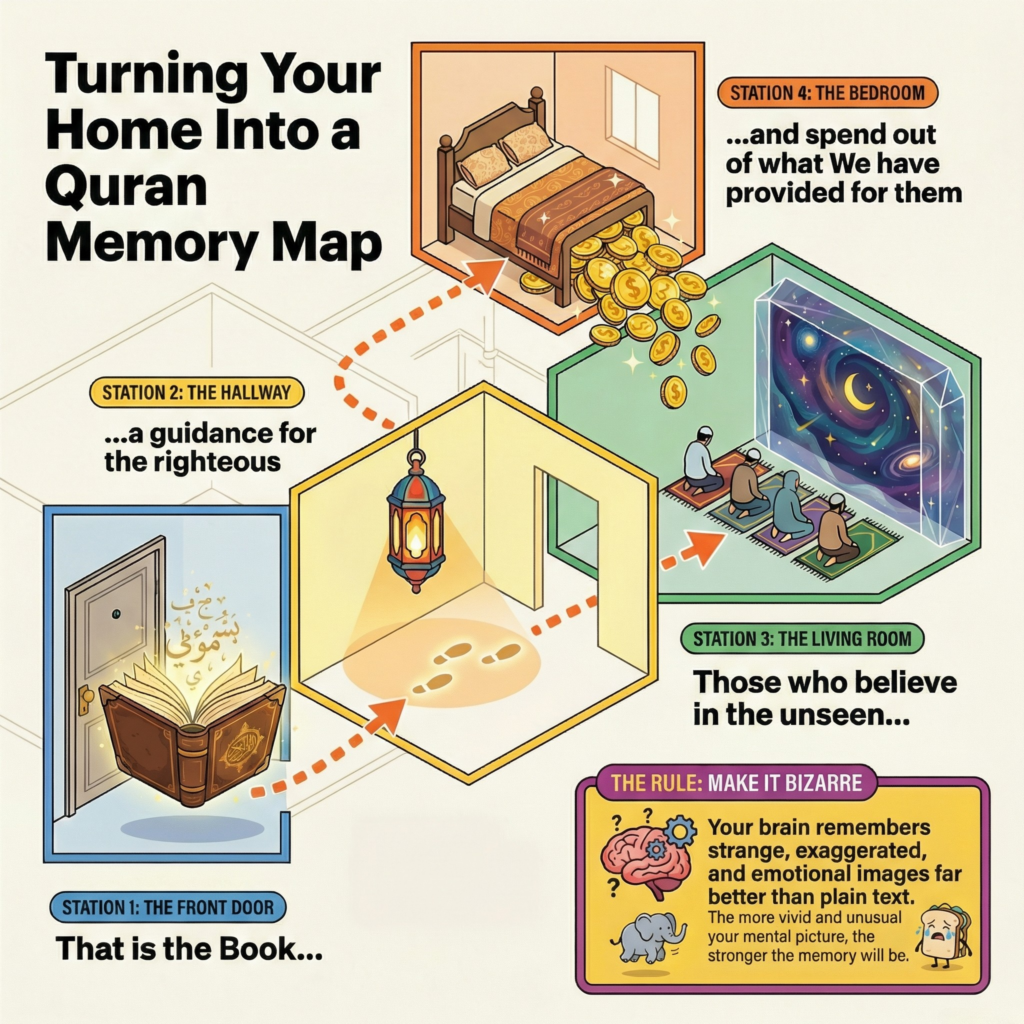
Choose a familiar location (your childhood home, your school, your neighborhood). Assign each room or landmark to a different Surah or Juz section. Within each room, link specific furniture or features to individual verses using vivid, exaggerated imagery.
Example for Surah Al-Baqarah Opening:
- Front door: A massive glowing book floating (“Dhalikal Kitabu”)
- Hallway: A bright lamp (“Hudan lil muttaqin”)
- Living room: People standing in prayer (“Alladhina yu’minuna bil-ghayb”)
The images should be strange, colorful, or emotionally striking. Normal, boring images don’t stick.
Research shows that six weeks of Memory Palace training creates connectivity patterns in the brain matching those of world-class memory athletes. These changes persist for at least four months after training stops.
Practical Application:
Start small. Use one room for one short Surah (like Surah Al-Ikhlas or Al-Falaq). Practice walking through the room mentally, seeing each image as you recite. Once comfortable, expand to larger sections.
Best For: Visual learners and those struggling with similar-sounding verses
Technique 10: Homophonic Transliteration for Non-Arabic Speakers
This controversial technique works best for beginners who find Arabic pronunciation intimidating.
Link the sound of an Arabic word to a similar-sounding word in your native language. One documented case involved a student who associated “Bis-mill-la” with “Bishop at a Mill.”
This is strictly a phonetic placeholder. You combine it with elaborative encoding (making the image vivid and strange) to create a memory hook.
Critical Warning:
This technique can create pronunciation errors if used carelessly. Always verify proper tajwid with a qualified teacher. The homophones are training wheels. Remove them as your Arabic improves.
Practical Application:
Use this only for verses that consistently trip you up. Write down the Arabic, your phonetic placeholder, and the actual meaning. Review all three together. Gradually phase out the placeholder as the direct Arabic-to-meaning connection strengthens.
Best For: Adult converts and non-Arabic speaking children beginning hifz
Technique 11: Visual Anchoring (The Linking Technique)
This simple method works remarkably well for short Surahs.
Associate each verse with a physical object in your study space. Verse 1 links to your lamp. Verse 2 links to your table. Verse 3 links to your bookshelf. As you recite, look at the corresponding object.
This creates a visual-spatial association that helps your brain maintain the correct sequence, especially when the flow of meaning feels abstract.
Practical Application:
Choose 5-7 stable objects that won’t move. Start with a short Surah (10 verses or less). During initial memorization, physically touch each object while reciting its verse. After a few days, simply glancing at the object will trigger the memory.
This technique also helps during review. If you forget what comes next, scanning the room often triggers the memory through visual association.
Best For: Kinesthetic learners and children
Technique 12: Color-Coded Mushaf System
Similar verses (mutashabihat) cause the most errors for advanced students. These verses differ by only a few words or specific endings.
Color-coding transforms your mushaf into a visual map.
Use highlighters strategically:
- Green for verses ending in “Ghafurun Rahim”
- Blue for “Sami’un ‘Alim”
- Yellow for “Alimun Hakim”
- Orange for verses with similar structures to others
Some students draw arrows connecting pronouns to their antecedents. Others circle repeated words to visualize the page’s structure.
Practical Application:
Don’t color randomly. Create a consistent system and write it down. As you encounter mutashabihat during memorization, immediately highlight them according to your system. During review, the color pattern becomes part of the memory itself.
For digital mushaf users, apps like Ayat (KSU) allow custom highlighting and annotations.
Best For: Visual learners managing advanced sections with many similar verses
Technique 13: The Fajr Window Strategy
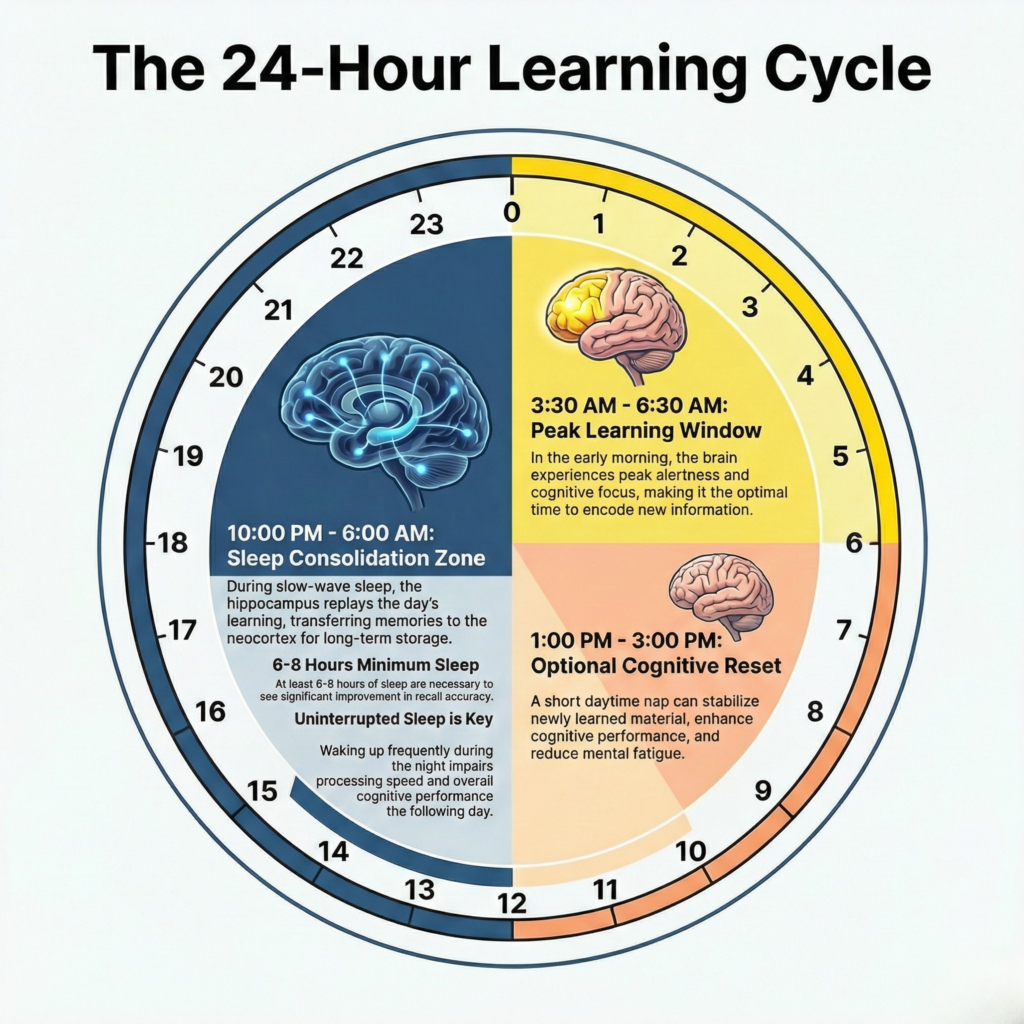
Analysis of 67 successful hifz journeys identified the most common peak memorization window: 3:30 AM to 6:30 AM.
This isn’t just Islamic tradition. Biology supports it. The human brain experiences peak alertness and cortisol levels in early morning. Your prefrontal cortex (responsible for focus and encoding) functions optimally during this window.
The “split-sleep” schedule is common among huffaz. Wake for Fajr, study for 1-2 hours, then return to sleep. Research comparing split sleep to consolidated sleep found no significant difference in daytime sleepiness or cognitive performance, provided total sleep duration remained sufficient.
Practical Application:
Go to bed by 9-10 PM. Wake at 3:30-4:00 AM. Pray Fajr, then immediately begin new memorization while your mind is fresh. Study for 60-90 minutes. If needed, return to sleep for another sleep cycle.
Reserve the Fajr window exclusively for new material (Sabaq). Use other times for review (Sabqi and Manzil).
Best For: Morning people and those with flexible morning schedules
Technique 14: Sleep-Dependent Consolidation Protocol
Harvard Medical School and Penn State research established that sleep is non-negotiable for declarative memory (the type used for text memorization).
During slow-wave sleep in the first half of the night, your hippocampus replays the day’s learning patterns. This transfers memories from temporary storage to permanent neocortex storage. Without this process, memories remain fragile.
The “all-nighter” approach is counterproductive. Students who sacrifice sleep for extra repetitions see worse results than those who stop earlier and sleep properly. A full 6-8 hours of uninterrupted sleep is necessary for significant recall improvement.
Night-waking impairs processing speed and working memory the following day, regardless of total sleep time.
Practical Application:
Treat sleep as a mandatory part of your hifz schedule, not an optional luxury. If you must choose between 50 more repetitions or going to bed on time, choose sleep. Your brain consolidates memories during rest, not during exhausted repetition.
Establish a consistent sleep schedule. Going to bed and waking at the same times daily optimizes your circadian rhythm for memory formation.
Best For: All learners, especially those currently sacrificing sleep.
Technique 15: Strategic Napping (Qaylulah)
The Islamic tradition of qaylulah (midday rest) aligns with cognitive science research on napping benefits.
A 20-30 minute nap between memorization sessions provides a cognitive reset. Studies show naps stabilize new word retention and reduce mental fatigue without causing sleep inertia (grogginess).
The Ideal Nap Protocol:
- Duration: 20-30 minutes (avoid longer naps that enter deep sleep)
- Timing: Early afternoon (1-3 PM)
- Environment: Dark, quiet room
Practical Application:
After your morning memorization session and midday Sabqi review, take a brief nap before returning to work or studies. Set an alarm to prevent oversleeping. Even 15 minutes provides measurable benefits.
For students memorizing in two shifts (morning and evening), the afternoon nap creates a natural boundary between sessions.
Best For: Students with flexible schedules and those experiencing afternoon fatigue
Technique 16: AI-Powered Feedback Apps
Technology has transformed self-learning. Real-time correction previously required a live teacher. Now AI provides instant, accurate feedback.
Rayhaan Quran AI uses voice recognition to detect mistakes in real-time. The app listens to your recitation and identifies tajwid errors, skipped words, or incorrect pronunciation. Performance analytics show which verses cause the most problems, enabling targeted review.
Quranly gamifies the hifz process with streaks, rewards, and social challenges. Platform data shows users engaging with habit trackers maintain consistency during “plateau phases” that typically occur after the first few months. The dopamine reward system keeps students motivated through difficult periods.
Mathani breaks verses into bite-sized segments perfect for beginners. The visual aids help new Muslims and children grasp pronunciation patterns.
Quran.com provides word-by-word translation with multiple qaris (reciters). Hearing different voices prevents over-reliance on a single recitation style.
Key Features to Look For:
| App Feature | Learning Benefit |
| Mistake detection | Prevents memorizing errors |
| Analytics dashboard | Identifies weak verses needing review |
| Multiple qaris | Develops flexible auditory recognition |
| Offline mode | Enables practice anywhere |
| Progress tracking | Maintains motivation through visible advancement |
Practical Application:
Choose one app as your primary tool. Use it daily for at least one review session. Most apps offer free trials. Test 2-3 options before committing.
Combine app feedback with weekly in-person teacher verification. Technology enhances but doesn’t replace traditional teaching relationships.
Best For: Self-learners, those without access to local teachers, and students wanting objective performance metrics
Technique 17: The Personalized Error Bank for Mutashabihat
Mutashabihat (similar verses) cause errors even for advanced huffaz. Managing them requires a systematic approach.
Create a dedicated notebook or digital document. Every time you confuse two similar verses, log both immediately.
Error Bank Template:
- Verse I’m Learning: [Full Arabic text]
- Similar Verse Elsewhere: [Full Arabic text + Surah:Ayah reference]
- Key Difference: [Highlight the distinguishing word/particle]
- Memory Hook: [Personal mnemonic for the distinction]
This focuses your brain’s attention on distinctions rather than similarities. The act of writing prevents the two memory traces from blurring together.
Example Entry:
Learning: “Qul huwa Allahu ahad” (Surah Al-Ikhlas 112:1)
Similar to: “Qul a’udhu bi Rabbil falaq” (Surah Al-Falaq 113:1)
Difference: “huwa Allahu” vs. “a’udhu bi Rabb”
Hook: “Ikhlas declares WHO (huwa), Falaq seeks WHERE to seek refuge (a’udhu)”
Practical Application:
Review your Error Bank weekly. These are your highest-risk verses. Test yourself specifically on these pairs during practice sessions. Many students find that 10-15 problematic pairs account for 80% of their mistakes.
Best For: Intermediate to advanced students managing large sections with many similar verses
How Memory Works for Quranic Memorization?
Before diving into specific techniques, you need to understand what happens in your brain during hifz.
Memory formation happens in three stages: encoding, consolidation, and retrieval. When you first read a verse, your brain encodes it as electrical signals. During sleep, particularly slow-wave sleep, your hippocampus transfers this information to your neocortex for long-term storage. When you recite from memory, you’re retrieving that stored information.
Your working memory can only hold about 7 items at once. This limitation explains why memorizing a full 10-line verse in one go feels overwhelming. Your brain simply can’t process that much new information simultaneously.
The Ebbinghaus Forgetting Curve shows that without review, you lose up to 70% of newly learned information within 24 hours. This scientific fact explains why students who cram before tests forget everything quickly. The solution lies in strategic review timing, which several techniques below address.
How to Creating Your Personal Hifz System?
You now have 17 techniques. Trying all of them simultaneously guarantees confusion and burnout. Instead, build a personalized system based on your lifestyle and learning style.
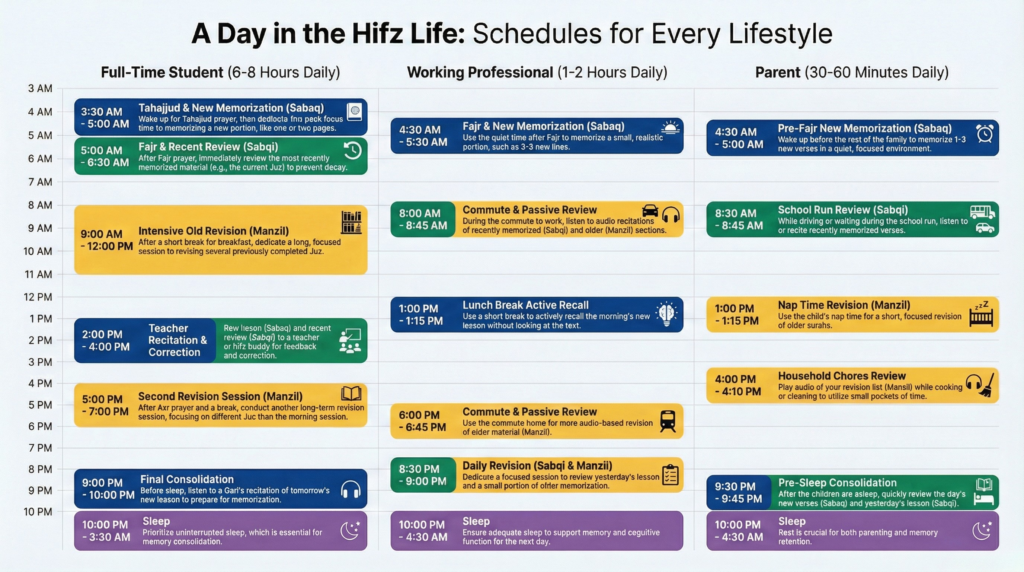
For Full-Time Students (6-8 hours daily available)
Morning (3:30-6:30 AM):
- New memorization using Technique 4 (Chunking) + Technique 6 (Active Recall 3×3)
- Apply Technique 1 (Luh method) by writing new section
Midday (10 AM-12 PM):
- Sabqi review of recent material
- Use Technique 5 (Spaced Repetition) to determine what to review
Afternoon:
- Technique 15 (Strategic nap)
- Manzil (old revision) with Technique 16 (AI app verification)
Evening:
- Technique 17 (Error Bank) maintenance
- Sleep by 9 PM for Technique 14 (Sleep Consolidation)
Expected Timeline: 1-2 years for full Quran
For Working Professionals (1-2 hours daily)
Pre-Fajr (4:00-5:00 AM):
- Technique 13 (Fajr Window) for new memorization only
- 3-5 lines maximum using Technique 6 (Active Recall)
Commute:
- Listen to the section you just memorized on repeat
- Technique 7 (Elaborative Interrogation) while listening
Lunch Break (15-20 minutes):
- Quick Sabqi review using Technique 16 (AI app)
Evening (30 minutes before bed):
- Manzil review
- Write in Technique 17 (Error Bank) if needed
Expected Timeline: 3-5 years for full Quran
For Parents with Young Children (30-60 minutes daily)
After Fajr (20-30 minutes):
- New memorization: 1-3 lines only
- Use Technique 11 (Visual Anchoring) in consistent study spot
During Children’s Nap/School:
- Review using Technique 16 (AI app) for hands-free verification
Before Bed:
- Technique 5 (Spaced Repetition) review of older sections
- 10 minutes maximum to avoid cutting into sleep
Expected Timeline: 5-10 years for full Quran (perfectly acceptable pace)
Measuring Your Progress
Track these metrics monthly:
Retention Rate: Recite a random previously memorized section. Calculate percentage of verses recalled correctly on first attempt. Target: 85%+ after four months.
Daily Consistency: Track consecutive days of practice. Breaks longer than 2-3 days correlate with sharp retention drops.
Review Ratio: Time spent on new memorization versus review. Ideal ratio shifts over time: 60/40 (new/review) in early months, 30/70 in later stages.
Error Pattern Analysis: Which verse types cause the most mistakes? Long verses? Similar verses? Specific Surahs? Target your weak categories.
Teacher Verification: Monthly in-person recitation assessment from a qualified teacher. Technology helps, but human verification remains essential.
Why This Approach Works for Learning Quran?
These techniques work because they align with your brain’s actual learning mechanisms.
Multi-Modal Encoding (Techniques 1, 4, 11): Writing, seeing, hearing, and speaking create multiple neural pathways to the same memory. When one pathway weakens, others provide backup routes.
Spaced Repetition (Techniques 3, 5): Reviews timed to the forgetting curve trigger gene transcription and protein synthesis, creating permanent neural connections instead of temporary modifications.
Active Retrieval (Techniques 6, 8): The effort of pulling information from memory strengthens neural pathways more than passive recognition.
Semantic Processing (Technique 7): Understanding meaning activates extensive neural networks, creating a richer, more durable memory than phonetic-only approaches.
Circadian Alignment (Techniques 13, 14): Studying when cortisol and alertness peak, then sleeping for consolidation, maximizes your brain’s natural rhythms.
Visual-Spatial Systems (Techniques 9, 12): Your evolutionarily superior spatial memory provides stable anchors for abstract text.
fMRI studies of memory athletes show that six weeks of mnemonic training creates brain connectivity patterns matching world champions. These changes predict memory improvements for at least four months after training stops. The techniques reorganize your brain’s functional network organization to enable superior performance.