
Ten authentic hadiths establish Tajweed as prophetic practice, covering pronunciation clarity, elongation rules, beautification, and rewards for both proficient and struggling reciters.
What Is Tajweed According to the Hadiths?
Tajweed is the science of reciting Quran correctly, preserving how Prophet Muhammad ﷺ received and delivered the revelation letter by letter.
Tajweed, from the Arabic root j-w-d (to make excellent), is the method for accurately pronouncing the Quran, preserving every letter as revealed. It links the reciter’s voice directly to the Prophet’s time, enabling recitation as the Companions heard it.
Ali ibn Abi Talib defined Tarteel (Quran 73:4) as “the Tajweed of letters and knowing where to pause.” Since incorrect pronunciation can alter meanings (e.g., qalb (heart) vs. kalb (dog)), scholars classify mistakes as major (meaning-changing) or minor.
Though the Companions spoke Classical Arabic naturally, Islam’s expansion led to Lahn (pronunciation errors) among non-Arab converts. Tajweed was codified to safeguard the revelation from linguistic contamination.
Hadith 1: The Letter-by-Letter Clarity
The Prophet recited distinctly, pronouncing each letter clearly and separately, never rushing or blending sounds together, as described by his wife Umm Salamah.
The Arabic Hadith Text:
Arabic: كَانَتْ قِرَاءَتُهُ مُفَسَّرَةً حَرْفًا حَرْفًا
Translation: “His recitation was clearly distinguished, letter by letter.”
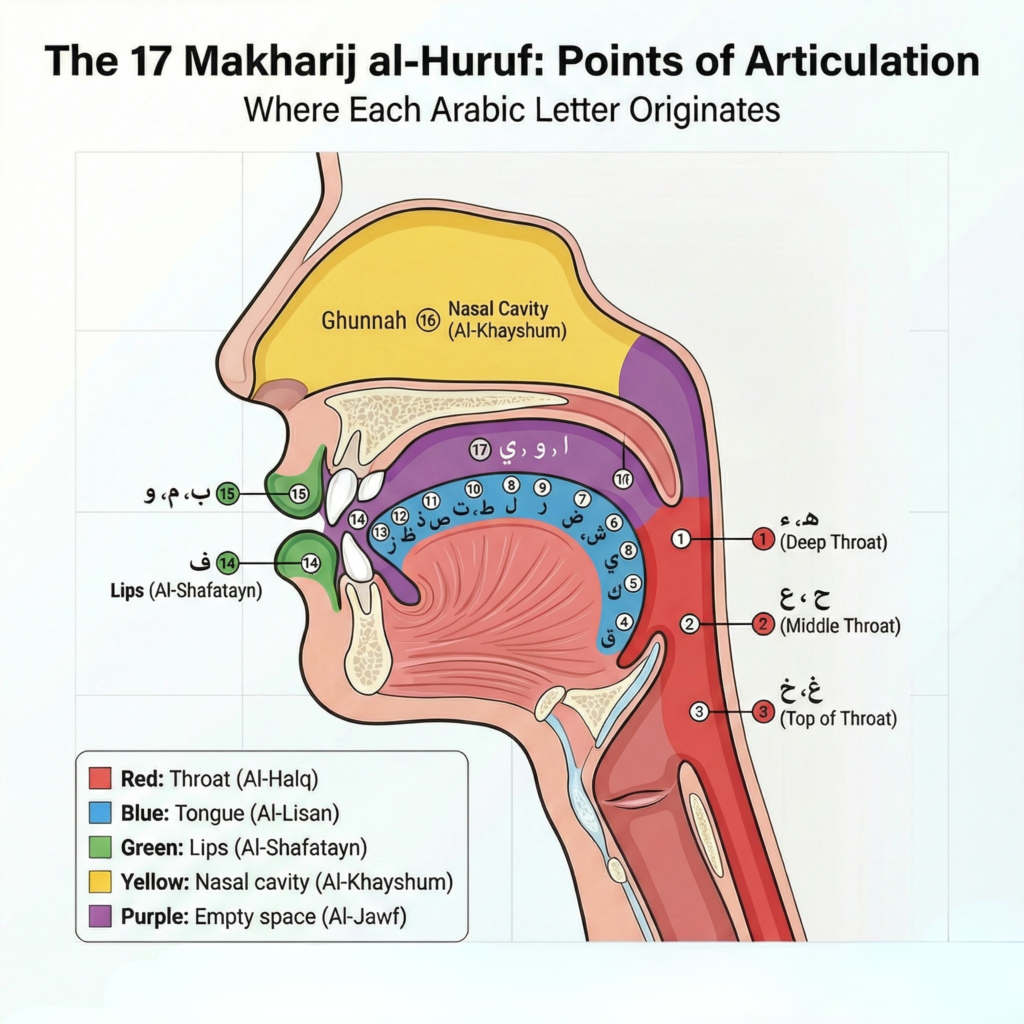
This hadith establishes the foundation of Makharij al-Huruf (articulation points). There are 17 specific points in the mouth and throat where Arabic.
The Five Articulation Areas:
- The throat produces Hamzah, Ha, Ayn, and Hha
- The tongue produces the majority of letters
- The lips produce Ba, Mim, and Waaw
- The nasal cavity produces Ghunnah sounds
- The empty space produces the three Madd letters
Letters with similar exits can easily be confused. Taa and Daal both come from the tongue’s tip touching the upper gum ridge. Without proper training, they blend together. The Prophet ﷺ never rushed his recitation. He gave each letter its full right.
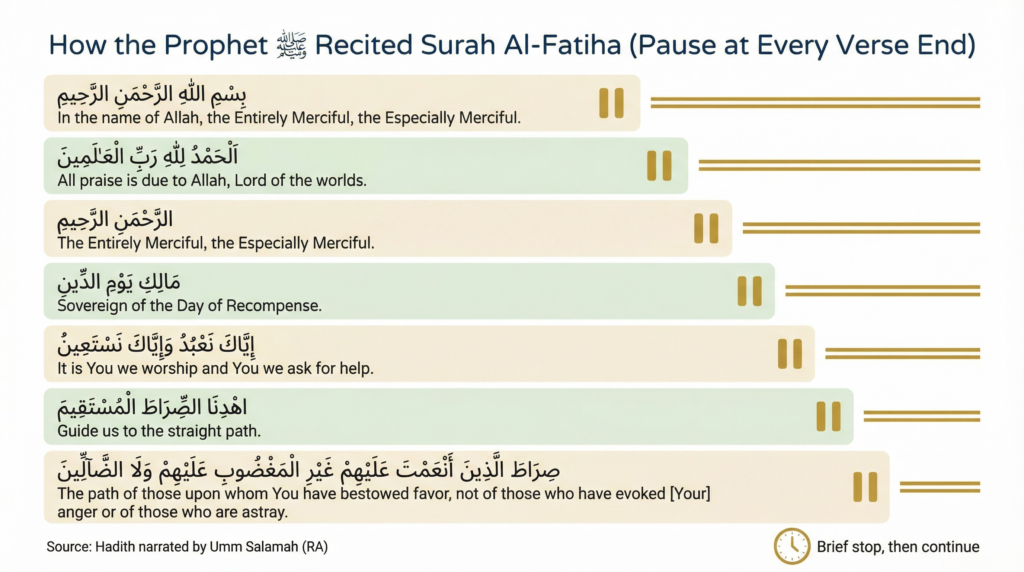
Hadith 2: The Verse-by-Verse Pausing Method
the Prophet paused at every verse ending, even when the meaning connected to the next verse, creating space for reflection and proper verse boundaries.
The Arabic Hadith Text:
Arabic: كَانَ يَقْرَأُ: الْحَمْدُ لِلَّهِ رَبِّ الْعَالَمِينَ، ثُمَّ يَقِفُ، ثُمَّ يَقْرَأُ: الرَّحْمَنِ الرَّحِيمِ، ثُمَّ يَقِفُ
Translation: “He would recite ‘Al-hamdu lillahi Rabb il-‘Alameen’ then pause, then recite ‘Ar-Rahman ir-Raheem’ then pause.”
This hadith changed my Salah completely. Before learning this, I connected verses based on grammatical flow. After learning the Prophetic method, I pause at every verse ending regardless of meaning connection.
The pause is called waqf. It serves multiple purposes:
Why Verse-Ending Pauses Matter:
- Prevents mechanical, rushed recitation
- Allows the mind to absorb each verse’s weight
- Establishes clear boundaries between themes
- Gives the listener time to process
- Follows the exact Prophetic pattern
Ibn Taymiyyah and Ibn al-Jazari both addressed the scholarly debate about this. Some asked: “What if the meaning continues to the next verse?” Their answer: Following the Prophetic Sunnah of pausing takes precedence over following grammatical continuity.
In prayer, this transformed my focus. Each verse becomes its own meditation. Alhamdulillahi Rabbil ‘Alameen. Stop. Breathe. Feel the praise. Ar-Rahman Ar-Raheem. Stop. Contemplate the mercy. The rhythm creates spiritual space.
HADITH 3: The Demonstration of Elongation (Madd)
Anas ibn Malik demonstrated the Prophet elongated (Madd) vowels in Allah’s names like “Ar-Rahmaan” and “Ar-Raheem,” extending them beyond normal speech length.
The Arabic Hadith Text:
Arabic: سُئِلَ أَنَسٌ: كَيْفَ كَانَتْ قِرَاءَةُ النَّبِيِّ صَلَّى اللهُ عَلَيْهِ وَسَلَّمَ؟ فَقَالَ: كَانَتْ مَدًّا، ثُمَّ قَرَأَ: بِسْمِ اللَّهِ الرَّحْمَنِ الرَّحِيمِ، يَمُدُّ بِبِسْمِ اللَّهِ، وَيَمُدُّ بِالرَّحْمَنِ، وَيَمُدُّ بِالرَّحِيمِ
Translation: “Anas was asked: ‘How was the Prophet’s recitation?’ He said: ‘It was characterized by elongation (Madd).’ Then he recited the Basmalah, elongating ‘Bismillah,’ elongating ‘Ar-Rahman,’ and elongating ‘Ar-Raheem.'”
What This Hadith Teaches About Madd
Madd isn’t decoration. It’s how the revelation came down. When you skip proper elongation, you’re not reciting the way Jibreel taught Muhammad ﷺ.
Arabic has three Madd letters: ا (Alif), و (Waaw), ي (Yaa). These vowels naturally stretch, but Tajweed specifies exactly how long.
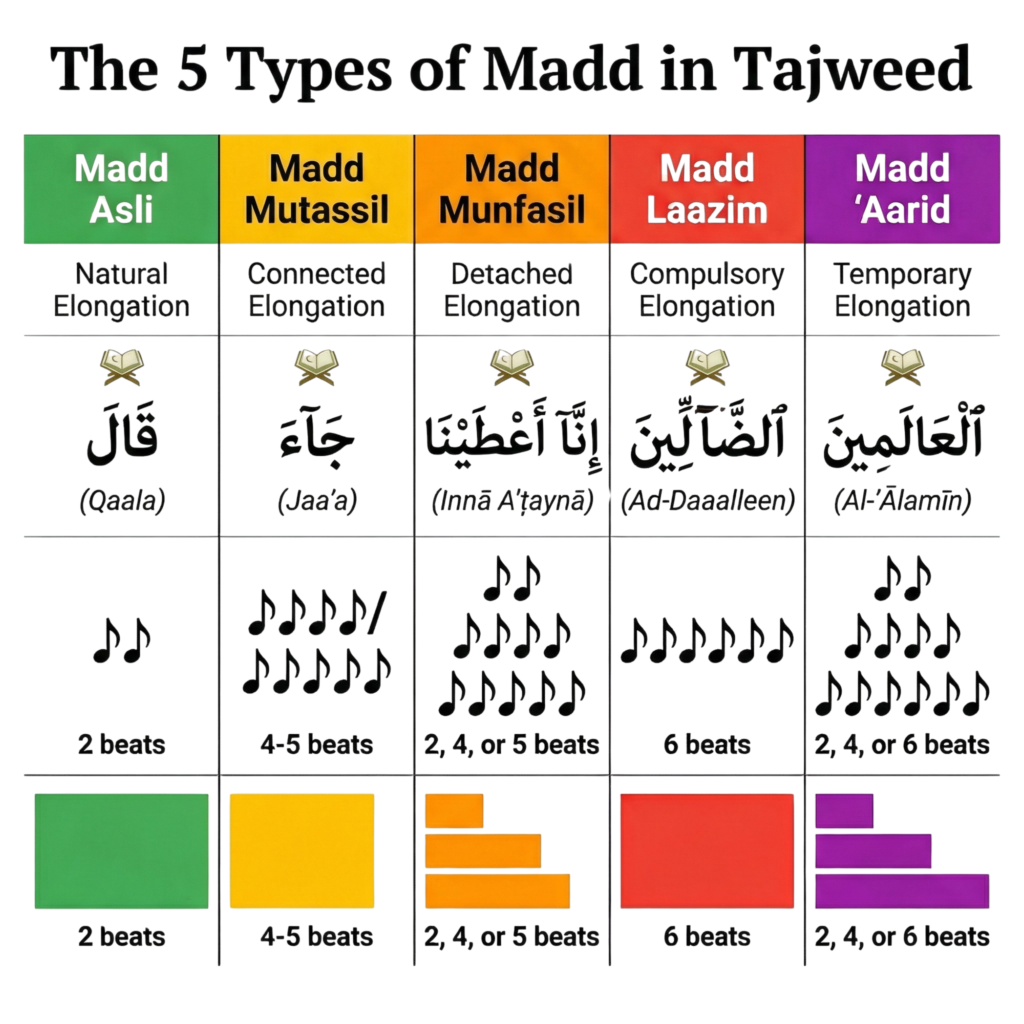
The Five Types of Madd From This Hadith
| Type | Duration (Beats) | When It Happens | Example |
| Madd Asli | 2 | Natural long vowel | قَالَ (Qaala) |
| Madd Mutassil | 4-5 | Hamzah in same word | جَاءَ (Jaa’a) |
| Madd Munfasil | 2, 4, or 5 | Hamzah in next word | إِنَّا أَعْطَيْنَاكَ |
| Madd Laazim | 6 | Permanent sukoon follows | الضَّالِّينَ |
| Madd ‘Aarid | 2, 4, or 6 | Stopping at verse end | الْعَالَمِينَ |
How to count beats: One beat = the time it takes to close or open one finger. Practice with a metronome at 60 BPM. Two beats = 2 seconds.
Correct method:
- Biiiiismillah (hold the “i” for 2 beats)
- Ar-Rahmaaaan (hold “aa” for natural Madd, 2 beats minimum)
- Ar-Raheeem (same)
When Hamzah appears, like in وَالسَّمَاءَ (was-samaa’a), hold the Alif for 4-5 beats because of Madd Mutassil.
Hadith 4: Beautifying the Quran with Your Voice
The Prophet commanded Muslims to beautify the Quran with their voices, making beautiful recitation not just allowed but encouraged when done for Allah’s sake.
The Arabic Hadith Text:
Arabic: زَيِّنُوا الْقُرْآنَ بِأَصْوَاتِكُمْ
Translation: “Beautify the Quran with your voices.”
This hadith addresses a question I hear constantly: “Is beautiful recitation showing off?” The answer lies in intention and method.
Ibn al-Qayyim and Ibn Katheer explain beautiful voices soften hearts and produce tears (khushoo). When you hear Sheikh Abdul Basit or Mishary Rashid, your soul responds differently than to monotone recitation.
Why? Allah created humans to respond to beauty. Beautiful Quran recitation is a mercy that draws people closer to the Book.
Three requirements for halal beautification:
- Intention must be pure Are you reciting beautifully to move hearts toward Allah? Or to impress people and gain praise? The first is worship, the second is showing off (riya).
- Rules come first Beauty cannot violate Tajweed. If you sacrifice correct Makharij for a melodious sound, you’ve failed.
- No musical imitation Scholars forbid Luhun al-Arab (Arab melodies). Don’t recite Quran like a pop song. The Quran has its own rhythm, established by Madd and Ghunnah rules.
HADITH 5: Abu Musa’s Melodious Voice
The Prophet told Abu Musa al-Ash’ari he was given a beautiful voice like Prophet Dawud’s flutes, praising vocal beauty while Abu Musa said he would have made it even better if he knew the Prophet was listening.
The Arabic Hadith Text:
Arabic: لَقَدْ أُوتِيتَ مِزْمَارًا مِنْ مَزَامِيرِ آلِ دَاوُدَ
Translation: “You have been given one of the Mazamir (melodious voices/flutes) of the family of Dawud.”
Abu Musa’s response: يَا رَسُولَ اللَّهِ، لَوْ عَلِمْتُ أَنَّكَ تَسْمَعُ لَحَبَّرْتُهُ لَكَ تَحْبِيرًا
“O Messenger of Allah, if I had known you were listening, I would have made it even more beautiful for you.”
The Prophet heard Abu Musa reciting at night. He didn’t know the Prophet ﷺ was there. This wasn’t a performance. It was pure worship.
When Abu Musa learned the Prophet had listened, he said he would have beautified it more. The Prophet didn’t rebuke him. This proves conscious effort to beautify is praiseworthy.
Three critical lessons:
- Natural talent is a gift from Allah Some people are born with beautiful voices. This is a trust (amanah). Use it for Quran.
- Effort to improve is encouraged Abu Musa didn’t say “my voice is what it is.” He said he would have made more effort. Striving for excellence in recitation pleases Allah.
- The Dawud standard Prophet Dawud had such a beautiful Quran recitation (Zabur) that birds and mountains would join him. This is the prophetic standard of vocal excellence.
If you have a good voice: Don’t waste it on songs and entertainment. Allah gave it to you for a reason. Lead Taraweeh. Teach children. Record beneficial content.
If you don’t have a naturally beautiful voice: The next hadith is for you. Keep reading.
HADITH 6: Allah’s Attention to Beautiful Recitation
Allah pays more attention to nothing like a prophet with a beautiful voice reciting Quran aloud, showing divine appreciation for beautiful recitation combined with prophethood’s sincerity.
The Arabic Hadith Text:
Arabic: مَا أَذِنَ اللَّهُ لِشَيْءٍ مَا أَذِنَ لِنَبِيٍّ حَسَنِ الصَّوْتِ يَتَغَنَّى بِالْقُرْآنِ يَجْهَرُ بِهِ
Translation: “Allah does not listen to anything as He listens to a Prophet with a beautiful voice reciting the Quran aloud and making it beautiful.”
The Arabic word adhin does not mean Allah literally hears (He hears everything). It means He gives attention, acceptance, and pleasure. This hadith reveals what brings divine pleasure.
Three conditions appear in this narration:
- A beautiful voice (hasan as-sawt)
- Reciting melodiously (yataghanna)
- Reciting aloud (yajhar)
The word yataghanna caused scholarly debate. Some translated it as “singing.” Others said “beautifying.” The consensus landed on “making the voice beautiful within Tajweed boundaries,” not musical singing that violates pronunciation rules.
When to Recite Aloud vs. Silently:
Islamic tradition provides guidance:
- In Fajr, Maghrib, and Isha prayers: Recite aloud
- In Dhuhr and Asr prayers: Recite silently
- In private Quran reading: Both are acceptable
- In gatherings: One person recites aloud, others listen
HADITH 7: Learn from Ibn Mas’ud’s Fresh Recitation
The Prophet said to recite Quran “fresh as it was revealed” by following Ibn Mas’ud’s recitation, establishing him as the primary reference for authentic pronunciation.
The Arabic Hadith Text:
Arabic: مَنْ أَحَبَّ أَنْ يَقْرَأَ الْقُرْآنَ غَضًّا كَمَا أُنْزِلَ، فَلْيَقْرَأْهُ عَلَى قِرَاءَةِ ابْنِ أُمِّ عَبْدٍ
Translation: “Whoever would like to recite the Quran fresh (as it was revealed), then let him recite it with the recitation of Ibn Umm Abd (Abdullah ibn Mas’ud).”
Ibn Mas’ud was highly recommended by the Prophet ﷺ for preserving the Qur’an with “freshness.” He was the first to recite publicly in Mecca despite violence, demonstrating his courage and precision. His teaching method was strict, emphasizing Tajweed rules as non-negotiable revelation components. For example, he corrected a student’s elongation in al-fuqara.
Ibn Mas’ud taught Al-Sulami, who taught Asim, who taught Hafs. The globally prevalent Hafs ‘an Asim recitation connects directly to Ibn Mas’ud’s chain, a living link to revelation.
Qualified teachers are essential. Self-teaching tools like apps or videos cannot provide the necessary direct correction for precision in recitation (e.g., distinguishing Qaf from Kaf or fixing Ghunnah duration). The prophetic model requires direct, in-person transmission: teacher recites, student repeats, teacher corrects. Without this guidance, learners reinforce unknown mistakes, as the author experienced after years of self-study before finding a certified teacher.
HADITH 8: Ubayy ibn Ka’b’s Divine Recognition
Allah commanded Prophet Muhammad to recite Surah Al-Bayyinah to Ubayy ibn Ka’b by name, honoring Ubayy’s Quranic mastery and establishing that students should learn from the most proficient.
The Arabic Hadith Text:
Arabic: إِنَّ اللَّهَ أَمَرَنِي أَنْ أَقْرَأَ عَلَيْكَ: لَمْ يَكُنِ الَّذِينَ كَفَرُوا
Ubayy asked: آللَّهُ سَمَّانِي لَكَ؟
“Did Allah mention me by name?”
The Prophet said: نَعَمْ “Yes.”
Ubayy’s response: He wept.
Ubayy ibn Ka’b, Sayyid al-Muslimeen and a primary scribe, was one of the few who memorized the entire Quran during the Prophet’s lifetime.
The Prophet’s personal recitation to Ubayy was a high honor, underscoring his status and Quranic mastery. Scholars cite three reasons for this: honoring Ubayy, demonstrating that masters must continually seek knowledge, and establishing that students should seek the most proficient reciters, emphasizing that knowledge has no ceiling.
Ubayy’s impact is foundational; nine of the ten major Mutawatir Qira’at trace back to him. His precision preserved the revelation. The core lesson is the necessity of humility and continuous learning; like Ubayy, never stop seeking knowledge.
HADITH 9: The Seven Modes of Recitation (Sab’at Ahruf)
The Quran was revealed in seven different modes (Ahruf) to accommodate various Arab dialects, allowing ease while maintaining the same core meanings across all variations.
The Arabic Hadith Text:
Arabic: إِنَّ هَذَا الْقُرْآنَ أُنْزِلَ عَلَى سَبْعَةِ أَحْرُفٍ، فَاقْرَءُوا مَا تَيَسَّرَ مِنْهُ
Translation: “This Quran has been revealed in seven different ways (Ahruf), so recite it in the way that is easiest for you.”
The Prophet ﷺ asked Angel Jibreel to increase the Quran’s recitation modes until they reached seven, accommodating his people’s diverse linguistic capabilities.
The “seven modes” do not mean seven different Qurans, but rather seven permitted variations in pronunciation, dialect, and certain word forms. These include differences in:
- Dialect (e.g., Quraysh vs. Hudhayl)
- Number (singular vs. plural)
- Verb Tense
- Synonyms
- Word Order
- Grammatical Form (masculine vs. feminine)
- Phonetics (heavy vs. light letters)
These variations were granted to ease recitation for different Arabian tribes, as their dialects varied. Critically, these variations never alter the core meaning. Later, to prevent confusion among new converts, Caliph Uthman standardized the written text to the Quraysh dialect while the seven modes were preserved in oral tradition.
HADITH 10: The Proficient and the Struggling Both Earn Rewards
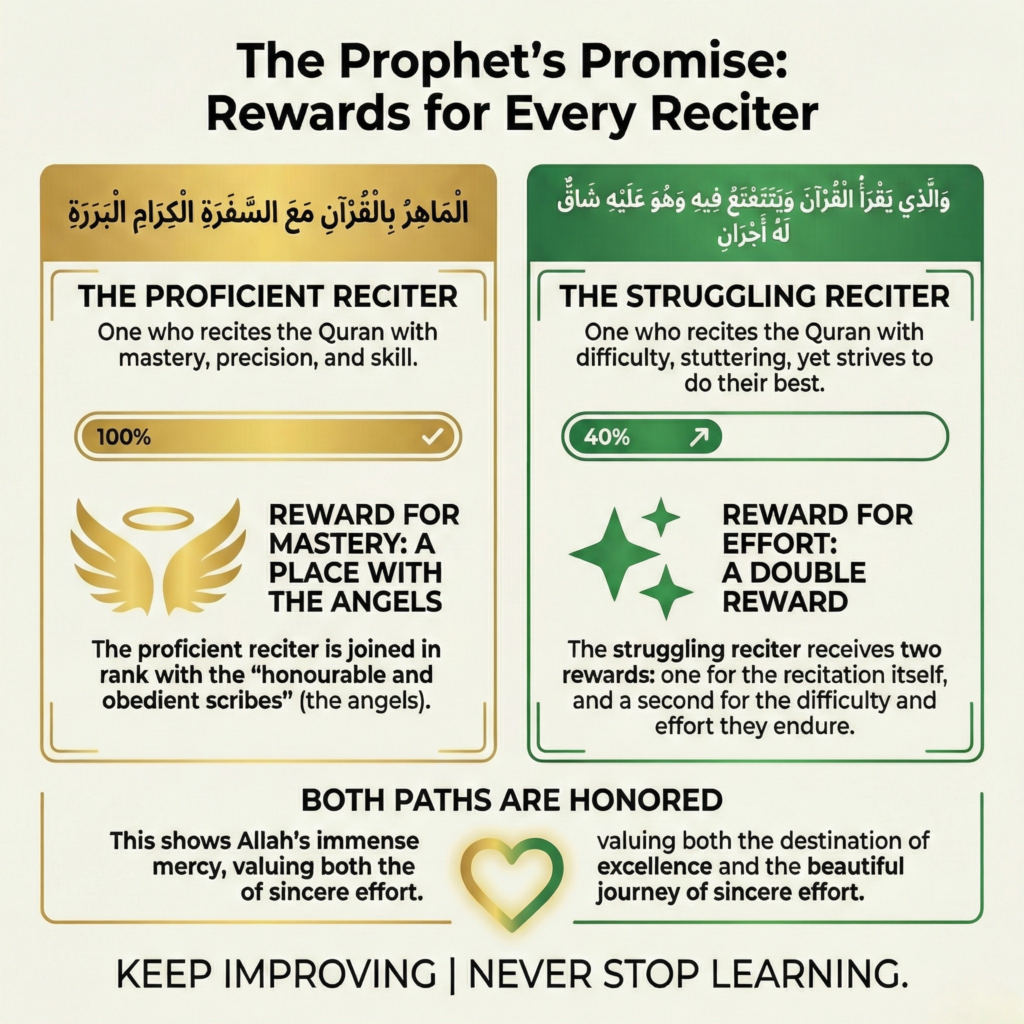
The struggling reciter who finds Quran difficult earns two rewards (for recitation and for effort), while the proficient reciter joins the noble angels in rank.
The Arabic Hadith Text:
Arabic: الْمَاهِرُ بِالْقُرْآنِ مَعَ السَّفَرَةِ الْكِرَامِ الْبَرَرَةِ، وَالَّذِي يَقْرَأُ الْقُرْآنَ وَيَتَتَعْتَعُ فِيهِ وَهُوَ عَلَيْهِ شَاقٌّ لَهُ أَجْرَانِ
Translation: “The one who is proficient in the recitation of the Quran will be with the noble and obedient scribes (angels). And the one who recites the Quran and stutters over it, finding it difficult, will have two rewards.”
A specific hadith changed my perspective on Quran recitation, having been discouraged by my non-native Arabic struggles. My teacher explained that the struggling reciter earns two rewards: one for the recitation itself and a second for the effort and difficulty (Al-Qadi Iyad confirms this breakdown).
While the proficient reciter earns a single reward and attains a higher rank, joining the noble angels (Safarah al-Kiram al-Bararah), the hadith offers spiritual comfort to those who struggle, including non-Arabs, people with speech impediments, and new learners.
The hadith both encourages the ultimate goal of proficiency (mastering Makharij and Sifaat) and provides hope: don’t quit if you struggle, as your extra effort earns additional reward from Allah.
What’s Your Next Step With Tajweed?
Choose one hadith to focus on this month, find a qualified teacher, commit to 15 daily minutes of practice, and remember you’re part of an unbroken chain from Prophet Muhammad.
Is Tajweed Mentioned Directly in Sahih Hadith?
Yes, multiple Sahih hadiths describe the Prophet’s precise pronunciation, elongation, pausing, and beautification of Quran, which scholars codified as Tajweed rules.
What Happens If I Pray Without Knowing Tajweed?
Your prayer is valid if you recite Fatiha correctly enough that major meanings aren’t changed, but learning Tajweed remains obligatory to avoid sinful pronunciation errors.