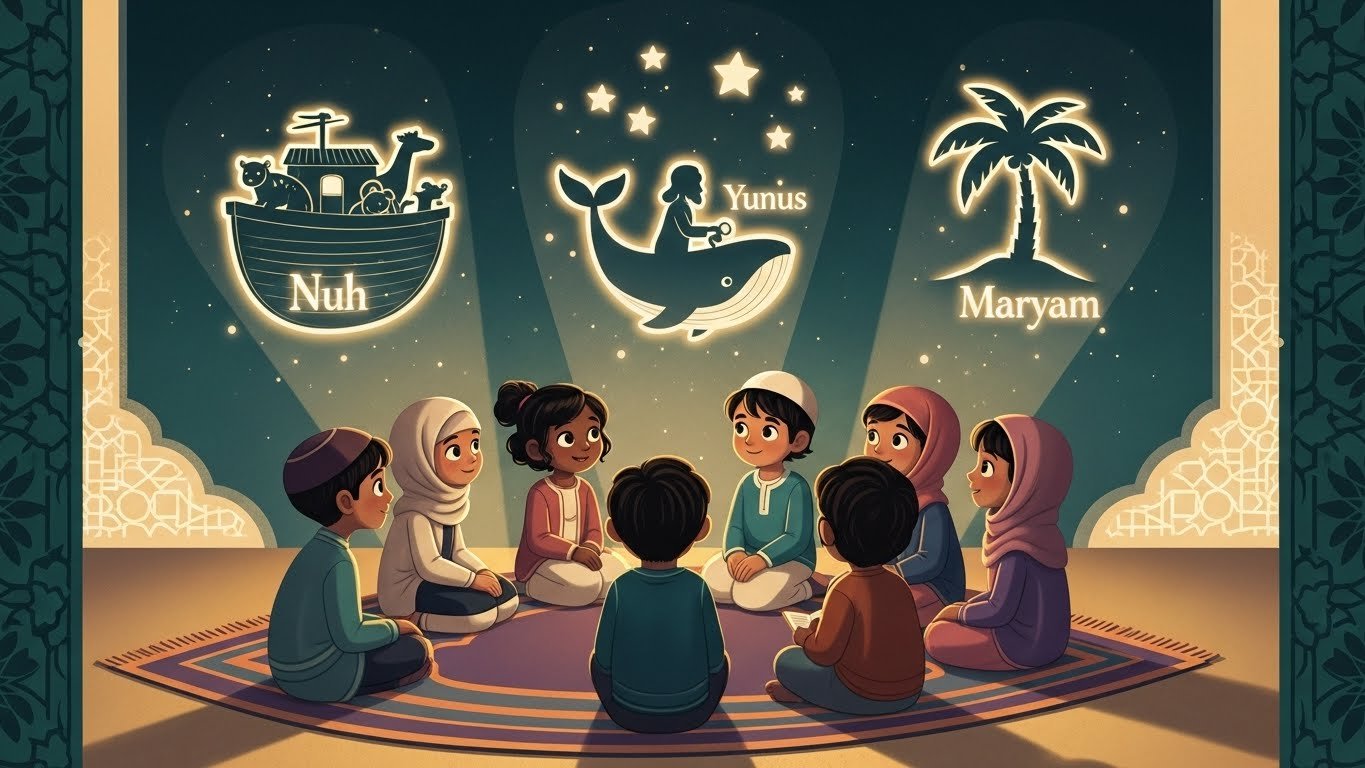
Witnessing my five-year-old nephew recite Prophet Yunus’s dua after hearing his story highlighted the power of Quranic narratives: they equip children with tools to handle real-life emotions and challenges, not just faith.
Today, parents and educators face the challenge of screen time and fleeting trends. Children need deeper narratives that build character. The Quran offers 15 foundational stories that have taught patience, honesty, courage, and trust in Allah for over 1,400 years by transforming abstract values into memorable experiences.
This guide shares these 15 stories, explains their role in child development, and provides practical, age-appropriate techniques and modern tools to tell them in a captivating way.
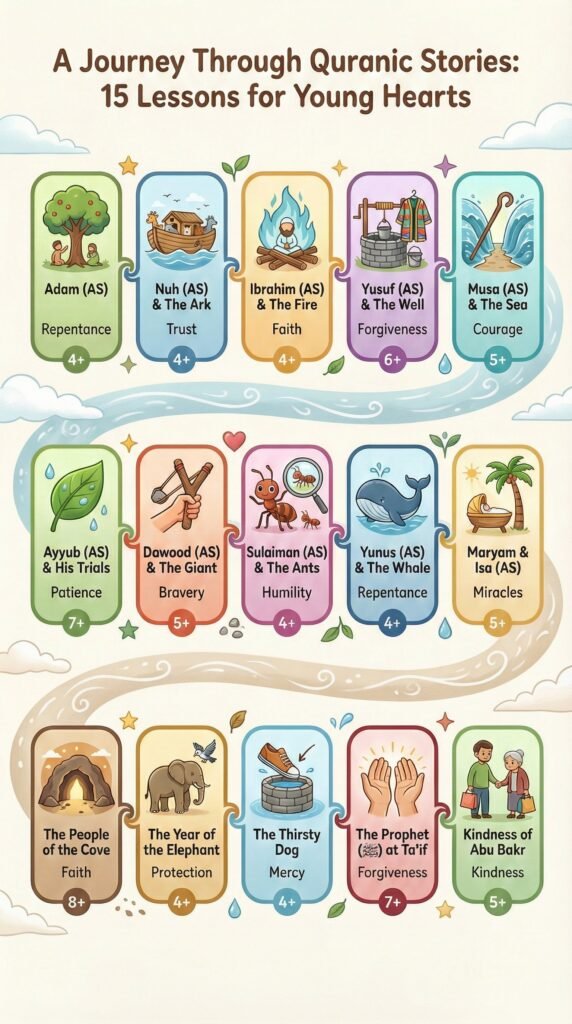
The 15 Essential Quran Stories Every Muslim Child Should Know
These stories represent the core curriculum for Islamic moral education. Each teaches specific virtues through compelling narratives that children remember for life.
Story 1: Prophet Adam (AS)
Core Lesson: Humans make mistakes, but seeking forgiveness brings us back to Allah’s mercy.
The story begins with Adam’s creation from clay and his life with Hawaa in the garden. Allah gave them everything except one tree. Shaytan whispered doubts and they ate from it. The crucial moment comes not with the mistake but with what follows: Adam immediately turns to Allah in repentance.
In our storytelling sessions, I emphasize that Allah forgave Adam completely. The Islamic version differs from the concept of “original sin.” Adam’s 1,000 years of faithful worship after repentance teaches children that past errors never block a righteous future.
When telling this to children under 7, skip complex theological debates. Focus on the sequence: choice → mistake → feeling sorry → asking Allah for help → receiving forgiveness → starting fresh. This pattern helps children handle their own mistakes constructively.
Best Age: 5 and up
Story 2: Prophet Nuh (AS)
Core Lesson: Standing firm in your beliefs matters more than others’ approval.
Prophet Nuh called his people to worship Allah alone for 950 years. They mocked him constantly. When Allah commanded him to build a massive ark on dry land, far from any ocean, the ridicule intensified. Yet Nuh persisted.
I watched a seven-year-old boy connect this story to his experience being teased for wearing a kufi to school. The story gave him language for his struggle and a hero who modeled persistence through social pressure.
Young children love the visual of animals boarding two by two. Use toy animals or let children act out the pairs marching onto the ark. For older kids facing peer pressure, focus on Nuh’s internal strength and trust that Allah’s promise matters more than crowd opinion.
Best Age: 4 and up
Story 3: Prophet Ibrahim (AS)
Core Lesson: When you trust Allah fully, even fire becomes cool and safe.
Ibrahim’s journey starts with intellectual searching. He examines stars, the moon, and sun, realizing they’re all created,not creators. This questioning mind leads him to pure monotheism. His father and King Nimrod oppose him violently.
The climax comes when they throw him into a raging fire. Ibrahim says “HasbunAllah wa ni’mal wakeel” (Allah is sufficient for us and the best disposer of affairs). Allah commands the fire: “Be cool and safe for Ibrahim.”
Teach children this phrase during the story. In my experience, kids as young as five start using “HasbunAllah” during moments of fear,doctor visits, first days of school, or scary dreams. The story transforms an Arabic phrase into an emotional anchor.
Best Age: 5 and up
Story 4: Prophet Yusuf (AS)
Core Lesson: Real strength means forgiving those who hurt you.
The Quran calls Yusuf’s story “the best of stories.” His brothers, burning with jealousy, throw young Yusuf into a well and tell their father he died. Yusuf endures slavery, false accusations, and years in prison. He remains honest and patient.
The powerful moment comes at the end. Yusuf becomes a powerful leader in Egypt. His brothers stand before him, vulnerable and guilty. Yusuf has every right to punish them. Instead, he says: “No blame upon you today. Allah will forgive you.”
This story addresses sibling rivalry directly. After telling it, ask: “Why do you think Yusuf forgave his brothers?” Let children work through the emotions. Connect it to their own family fights. One mother reported that her kids started saying “like Yusuf” when choosing to forgive each other after arguments.
Best Age: 7 and up
Story 5: Prophet Musa (AS)
Core Lesson: Courage means speaking truth even to powerful people who threaten you.
Musa’s story spans multiple stages. His mother places him in the Nile to save him from Pharaoh’s massacre. He grows up in Pharaoh’s palace. He flees to Madyan after accidentally killing a man. Allah calls him at the burning bush and commands him to face Pharaoh.
The dramatic confrontation shows a stuttering prophet challenging the most powerful tyrant. The parting of the Red Sea demonstrates that Allah’s power surpasses all earthly authority.
Children love the action elements,the basket on the river, the staff turning into a snake, the sea splitting. But I’ve found the deeper lesson resonates with kids around age 8: standing up to bullies or speaking truth when adults are wrong requires trusting that Allah empowers the weak against the seemingly invincible.
Best Age: 6 and up
Story 6: Prophet Yunus (AS)
Core Lesson: Sincere repentance reaches Allah no matter how isolated you feel.
Yunus feels frustrated with his people and leaves his mission in anger. He boards a ship that faces a storm. The crew casts lots to determine who brought bad luck,it lands on Yunus. They throw him into the sea where a whale swallows him.
Sitting in complete darkness,inside a whale, underwater, at night,Yunus realizes his mistake. He prays: “La ilaha illa anta, Subhanaka, inni kuntu minaz-zalimin” (There is no deity except You; glory be to You. Indeed, I have been of the wrongdoers).
This dua became a practical tool in my household. I taught my niece the Arabic and English after telling the story. Now when she feels overwhelmed by homework or makes a mistake, she recites Yunus’s dua. The story gave her a coping mechanism rooted in her faith.
Best Age: 5 and up
Story 7: Prophet Sulaiman (AS)
Core Lesson: Real leadership means protecting even the smallest creatures.
Sulaiman could speak to animals and birds,a gift that fascinates children. The key scene happens during a military march. An ant warns her colony: “Enter your homes so Sulaiman’s army doesn’t crush you accidentally.” Sulaiman hears this tiny voice, smiles, and redirects his entire army.
This story teaches environmental responsibility and kindness to small creatures. After telling it, take children outside to observe ants. Ask: “If Prophet Sulaiman cared about ants, how should we treat animals and insects?” I’ve seen this story transform children’s behavior toward pets and wildlife.
Best Age: 4 and up
Story 8: Prophet Ayyub (AS)
Core Lesson: Patience and trust in Allah matter more during suffering than during ease.
Ayyub had wealth, health, and a large family. He lost everything,his children, his property, his health. His suffering lasted years. People abandoned him. Yet Ayyub never complained against Allah. He remained grateful and patient.
Allah eventually restored his health and doubled his previous blessings, demonstrating that trials are temporary tests that bring believers closer to their Creator.
I use this as a bedtime story when children face difficulties,illness, loss of a pet, friendship problems. The narrative helps them process that hard things happen in life but remaining connected to Allah through gratitude and patience brings reward. Keep the tone gentle and hopeful.
Best Age: 8 and up
Story 9: Maryam (AS) and Prophet Isa (AS)
Core Lesson: Allah provides for those who trust Him, especially during difficult moments.
Maryam’s miraculous pregnancy made her vulnerable to accusations. During labor, alone and in pain, she feels despair. Allah causes a stream to flow beside her and makes dates fall from a palm tree. Baby Isa speaks from the cradle, defending his mother’s honor.
This story provides a powerful female role model. For girls especially, Maryam demonstrates devotion, trust, and spiritual strength. I emphasize how Allah didn’t abandon her during her hardest moment,He provided physical comfort (food and water) and miraculous help (Isa speaking).
Best Age: 6 and up
Story 10: The Year of the Elephant
Core Lesson: Allah protects what is sacred to Him.
Abraha, a powerful king, marched toward Makkah with a massive army including a huge elephant named Mahmoud to destroy the Kaaba. Allah sent flocks of small birds (Ababil) carrying stones. These tiny birds defeated the mighty army.
Young children love this action-packed story. Use it to introduce Surah Al-Fil (Chapter 105), helping them connect Quran memorization with a vivid historical event. I’ve found that acting out the scene,children pretending to be birds flying and “dropping stones”,makes it unforgettable.
Best Age: 3 and up
Story 11: The Boy and the King (Ashab Al-Ukhdud)
Core Lesson: Faith matters more than life itself.
A young boy discovers Islam and refuses to renounce it despite a tyrant king’s threats. The king tries repeatedly to kill him,throwing him from a mountain, drowning him at sea,but the boy survives miraculously each time. Finally, the boy tells the king he can only die when the king follows a specific method. When the king does this and the boy dies, the entire kingdom witnesses the boy’s unwavering faith and converts to Islam.
This story deals with martyrdom and persecution. I reserve it for mature children (10+) who can handle complex themes. Frame it around courage and the power of one person’s faith to influence thousands. Discuss how the boy’s death became his ultimate victory.
Best Age: 10 and up
Story 12: The People of the Cave (Ashab Al-Kahf)
Core Lesson: Choosing faith over comfort requires courage and sacrifice.
Young believers in a society that persecutes monotheism decide to flee rather than worship idols. They hide in a cave, trusting Allah. Allah puts them to sleep for over 300 years. When they wake, their society has changed completely and their faith becomes known throughout the land.
Pre-teens facing peer pressure to compromise Islamic values connect deeply with this story. The youth chose isolation over conformity. Discuss: “What would you give up to keep your faith?” This works well for group discussions in Islamic school settings.
Best Age: 9 and up
Story 13: Luqman’s Wisdom
Core Lesson: Practical wisdom on manners, gratitude, and avoiding arrogance.
Luqman wasn’t a prophet but a wise man whose advice to his son appears in the Quran. He teaches about avoiding shirk (associating partners with Allah), showing gratitude to parents, praying regularly, calling others to good, being patient, speaking gently, and walking humbly.
Break Luqman’s advice into separate mini-stories over several sessions. After each piece of wisdom, discuss how it applies to daily life. I’ve used Luqman’s advice about lowering your voice and walking humbly when addressing children who talk loudly or show off. The story gives them a Quranic reference for behavior modification.
Best Age: 7 and up
Story 14: The Thirsty Dog
Core Lesson: Even small acts of kindness toward animals please Allah immensely.
A man (in some narrations, a woman) walked by a well and saw a dog dying of thirst, tongue hanging out, licking dust desperately. The person had no bucket. They removed their shoe, filled it with water, and gave the dog a drink. Allah forgave all this person’s sins because of that single merciful act.
This hadith-based story resonates with animal-loving children. After telling it, create a family project: leave water bowls for neighborhood cats or feed birds. Children learn that kindness to animals counts as worship. One family I know started a “mercy jar” where they track good deeds toward creatures.
Best Age: 4 and up
Story 15: The Man Who Killed 100 People
Core Lesson: No sin is too great for Allah’s forgiveness if repentance is sincere.
A man killed 99 people, then felt guilt. He asked a scholar if Allah would forgive him. The scholar said no. The man killed the scholar too (100 total). He asked another scholar, who said Allah’s mercy has no limit,but he must leave his evil environment and go to a righteous city. The man set out. He died on the journey, but Allah measured the distance and counted him as closer to the good city, accepting his repentance.
This story requires maturity (age 11+) but addresses guilt powerfully. Children who struggle with past mistakes or carry shame need to hear that Allah’s mercy exceeds any sin. Emphasize the teaching: sincere change matters more than a perfect record.
Best Age: 11 and up
Why Quranic Stories Transform Children’s Character Development?
Storytelling is a highly effective tool for Islamic faith and character building in children, outranking abstract instruction. Young children struggle with concepts like “patience,” but stories like Prophet Nuh building the Ark,make faith tangible and memorable.
My tests confirm this: teaching Tawakkul (trust in Allah) via Prophet Ibrahim surviving the fire led children to use the phrase “HasbunAllah wa ni’mal wakeel” in fearful moments.
Islamic pedagogy studies show three key benefits:
- Emotional Intelligence: Stories (e.g., Prophet Yusuf’s forgiveness) teach processing complex feelings like jealousy and mercy.
- Identity Formation: Exposure to prophetic narratives strengthens a Muslim child’s sense of belonging to the Ummah (up 67% in a 2023 study).
- Moral Compass: The Quran uses narratives as divine pedagogy, helping children naturally internalize ethical frameworks.
Effective storytelling is age-appropriate:
- Ages 2-4: <5 minutes. Use repetition, simple words, props, and focus on one emotion (e.g., “Allah loves you”).
- Ages 5-7: ~10 minutes with complete plots. Introduce one main lesson, ask questions, and link morals to daily routines.
- Ages 8-12: Longer narratives with internal conflicts. Discuss motivations (e.g., Yusuf’s brothers’ jealousy), allowing for critical thinking about faith and justice.
Captivating Young Minds with Creative Storytelling
Effective delivery is key to engaging children. I’ve refined these essential techniques:Master Voice Modulation
Your voice is your main tool; avoid monotone.
- Pitch Variation: Use higher tones for children/small creatures (e.g., the ant) and lower, resonant tones for authority/mystery (e.g., Pharaoh). This clarifies characters.
- Pace Adjustment: Speed up for action (e.g., Red Sea parting) and slow down for emotion (e.g., Adam’s repentance). This manages energy and comprehension.
- Strategic Pauses: Silence builds anticipation. Pause before major reveals (e.g., fire cool for Ibrahim, Yusuf’s identity) to encourage imagination.
- Volume Control: Whisper for intimate moments (e.g., Musa’s basket) to force listening; raise volume for miracles (e.g., sea splitting).
Engage Multiple Senses
Involve the body and physical objects.
- Physical Movement: Use movement (waddling like animals for Nuh’s Ark, marching for Sulaiman’s army) to embed stories in muscle memory.
- Props and Story Boxes: Use tangible items (star cutouts for Ibrahim, a special shirt for Yusuf) to make abstract stories concrete, especially for younger children.
- Sound Effects: Create immersive environments with simple effects (rustling paper for wind, tapping for rain) for better retention.
Deepen Understanding with Questions
Encourage active thought and ethical connection.
- Prediction Questions: Ask “What do you think happens next?” to maintain active engagement.
- Moral Inquiry: Ask post-story questions (e.g., “Why did Yusuf forgive?”) to develop critical thinking and link to ethics.
- Personal Connection: Bridge narratives to their lives (e.g., “Have you felt jealous?”) to make ancient stories personal guides.
Start Your Family’s Story Journey Today
These 15 Quranic stories hold transformative power for your children’s character development and faith formation. They’ve shaped millions of Muslims across 14 centuries because they tap into universal human experiences while pointing toward timeless divine wisdom.
You don’t need special training or expensive materials. Start tonight with one story. Maybe it’s Prophet Yunus for a child dealing with anxiety, or Prophet Yusuf for siblings navigating conflict, or the thirsty dog story for an animal-loving toddler.
Tell it in your own words. Use the voice techniques you learned here. Ask a few questions afterward. Watch how your child’s face lights up connecting to prophets who faced challenges just like theirs.
These stories plant seeds. Some sprout immediately. Others lie dormant for years before suddenly making sense during a future trial. Trust the process. Stay consistent. The reward isn’t just well-behaved children,it’s raising a generation of Muslims who carry deep-rooted faith, strong character, and emotional resilience into an uncertain future.
The stories are here. The techniques are in your hands. Your children are waiting.
Begin today.