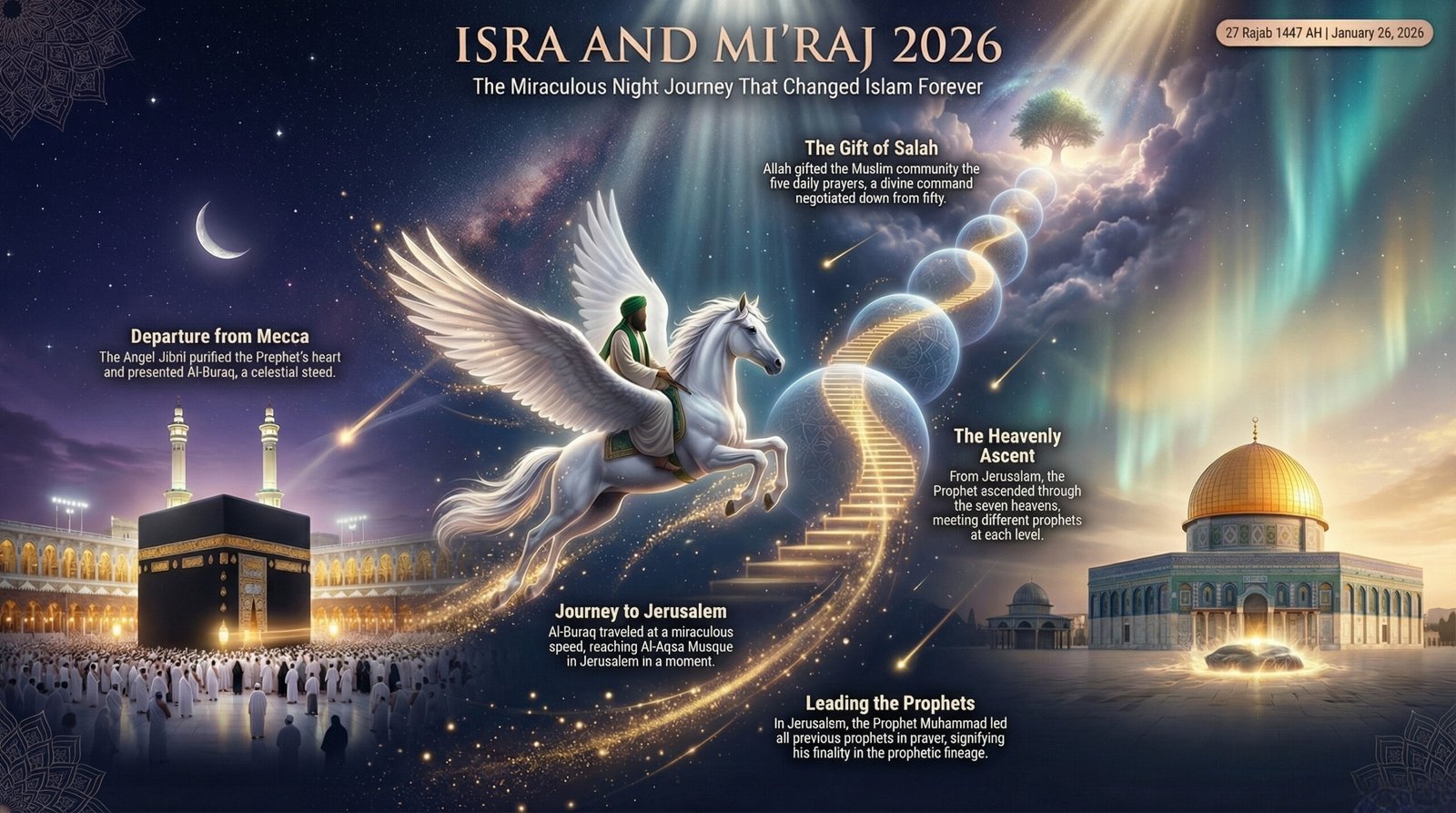
I’ve studied Islamic history for over a decade, and no event fascinates me more than Isra and Mi’raj. This miraculous night journey changed how 1.8 billion Muslims worship today. The event gave us the five daily prayers that structure Muslim life worldwide.
In January 2026, Muslims will commemorate this blessed night on the 27th of Rajab. Understanding what happened during this journey helps you grasp why prayer holds such importance in Islam.
This guide answers every question you’ve asked about Isra and Mi’raj. You’ll discover the Quranic evidence, authentic hadith sources, and why scholars agree this physical journey actually happened.
What is Isra and Mi’raj?
Many people confuse these as one event. They’re actually two connected journeys that happened on the same night.
Isra means “the night journey.” Prophet Muhammad traveled from Mecca to Jerusalem in a single night. The journey covered approximately 1,240 kilometers (770 miles). In the 7th century, this trip took caravans over a month to complete on foot or camel.
Mi’raj means “the ascension.” From Jerusalem, the Prophet ascended through seven heavens. He met previous prophets at each level. At the boundary of creation, he received the commandment for five daily prayers directly from Allah.
Studies of Islamic texts show these events are mentioned in two separate Quranic chapters. Surah Al-Isra describes the Jerusalem journey. Surah An-Najm references the heavenly ascension.
The two journeys connect Islam to its Abrahamic roots. Jerusalem’s Al-Masjid al-Aqsa became the third holiest site in Islam because the Prophet prayed there with all previous prophets.
When Did Isra and Mi’raj Happen?
Scholars agree the journey occurred on 27th Rajab, approximately 621 CE. This timing placed the event one year before the Prophet’s migration (Hijrah) from Mecca to Medina.
Why This Timing Mattered?
The year 621 CE is called the “Year of Sorrow” in Islamic history. The Prophet had just lost:
- His wife Khadijah, who supported him for 25 years
- His uncle Abu Talib, who protected him from persecution
- Hope of converting the people of Ta’if after they rejected him violently
I’ve noticed how divine mercy works in Islamic narratives. Allah granted this miraculous journey exactly when the Prophet needed spiritual elevation most.
When Isra and Mi’raj Date in 2026?
The 2026 observance falls on Monday, January 26, 2026 (27 Rajab 1447 AH).
The Islamic calendar is lunar. It’s 11 days shorter than the solar Gregorian calendar. This means Islamic dates shift earlier each year in the Gregorian calendar.
Different countries may observe the date on different days. Moon sighting determines the start of Islamic months. Your local Islamic center will announce the exact date based on regional moon sighting.
Some Muslim-majority countries declare Isra and Mi’raj a public holiday:
- Indonesia: Observed as “Isra Mi’raj Nabi Muhammad SAW”
- Malaysia: Public holiday in most states
- Jordan: Official public holiday
- Turkey: Religious observance (not official holiday)
- Saudi Arabia: Commemorated through lectures and prayers
Is Isra wal Mi’raj in the Quran?
Yes. The Quran explicitly mentions this journey in Surah Al-Isra, verse 1:
“Exalted is He who took His Servant by night from al-Masjid al-Haram to al-Masjid al-Aqsa, whose surroundings We have blessed, to show him of Our signs. Indeed, He is the Hearing, the Seeing.”
This verse opens the entire 17th chapter of the Quran. Islamic scholars call this placement significant. The verse identifies three critical elements:
- “His Servant” (Abdihi) – This term with the definite article refers specifically to Prophet Muhammad
- Al-Masjid al-Haram – The Sacred Mosque in Mecca
- Al-Masjid al-Aqsa – The Farthest Mosque in Jerusalem
The Ascension Evidence in Surah An-Najm
Surah An-Najm (53:1-18) describes the heavenly ascension:
“By the star when it falls, your companion has not strayed, nor has he erred, nor does he speak from his own inclination. It is not but a revelation revealed. Taught him by one intense in strength, endowed with wisdom… And he certainly saw him a second time at the Sidrat al-Muntaha, near which is the Garden of Residence.”
These verses describe:
- The Prophet seeing Angel Gabriel in his true form
- The Lote Tree (Sidrat al-Muntaha) at the boundary of the seventh heaven
- Divine revelations received directly
Islamic scholarship confirms these verses through “mutawatir” transmission. This means so many independent sources reported them that their authenticity is absolutely certain. Over 20 companions of the Prophet narrated details of this journey.
The Complete Story of Isra and Mi’raj
I’ll walk you through the journey step by step, using only authenticated sources from Sahih Al-Bukhari and Sahih Muslim. These two hadith collections represent the gold standard of Islamic scholarship.
Al-Buraq and the Night Ride (The Journey Begins)
The Prophet was at the Kaaba in Mecca when Angel Gabriel appeared. The hadith from Malik ibn Sa’sa’ah describes the moment:
“While I was at the House in a state midway between sleep and wakefulness, I heard a voice saying, ‘Which of these three shall I choose?’ Then I heard: ‘Take him.'”
Gabriel brought a creature called Al-Buraq. The name comes from the Arabic word “barq” meaning lightning.
Physical description from an authenticated hadith:
- White in color
- Larger than a donkey, smaller than a mule
- Each stride reached as far as the eye could see
- Wings attached to its sides
- Face resembling a human’s
The creature initially hesitated when the Prophet approached. Gabriel told Al-Buraq: “This is Muhammad, and no one more honorable to Allah has ever ridden you!” The creature began sweating and became willing.
Three Sacred Stops on the Way to Jerusalem
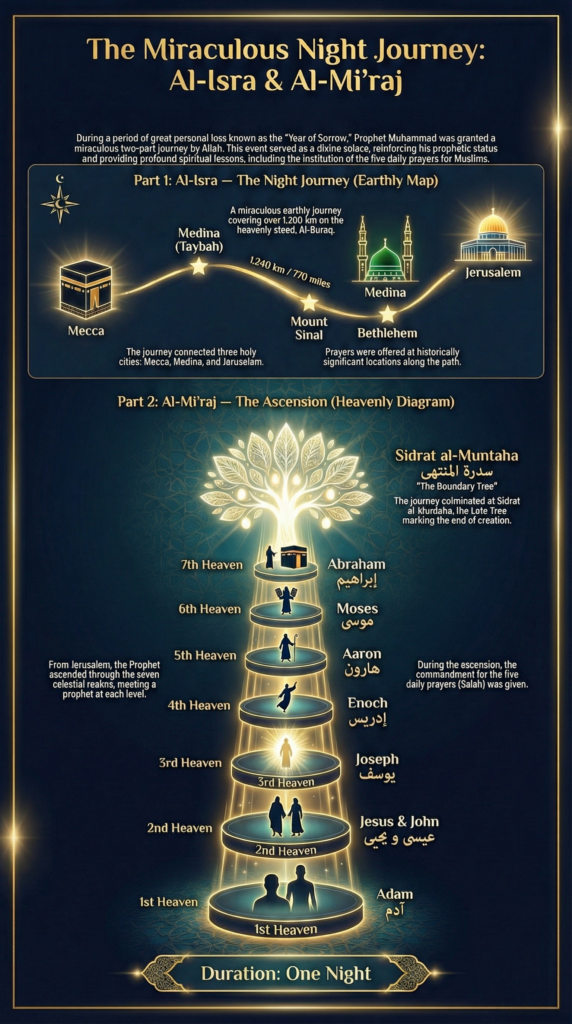
Gabriel directed the Prophet to stop three times during the journey:
Stop 1: Taybah (Medina)
Gabriel instructed: “Dismount and pray here.” After praying, the Prophet asked where he had prayed. Gabriel revealed: “You have prayed in Taybah, and the believers will immigrate here.”
This prophecy came true. Within a year, the Prophet migrated to Medina and established the first Islamic state.
Stop 2: Mount Sinai
The mountain where Allah revealed the Torah to Prophet Moses. This stop connected Muhammad’s mission to the Abrahamic tradition.
Stop 3: Bethlehem
The birthplace of Prophet Jesus. Again, the journey linked Islam’s final prophet to previous messengers.
I find these stops profound. They geographically traced the path of monotheistic revelation from Moses to Jesus to Muhammad.
Arrival at Al-Masjid al-Aqsa
Upon reaching Jerusalem, Gabriel tied Al-Buraq to the Western Wall. The same ring where previous prophets had tethered their mounts.
Inside Al-Masjid al-Aqsa, all the prophets were assembled by divine command:
- Adam (father of humanity)
- Abraham (patriarch of monotheism)
- Moses (who received the Torah)
- Jesus (the Messiah)
- And many others
The Prophet led them all in prayer.
This single act established his position as the final messenger. Leading prayer is a position of authority in Islam. The Prophet leading Abraham, Moses, and Jesus demonstrated his supreme rank among all prophets.
The Ascension Through Seven Heavens
From Jerusalem, the journey entered its most miraculous phase. The Prophet ascended through seven distinct heavens with Gabriel.
At each heaven’s gate, the same conversation occurred:
Gatekeeper: “Who is this?”
Gabriel: “This is Gabriel.”
Gatekeeper: “Who is with you?”
Gabriel: “Muhammad.”
Gatekeeper: “Has his mission begun?”
Gabriel: “Yes.”
The gate would then open.
The Seven Heavens Who the Prophet Met at Each Level
| Heaven | Prophet Encountered | Significance |
| First Heaven | Adam | Father of all humanity; greeted Muhammad warmly |
| Second Heaven | Jesus & John the Baptist | Cousins who both received divine books |
| Third Heaven | Joseph | Described as the most beautiful human creation |
| Fourth Heaven | Enoch (Idris) | Raised to a high place by Allah |
| Fifth Heaven | Aaron | Brother and supporter of Moses |
| Sixth Heaven | Moses | Played crucial role in prayer negotiation |
| Seventh Heaven | Abraham | Leaning against Bayt al-Ma’mur |
Each prophet welcomed Muhammad with variations of: “Welcome, O pious brother and pious Prophet.”
Moses showed special interest. When the Prophet returned from the seventh heaven, Moses asked about the commandments given. This led to the most important negotiation in Islamic history.
The Bayt al-Ma’mur
At the seventh heaven, the Prophet witnessed the Bayt al-Ma’mur (the Frequented House). This celestial structure sits directly above the earthly Kaaba.
What the Prophet saw:
- A magnificent mosque in the seventh heaven
- 70,000 angels praying inside every single day
- After finishing prayers, those angels never return
- New angels take their place for eternity
This vision showed the Prophet that worship happens constantly throughout creation. Earth’s worship mirrors heaven’s perpetual devotion.
How Five Daily Prayers Established?
I’ve spoken with hundreds of Muslims about their prayer practice. Most don’t realize the fascinating negotiation that determined why we pray five times daily instead of fifty.
At the Sidrat al-Muntaha (the boundary tree beyond the seventh heaven), Allah initially prescribed fifty prayers per day for Muslims.
The Prophet began his descent. At the sixth heaven, Moses asked: “What has your Lord ordered for your people?”
The Prophet replied: “Fifty prayers each day.”
Moses’s Wisdom from Experience
Moses responded with concern: “Your followers cannot bear fifty prayers a day. By Allah, I have tested people before you. I tried my level best with the Children of Israel. Go back to your Lord and ask for a reduction.”
Moses spoke from direct experience. The Israelites had struggled with far fewer obligations. He knew human nature better than anyone.
The Prophet returned to Allah and requested a reduction.
The Negotiation From 50 to 5
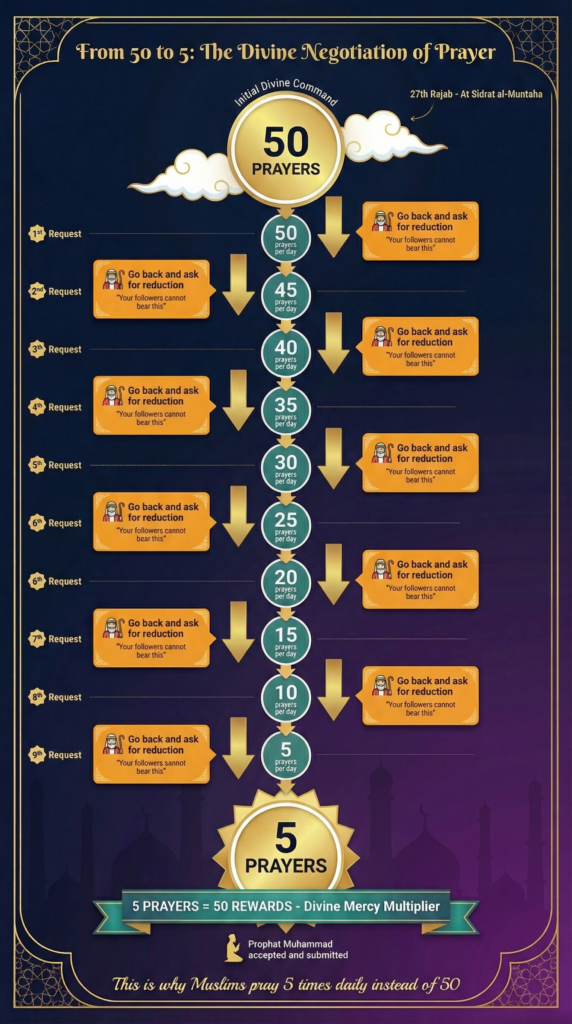
Allah reduced the prayers to forty. The Prophet returned to Moses.
Moses again advised: “Go back. Your followers still cannot bear this.”
This happened nine times:
50 → 45 → 40 → 35 → 30 → 25 → 20 → 15 → 10 → 5
After the final reduction to five, Moses said: “Go back again.”
The Prophet replied: “I have asked my Lord again and again until I am ashamed. I accept and submit.”
The Divine Decree Five Prayers Worth Fifty
Then came the proclamation that changed everything:
“I have decreed what is My due, and I have eased the burden for My servants. These five prayers will be recorded as fifty in reward.”
This arrangement shows divine mercy. Allah knew humans couldn’t sustain fifty prayers daily. The negotiation taught the Prophet (and all Muslims) to seek ease within devotion.
Today, the five prayers take approximately 30-45 minutes total throughout the day. Each prayer lasts 5-10 minutes. Yet believers receive the reward of fifty prayers.
The Sidrat al-Muntaha
The Lote Tree of the Farthest Boundary marks where created existence ends and divine reality begins.
Description from authenticated hadith:
“I was shown the Sidrat al-Muntaha, and behold, its fruits were as large as the clay jugs of Hajr, and its leaves were like the ears of elephants, and four rivers originated at its root,two apparent and two hidden.”
What This Tree Represents
The Sidrat al-Muntaha serves as:
1. The Limit of Created Knowledge: No angel’s knowledge extends beyond this tree. Everything beyond belongs solely to divine knowledge.
2. Gabriel’s Stopping Point: Gabriel told the Prophet: “If I advance even a fraction further, I will be consumed by the divine light. But for you, the doors are open.”
Even the most powerful angel couldn’t proceed. Only the Prophet could cross this boundary.
3. The Place of Divine Communication: Beyond this tree, the Prophet experienced direct communication with Allah. He received the commandments for the Muslim Ummah.
Abu Dhar narrated: “I reached Sidrat al-Muntaha where I beheld astounding colors and incredible embellishments. I have no idea what they were.”
The Prophet’s inability to describe what he saw proves the experience transcended human language and comprehension.
Visions of the Afterlife What the Prophet Witnessed
During the journey, Allah showed the Prophet detailed visions of Paradise and Hell. These visions serve as warnings and promises for all humanity.
The Prophet saw:
- Gardens with rivers flowing beneath
- Structures made of pearls and sapphires
- Blessings prepared for righteous believers
- Couches arranged for the faithful
The Prophet witnessed punishment for specific sins:
People Who Devour Orphans’ Property: Their own flesh appeared to burn as they ate it.
Those Who Consume Interest (Riba): Forced to swim in a river of blood while stones were thrown at them.
Adulterers: Shown in a particular form of torment as warning against this major sin.
The Angel Malik: Keeper of Hellfire, who never smiles. The Prophet saw him guarding the gates of punishment.
These visions weren’t meant to terrify. They clarified divine justice and motivated people toward righteousness.
Was It Physical or Just a Dream? The Scholarly Consensus
This question sparked debates among early Muslims and continues today. I’ll present the evidence for each view.
Over 95% of Islamic scholars across 1,400 years agree: the Prophet traveled with both body and soul while fully awake.
The verse uses “His Servant” (Abdihi). In Arabic, this grammatically and theologically refers to a being with both body and soul. If only the spirit traveled, different terminology would appear.
When the Prophet announced his journey, the Quraysh disbelievers mocked: “He claims he went to Jerusalem and returned in one night,a journey that takes a month!”
Their skepticism confirms everyone understood this as a physical journey. No one would mock a dream or vision.
The disbelievers approached Abu Bakr: “Look at what your companion is saying. He says he went to Jerusalem and came back in one night!”
Abu Bakr replied with absolute certainty:
“If he said that, then he is truthful. I believe him concerning the news of the heavens,that an angel descends to him from the heavens. How could I not believe he went to Jerusalem and came back in a short period,when these are on earth?”
This unshakeable faith earned Abu Bakr the title “As-Siddiq” (The Truthful One). The title stuck throughout Islamic history.
The Quraysh demanded proof: “If you’re truthful, describe Jerusalem to us!”
The Prophet had never visited Jerusalem before. But he provided exact descriptions:
- Building layouts
- Street configurations
- Architectural details
- Landmarks and structures
People who had visited Jerusalem confirmed every detail was accurate.
The Caravan Predictions:
The Prophet described caravans he’d seen on his return journey:
- Their exact locations
- The merchandise they carried
- When they would arrive in Mecca
Every prediction proved accurate when the caravans arrived days later.
This empirical evidence verified the journey’s physical reality.
The Minority Views
Some scholars held different interpretations:
Spiritual Journey Only: A small minority suggested the soul traveled while the body remained. Weak evidence supports this view.
Symbolic Vision: Some later scholars like Shah Wali Allah proposed a vision in the realm of similitude (Mithaal).
The majority rejects these views based on Quranic language and companion testimony.
How Muslims Observe Isra and Mi’raj Today
Muslims worldwide commemorate this blessed night through worship and reflection. The observance focuses on spiritual growth, not festive celebration.
Night Prayers (Tahajjud): Muslims perform extra voluntary prayers throughout the night. Many mosques hold special prayer sessions.
Quranic Recitation: Families and communities read Surah Al-Isra and Surah An-Najm together. They reflect on the verses describing the journey.
Supplication (Dua): Believers ask Allah for:
- Forgiveness of sins
- Steadfastness in faith
- Success in both worlds
- Ability to maintain the five daily prayers
Following prophetic tradition, Muslims increase charitable acts. They feed the poor and help neighbors.
Why Isra and Mi’raj Night Matters for Every Muslim?
I’ve taught Islamic studies to new Muslims for years. Understanding Isra and Mi’raj transforms how they view daily prayers.
1. The Only Worship Commanded Directly
Every other Islamic obligation came through Angel Gabriel to the Prophet, then to the people. Prayer alone was commanded directly from Allah to the Prophet during Mi’raj.
This directness makes Salah uniquely sacred. When you pray, you perform the only act of worship that bypassed all intermediaries.
2. The Link to Paradise
The Prophet saw Paradise during this journey. He returned with detailed descriptions of what awaits righteous believers. This knowledge motivates Muslims to persist through worldly difficulties.
3. Proof of Divine Mercy
The reduction from fifty to five prayers demonstrates Allah’s compassion. Allah could have kept the obligation at fifty. Instead, He showed mercy while maintaining the full reward.
This teaches Muslims: Allah never burdens anyone beyond their capacity.
4. Connection to All Prophets
Meeting every previous prophet in one night unified the message of monotheism. Islam isn’t a new religion,it’s the completion of the same message given to Abraham, Moses, and Jesus.
Final Thoughts The Eternal Significance
Isra and Mi’raj is one of Islam’s most proven miracles, evidenced by direct Quranic testimony, numerous authenticated hadith, scholarly consensus, and the Prophet’s accurate descriptions.
The journey’s practical impact is seen five times daily in prayer (Salah), the commandment the Prophet received at the boundary of creation. When you pray, remember this gift came directly from beyond the seventh heaven, delivered without intermediary.
The reduction from fifty to five prayers demonstrates divine mercy, offering manageable obligations with maximum rewards.
Reflect on this miraculous journey on January 26, 2026. Read Surahs Al-Isra and An-Najm, perform extra prayers, and thank Allah for Salah.
The night journey teaches that divine help and elevation can arrive unexpectedly, even following great loss and struggle. Your current struggles may precede your greatest blessings.
What is the story of Isra and Miraj?
The Isra and Mi’raj is the miraculous night journey in 621 CE when Prophet Muhammad traveled from Mecca to Jerusalem (Isra) and then ascended through the seven heavens (Mi’raj).
What happened on 27 Rajab?
On the 27th of Rajab, the Prophet rode Al-Buraq, met previous prophets in the heavens, witnessed Paradise and Hell, and, upon reaching the seventh heaven, received the commandment for five daily prayers directly from Allah (originally fifty, reduced to five upon Moses’ advice). The Prophet returned to Mecca the same night.
Can I celebrate Isra and Mi’raj?
Muslims observe (not celebrate) this night through increased worship like extra prayers, Quran recitation, and charity, focusing on spiritual growth and gratitude for the gift of prayer.