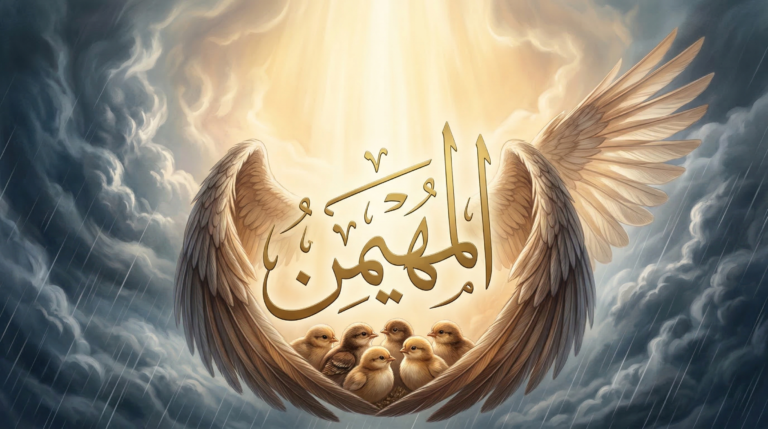

During moments of intense fear or uncertainty, Islam provides a powerful Divine Name for comfort: Al-Mu’min (ٱلْمُؤْمِنُ).
As one of the 99 Names of Allah, Al-Mu’min signifies that He both grants security to creation and affirms the truth of His promises and Messengers. This dual meaning offers a stabilizing anchor, transforming how we perceive fear and trust in Allah.
This entry is part of a series on the 99 Names of Allah, exploring the linguistic and practical depths of this comforting Name.
What Does Al-Mu’min Mean?
In classical Islamic calligraphy, particularly in the Thuluth or Naskh scripts, this Name (ٱلْمُؤْمِنُ) is written with a commanding opening Hamza-Alif (أ), a flowing Meem (م), and a grounded Noon (ن) at the close.
The visual structure mirrors the Name’s meaning: something stable, rooted, and sheltering. Calligraphers often note that the Meem sits at the heart of the word, just as security (amn) sits at the heart of existence under Allah’s care.
Al-Mu’min derives from the triliteral root أ – م – ن (Alif, Meem, Noon). This root is one of the most significant in the entire Arabic language. Classical Arabic scholars trace its core meaning to:
- Being secure and free from fear
- Being in a state of quiet and tranquility
- Being someone who is trusted and trustworthy
Every word built from this root carries that sense of settled peace. Amn means security. Iman means faith. Amanah means trustworthiness. Mu’min means the one who grants that state or embodies it.
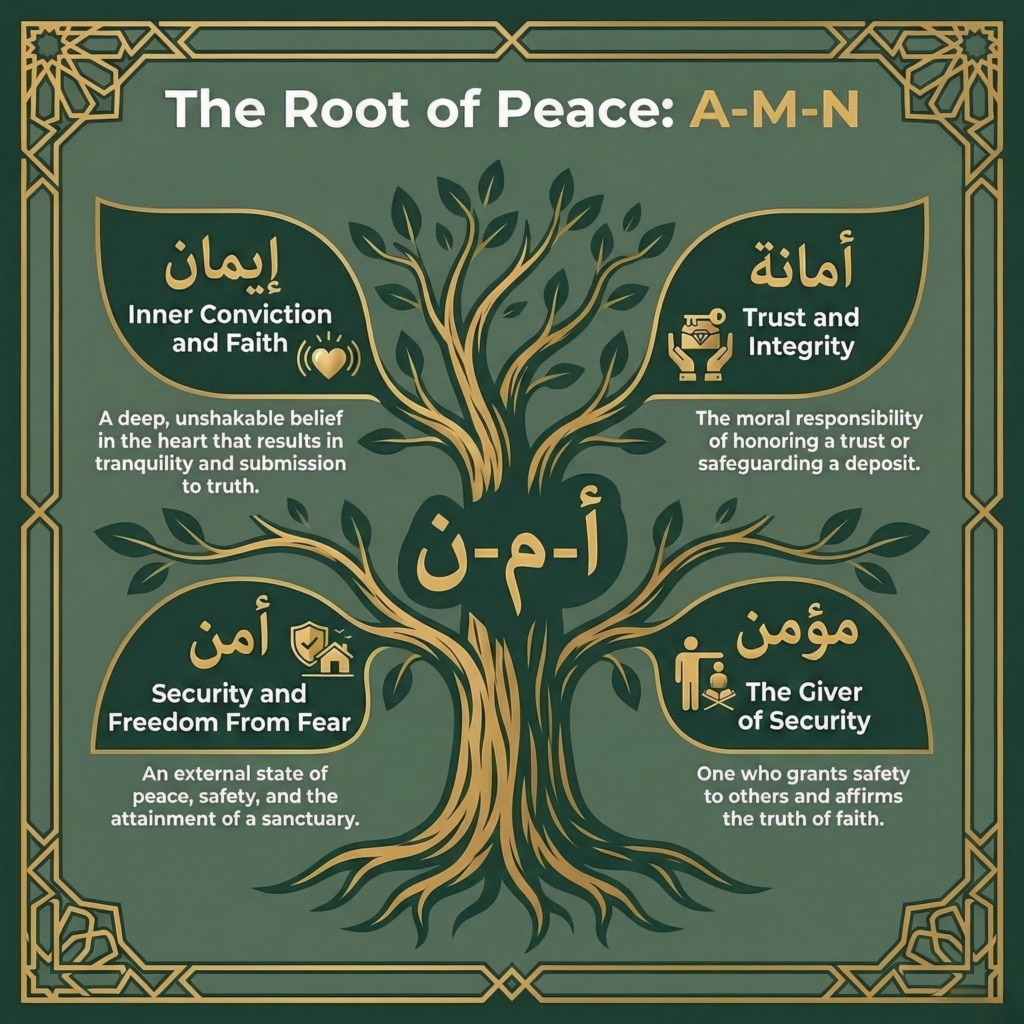
Morphologically, Al-Mu’min is the active participle (ism fā’il) of the Form IV verb āmana. The Form IV pattern in Arabic adds a causative dimension. So where the base root means “to be safe,” this Form IV construction means “to make safe” or “to grant security.” This is a crucial distinction. Allah does not merely possess security. He actively creates and delivers it to His creation.
Two Dimensions of the Name Al-Mu’min
Most scholars identify two inseparable meanings:
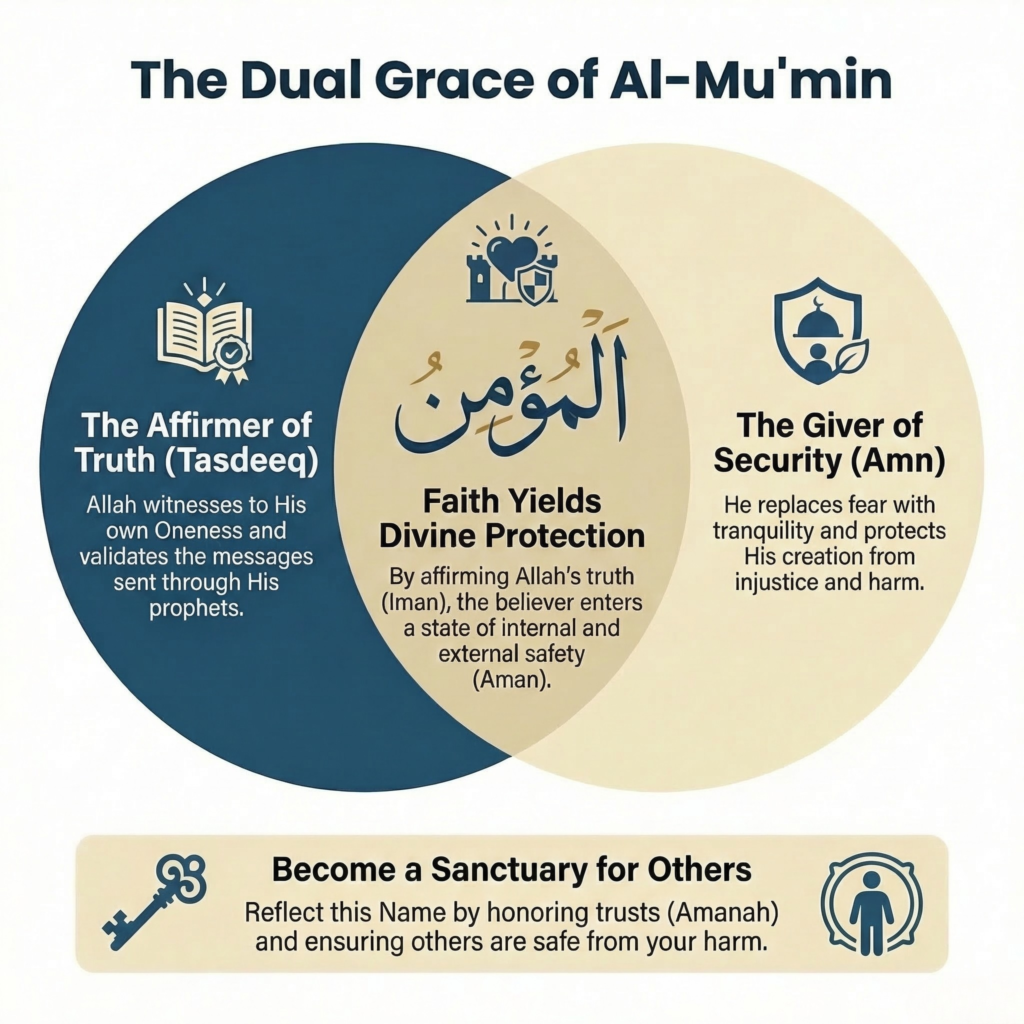
First: The Bestower of Safety (Amn). Allah grants His servants protection from fear, from injustice, and from ultimate loss. The security He offers is not circumstantial. It is guaranteed by His nature.
Second: The Affirmer of Truth (Tasdeeq). Allah confirms the truthfulness of His Prophets and their messages. He is the Divine Witness who verifies all truth. This also means His own promises are never broken.
Together, these two meanings form a complete picture. You are safe because His word is true. His word is true because He is the source of all safety.
Mentions of Al-Mu’min in the Quran and Hadith
1. Surah Al-Hashr, Verse 23
This is the primary verse in the Quran where Al-Mu’min appears directly among the Divine Names:
Arabic:
هُوَ ٱللَّهُ ٱلَّذِى لَآ إِلَٰهَ إِلَّا هُوَ ٱلْمَلِكُ ٱلْقُدُّوسُ ٱلسَّلَٰمُ ٱلْمُؤْمِنُ ٱلْمُهَيْمِنُ ٱلْعَزِيزُ ٱلْجَبَّارُ ٱلْمُتَكَبِّرُ
Reference: Quran 59:23
Translation (Sahih International): “He is Allah, other than whom there is no deity, the Sovereign, the Pure, the Perfection, the Giver of Security, the Guardian, the Exalted in Might, the Compeller, the Superior.”
Notice the placement of Al-Mu’min in this verse. It appears immediately after As-Salam (The Source of Peace) and immediately before Al-Muhaymin (The Guardian). This sequence is not accidental. Peace flows from Allah’s nature. Security is His active gift to creation. And His guardianship ensures that security is preserved. These three Names form a theological arc: essence, action, and maintenance.
2. Surah Quraysh, Verse 4
Arabic:
ٱلَّذِىٓ أَطْعَمَهُم مِّن جُوعٍ وَءَامَنَهُم مِّنْ خَوْفٍ
Reference: Quran 106:4
Translation (Sahih International): “[He] who has fed them against hunger and secured them against fear.”
This verse shows Allah’s quality of ta’meen (granting security) in action. Physical sustenance and internal safety are both gifts from the same Divine source.
3. Authentic Hadith
The Prophet Muhammad ﷺ directly connected the concept of this Name to how a believer must behave:
Arabic:
عَنْ عَبْدِ اللَّهِ بْنِ عَمْرٍو، أَنَّ النَّبِيَّ صَلَّى اللَّهُ عَلَيْهِ وَسَلَّمَ قَالَ: «الْمُسْلِمُ مَنْ سَلِمَ الْمُسْلِمُونَ مِنْ لِسَانِهِ وَيَدِهِ، وَالْمُؤْمِنُ مَنْ أَمِنَهُ النَّاسُ عَلَى دِمَائِهِمْ وَأَمْوَالِهِمْ»
Reference: Sunan At-Tirmidhi, Hadith 2627 (Hasan Sahih)
Translation: “The Muslim is the one from whose tongue and hand the Muslims are safe. The believer (mu’min) is the one from whom people are safe with regards to their blood and their wealth.”
This Hadith is extraordinary. The Prophet ﷺ defines a true believer by the very attribute of Allah’s Name: granting security to others. To be a mu’min is to reflect, even in a limited human way, the Name of Al-Mu’min.
Tafseer Meaning Of Al-Mu’min
Imam Al-Ghazali
In his landmark work Al-Maqsad Al-Asna, Al-Ghazali defines Al-Mu’min as the One “to whom security is ascribed because He conveys the means to attain it and seals the paths of danger.” He argues that absolute security, the kind that is complete and permanent, can only originate from Allah. Human security is borrowed. Divine security is inherent.
Al-Ghazali further notes that this Name carries an implication for the human servant: the highest form of worship related to Al-Mu’min is making your own circle of life a place of safety for others.
Ibn Abbas and the Promise of Justice
The companion and scholar Ibn Abbas, whose tafseer is among the earliest and most authoritative, explains Al-Mu’min as: “Allah has granted safety to His servants by promising He will never be unjust to them.” This interpretation makes the Name deeply personal.
The security Allah offers is not just physical. It is the assurance that you will never be wronged by Him. Not in this life and not on the Day of Judgment.
Mujahid and Qatadah: The Dimension of Verification
The classical Tabi’een scholars Mujahid and Qatadah emphasize the Tasdeeq (verification) dimension. They explain that Allah is Al-Mu’min because He affirms the truth of His Prophets and verifies His own word.
Every promise He made in the Quran is divinely certified. This makes the Quran not just a book of guidance but a document backed by the most reliable source of truth in existence.
How to Apply Al-Mu’min in Your Daily Life
1. Turn to This Name Specifically During Anxiety
Anxiety and fear are among the most common human experiences. Research from the World Health Organization estimates that 301 million people globally live with anxiety disorders. The Islamic answer to fear is not the absence of danger. It is the presence of Allah Al-Mu’min.
When a wave of panic rises, pause and say: “Ya Mu’min, aamin qalbi” (O Giver of Security, bring peace to my heart). This is not magical thinking. It is a conscious act of redirecting your attention from the source of fear to the Source of security. Practiced regularly, this trains the heart to seek stability in the right place.
2. Make Others Feel Safe Around You
The Hadith of Tirmidhi quoted above ties human belief directly to this attribute. Ask yourself a direct question: “Are the people around me safe from my words, my anger, and my behavior?” A person who gossips, shouts at family, or betrays trust has disconnected their conduct from this Divine Name.
One practical step: audit your speech for one week. Each time you notice your words making someone around you anxious or uncomfortable, write it down. That list becomes your personal roadmap for reflecting Al-Mu’min in your character.
3. Trust Allah’s Promises Completely
Al-Mu’min is the Affirmer of all truth. Every promise He made in the Quran is verified by His own Name. “After hardship comes ease” (94:5-6). “Allah does not burden a soul beyond that it can bear” (2:286). “He will surely substitute for them, after their fear, security” (24:55).
These are not motivational phrases. They are certified promises from Al-Mu’min. Reading them during difficult times shifts the mind from “will things get better?” to “I know they will, because Allah said so.”
Duas Using the Name Al-Mu’min
Prophetic Dua for Safety and Ease
This supplication is reported in the Sunnah and directly calls upon Allah to grant the safety implied in His Name:
Arabic:
اللَّهُمَّ اسْتُرْ عَوْرَاتِي وَآمِنْ رَوْعَاتِي
Transliteration: Allaahumma-stur ‘awraatee wa aamin raw’aatee.
When to recite: During moments of fear, before stepping into a difficult situation, or as part of your morning adhkar.
Dua for Firmness of Faith
This supplication calls directly upon the Name Al-Mu’min to ask for what only He can give: settled, unshakeable certainty.
Arabic:
يَا مُؤْمِنُ ثَبِّتْ إِيمَانِي وَقَوِّ يَقِينِي
Translation: “O Al-Mu’min, make my faith firm and strengthen my certainty.”
When to recite: During periods of doubt, spiritual dryness, or when facing arguments against your faith.
Related Names of Allah
Understanding Al-Mu’min becomes even richer when you compare it with two closely related Names:
1. Al-Muhaymin (ٱلْمُهَيْمِنُ): The Guardian and Overseer
In Surah Al-Hashr 59:23, these two Names appear side by side. Al-Mu’min actively grants security. Al-Muhaymin watches over and preserves that security. Think of Al-Mu’min as the one who builds the shelter and Al-Muhaymin as the one who keeps a constant watch over it. Both Names are necessary to understand how completely Allah protects His creation.
2. As-Salam (ٱلسَّلَامُ):The Source of Peace
As-Salam refers to Allah’s essential, inherent perfection and flawlessness. There is no deficiency in Him whatsoever. Al-Mu’min, by contrast, describes His outward action toward creation: He actively extends that peace and security to His servants. As-Salam is about what Allah is. Al-Mu’min is about what He does for you.
How to Teach Al-Mu’min to Children
Sit with your child during a quiet moment and ask: “Do you remember the last time you heard really loud thunder? How did it feel?”
Let them answer. Then ask: “What happened when you came inside and got a big hug?”
When they say “safe” or “better,” tell them:
“That warm, cozy feeling when you are inside and the storm is outside, and someone who loves you is hugging you tight — that feeling is a gift from Allah. It is called amn, which means security. Allah’s Name Al-Mu’min means He is the One who gives that feeling to your heart. No matter how loud the storm in your life gets, Allah Al-Mu’min is always there, and He can fill your heart with that same safe, warm feeling. All you have to do is ask Him.”
You can follow this with a small activity: draw a picture of a storm outside a warm house. Write the Name Al-Mu’min on the roof. Every time the child feels scared, they can look at the drawing and remember Who provides the shelter.
Summary
In a world of information overload, social anxiety, geopolitical fear, and personal uncertainty, Al-Mu’min stands as one of the most relevant Divine Names a Muslim can hold close. It is not a passive concept. It is an active promise from the Most Reliable source in existence.
Allah grants security. His word is verified truth. And the more a believer reflects this Name in how they treat others, the closer they come to the highest standard the Prophet ﷺ described: a true mu’min, from whom every person they encounter feels completely safe.