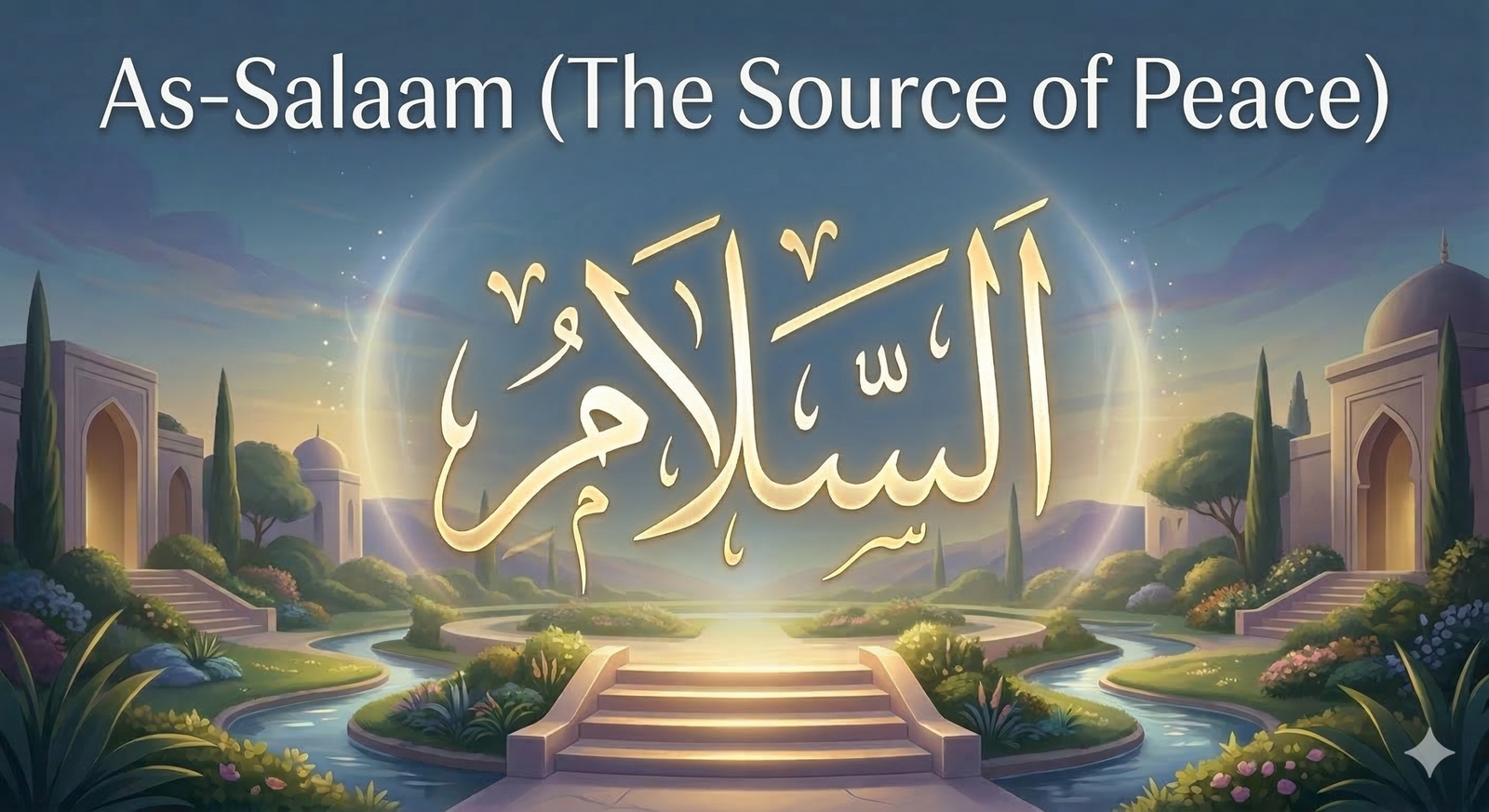
The moment a Muslim concludes prayer with “As-Salaamu Alaykum wa Rahmatullah,” they invoke a profound Name of Allah. Beyond a simple greeting, As-Salaam (ٱلسَّلَامُ) signifies the Being who is Peace in His very Essence, existing before creation itself.
As the 5th of the 99 Names of Allah, As-Salaam is a theological declaration. It identifies Allah as the One whose Essence is entirely free from defect, weakness, or imperfection.
He does not merely possess peace; He is Peace.This exploration examines the Name’s Arabic roots, Quranic significance, and practical applications. Understanding the 99 Names of Allah through this lens transforms one’s perception of prayer and the heart.
What Does As-Salaam Mean in Arabic?
The Name is written with the definite article Al (ٱل) followed by the letters Seen (سـ), Lam (لـ), Alif (اـ), and Meem (م). In calligraphy, the vertical Alif and Lam are often elongated in Thuluth script to reflect Divine majesty, while the curved Meem at the end suggests the encompassing, all-embracing nature of this peace.
Arabic Text: ٱلسَّلَامُ
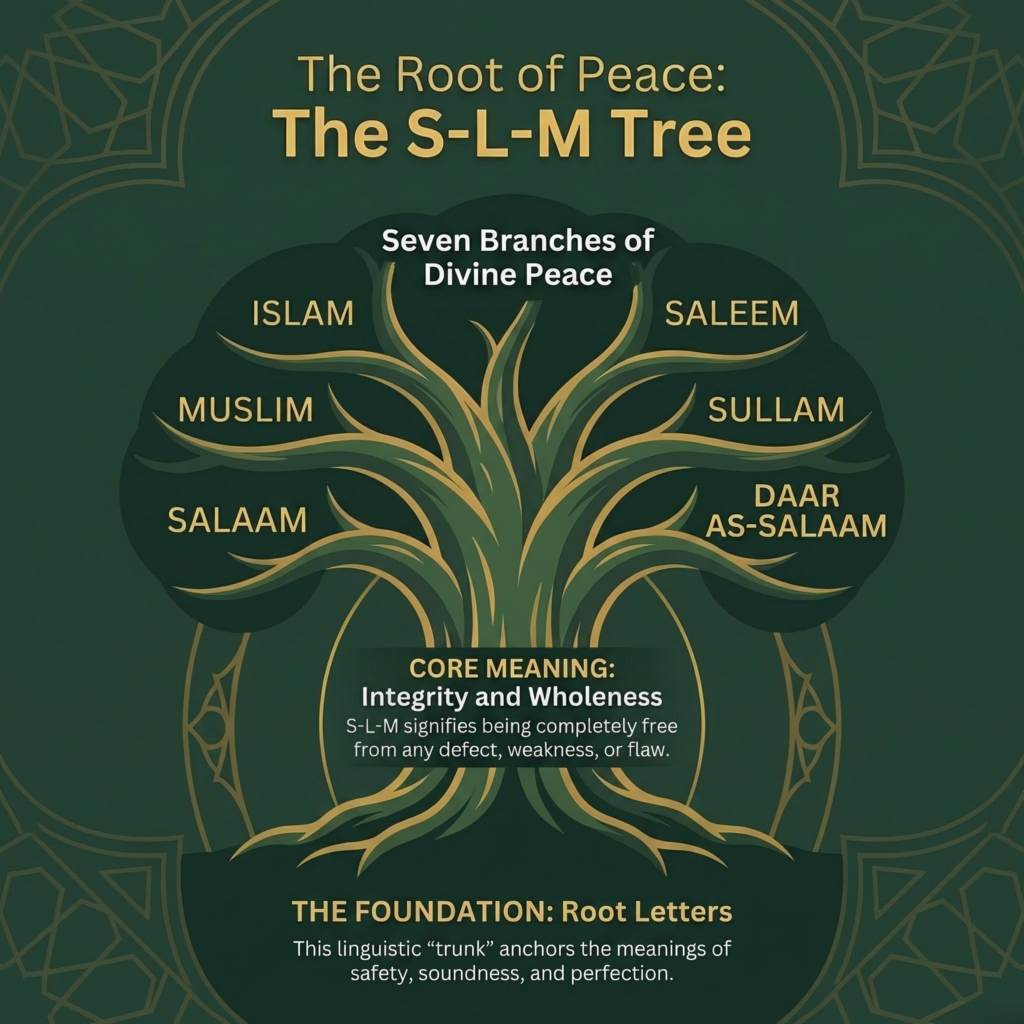
The root of As-Salaam is the triliteral Arabic root S-L-M (سين، لام، ميم). This is one of the most important roots in the entire Arabic language. It is the same root that gives us:
- Islam (اَلْإِسْلَامُ): the religion of submission and peace
- Muslim (مُسْلِمٌ): one who submits to the Source of Peace
- Salaam (سَلَامٌ): the greeting of peace
- Salaamah (سَلَامَة): immunity and well-being
- Saleem (سَلِيمٌ): sound, unblemished, free of flaw
In classical Arabic, the verb salima described a leather hide that had been treated and finished by a tanner, made firm, sound, and completely free of any weakness or crack. The idea embedded in the root is not just “being at peace” passively. It means integrity. Completeness. Nothing missing, nothing broken, nothing that could fail.
Here is the critical insight: when applied to Allah, As-Salaam means He is the Being whose Essence contains zero deficiency. No fatigue. No error. No decline. No need. He is structurally, ontologically, and eternally sound.
There is also a beautiful secondary meaning. The word Sullam (سُلَّمٌ), meaning a ladder or staircase, comes from this same root. A ladder lifts you from danger to safety. As-Salaam is the One who lifts His servants from the storms of this world to the safety of His nearness.
| Derived Term | Arabic | Meaning |
| Salaamah | سَلَامَة | Immunity and well-being |
| Saleem | سَلِيم | Sound, unblemished heart |
| Tasleem | تَسْلِيم | Submission, surrendering to Allah |
| Silm | سِلْم | Peace, reconciliation |
| Daar As-Salaam | دَارُ السَّلَام | The Home of Peace (Paradise) |
Mentions of As-Salaam in the Quran and Hadith
Quran 59:23, Surah Al-Hashr
The Name As-Salaam appears explicitly as a Divine title in the closing verses of Surah Al-Hashr.
Arabic:
هُوَ ٱللَّهُ ٱلَّذِي لَآ إِلَٰهَ إِلَّا هُوَ ٱلۡمَلِكُ ٱلۡقُدُّوسُ ٱلسَّلَٰمُ ٱلۡمُؤۡمِنُ ٱلۡمُهَيۡمِنُ ٱلۡعَزِيزُ ٱلۡجَبَّارُ ٱلۡمُتَكَبِّرُۚ سُبۡحَٰنَ ٱللَّهِ عَمَّا يُشۡرِكُونَ
Transliteration: Huwal-lāhul-ladhī lā ilāha illā huwal-Malikul-Quddūsus-Salāmul-Muʾminul-Muhayminul-ʿAzīzul-Jabbārul-Mutakabbir. Subḥānal-lāhi ʿammā yushrikūn.
Translation (Sahih International): “He is Allah, other than whom there is no deity, the Sovereign, the Pure, the Perfection, the Bestower of Faith, the Overseer, the Exalted in Might, the Compeller, the Superior. Exalted is Allah above whatever they associate with Him.” (Quran 59:23)
Notice the context. Surah Al-Hashr discusses the fall of a powerful tribe who trusted in their fortresses and their wealth. After describing how easily those walls crumbled, Allah announces His own Names. He is As-Salaam. While every worldly structure of security collapses, He remains the one permanent source of peace and safety.
Quran 10:25, Surah Yunus
Arabic:
وَٱللَّهُ يَدۡعُوٓاْ إِلَىٰ دَارِ ٱلسَّلَٰمِ وَيَهۡدِي مَن يَشَآءُ إِلَىٰ صِرَٰطٖ مُّسۡتَقِيمٖ
Transliteration: Wallāhu yadʿū ilā dāris-salāmi wa yahdī man yashāʾu ilā ṣirāṭim-mustaqīm.
Translation (Sahih International): “And Allah invites to the Home of Peace and guides whom He wills to a straight path.” (Quran 10:25)
Paradise is named Daar As-Salaam, the Home of Peace, because it is the only realm where the attribute of As-Salaam is completely realised for His creation. No grief. No death. No conflict. No worry. It is a space where every form of harm is permanently absent, because the Source of Peace is there.
Authentic Hadith
The Prophet Muhammad (ﷺ) gave one of the most important theological corrections recorded in the Sunnah on this Name.
Arabic:
عَنْ عَبْدِ اللَّهِ قَالَ كُنَّا نَقُولُ فِي الصَّلاَةِ السَّلاَمُ عَلَى اللَّهِ السَّلاَمُ عَلَى فُلاَنٍ فَقَالَ لَنَا النَّبِيُّ ﷺ: لاَ تَقُولُوا السَّلاَمُ عَلَى اللَّهِ فَإِنَّ اللَّهَ هُوَ السَّلاَمُ
Transliteration: ʿAn ʿAbdillāhi qāla kunnā naqūlu fī ṣ-ṣalāti: As-salāmu ʿalal-lāh… fa-qāla lanal-nabiyyu (ﷺ): Lā taqūlū as-salāmu ʿalal-lāh, fa-innal-lāha huwas-salām.
Translation: “Narrated by Abdullah ibn Masʿud: We used to say in the prayer, ‘Peace be upon Allah from His servants.’ The Prophet (ﷺ) said to us: Do not say ‘Peace be upon Allah,’ for indeed Allah Himself is As-Salaam (Peace).” (Sahih al-Bukhari 831)
This correction carries enormous weight. You do not wish peace upon Allah. He is not in need of it. He is its very Source and Substance.
Tafseer Meaning of As-Salaam
Al-Ghazali: The Flawless One
Imam al-Ghazali, in his renowned work Al-Maqsad al-Asna, defines As-Salaam as “The Flawless.” He explains that human perfections are always fragile. A healthy person can fall ill. A kind person can slip into anger. A strong empire can decay. All created things carry within them the seeds of their own imperfection.
Allah as As-Salaam is categorically different. His perfection is not something He achieved or maintains. It is His Essence. Nothing can introduce weakness into it.
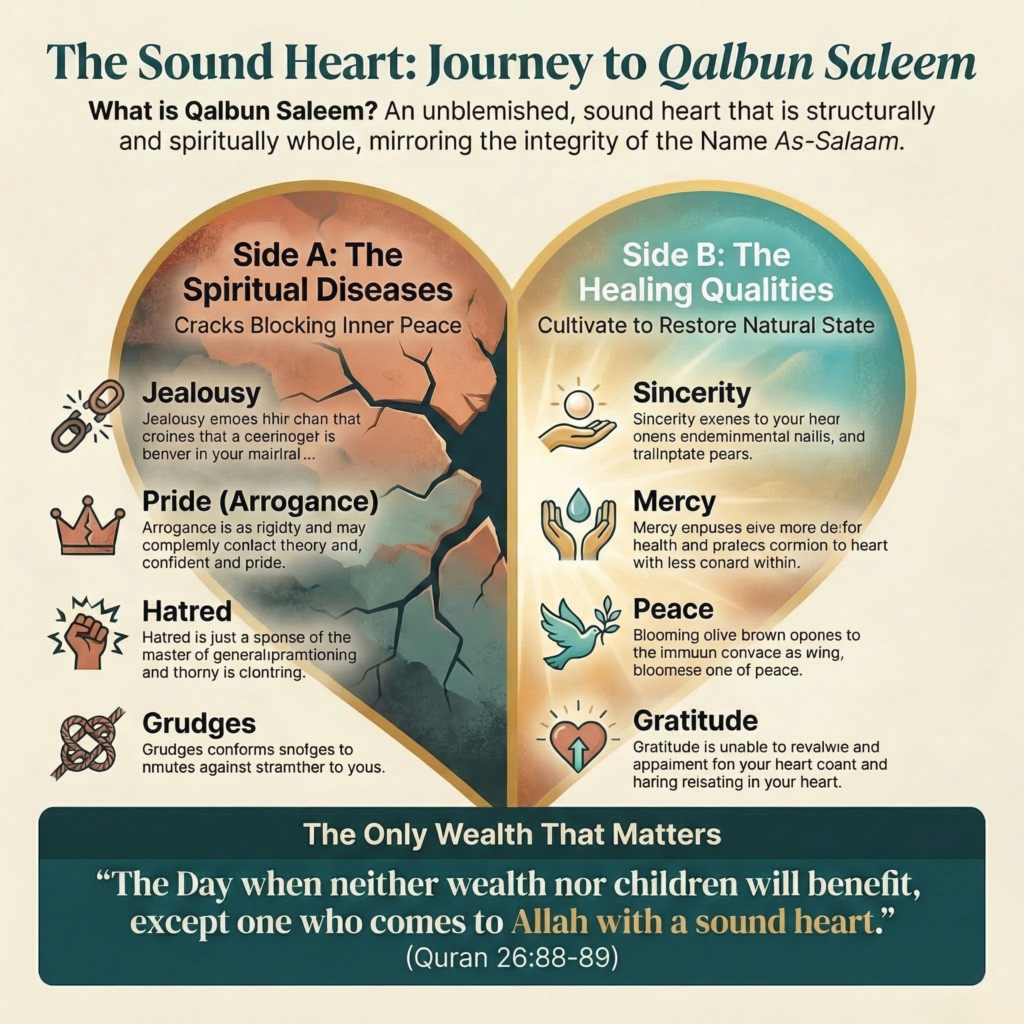
Al-Ghazali adds a personal implication: the believer who wishes to draw near to this Name must pursue a qalbun saleem (قَلْبٌ سَلِيمٌ), a sound heart, free of the spiritual diseases of jealousy, hypocrisy, arrogance, and hatred. The Quran confirms this: “The Day when neither wealth nor children will benefit, except one who comes to Allah with a sound heart.” (Quran 26:88-89)
Ibn Kathir: Free from Every Defect and Injustice
Ibn Kathir in his Tafsir explains As-Salaam as the One “free from any defects or shortcomings that lessen or decrease His perfect attributes and actions.” He specifically notes that Allah’s actions are entirely free from malice, haste, or injustice.
This interpretation reshapes how a believer processes hardship. When a trial arrives, the believer knows the decree came from a Being whose actions contain zero malice. There is a wisdom (hikmah) behind every difficulty that preserves the ultimate safety of the faithful.
As-Sa’di: The Active Bestower of Peace
Sheikh Abdur-Rahman As-Sa’di provides a complementary angle. He teaches that As-Salaam is not only perfect in Himself, but actively bestows peace on His creation. He “grants safety to His servants by promising that He will never be unjust to them.”
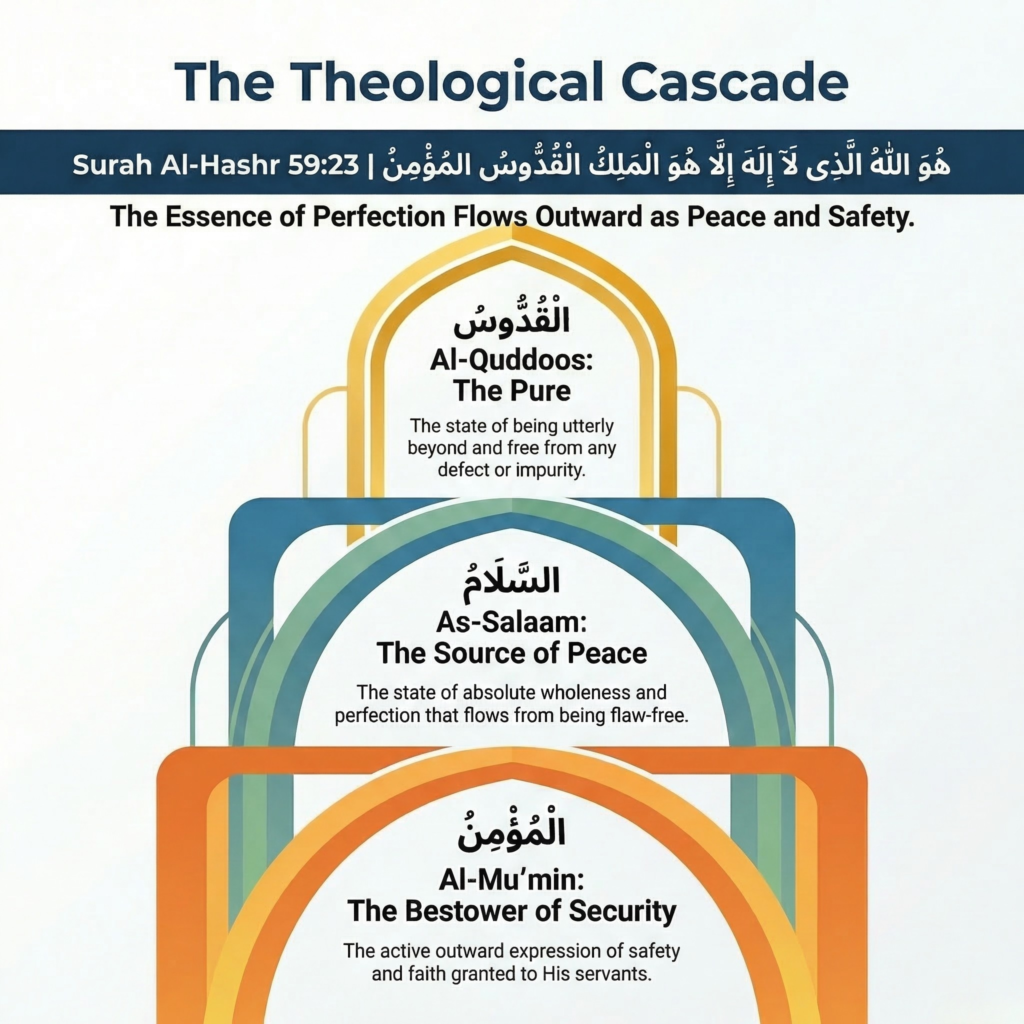
While Al-Quddoos (The Pure) focuses on Allah being beyond every imperfection, As-Salaam goes further: He is the positive, active Source who sends that peace outward into creation.
How to Apply As-Salaam in Your Daily Life?
1. Audit Your Heart Like a Doctor
Al-Ghazali teaches that the path to Allah as As-Salaam runs directly through the heart. Think of this as a weekly “heart check-up.” Ask yourself: Is there jealousy toward someone’s success? Is there a grudge you are carrying? Is there pride blocking your apology to a family member?
These are not minor spiritual issues. They are the exact “defects” that prevent the heart from becoming saleem. The Quran links the sound heart directly to salvation on the Day of Judgment. Set a consistent time, Friday evening works well for many, to make a sincere intention to remove one internal flaw.
2. Upgrade Your Salaam from a Habit to a Commitment
The Prophet (ﷺ) said: “As-Salaam is one of the Names of Allah which He has placed on the earth. Therefore, give the greeting among yourselves.” (Reported by Anas, graded Hasan)
Every time you say Assalamu Alaykum, you are invoking the Name of Allah as a guarantee. You are saying: “You are safe from me. My tongue will not hurt you. My actions will not harm you.” Take this seriously in your household first. Say it to your children when you enter their room. Say it to your parents before asking them anything. The simple act of restoring this greeting with full intention creates a measurable shift in the atmosphere of a home.
3. Find Inner Stability During Anxiety
Many Muslims carry significant anxiety about the future. Rizq. Health. Children. Relationships. When that inner noise gets loud, the Name As-Salaam becomes an anchor.
Recognise that the One managing your affairs is As-Salaam. His plans for you contain zero defect, zero malice, zero error. A practical technique: when anxiety rises, pause and say “Yaa Salaam” three times slowly. This is not superstition. It is a deliberate act of redirecting your trust back to the One whose Essence is peace.
Duas Using the Name As-Salaam
Post-Prayer Dhikr (Masnoon)
This supplication is recommended immediately after every obligatory prayer, narrated in Sahih Muslim.
Arabic:
أَسْتَغْفِرُ اللَّهَ (ثَلَاثًا) اللَّهُمَّ أَنْتَ السَّلَامُ وَمِنْكَ السَّلَامُ تَبَارَكْتَ يَا ذَا الْجَلَالِ وَالْإِكْرَامِ
Transliteration: Astaghfirullāh (3 times). Allāhumma antas-salāmu wa minkas-salāmu, tabārakta yā dhal-jalāli wal-ikrām.
Translation: “I seek Allah’s forgiveness (3 times). O Allah, You are As-Salaam, and from You is all peace. Blessed are You, O Possessor of Majesty and Honor.”
Say this dua as a transition. Your prayer was imperfect. You drifted in focus. You forgot what you recited. By saying this immediately after tasleem, you hand your imperfect worship back to the One who is perfectly sound and ask Him to seal it with His peace.
Personal Dua for Safety and Calm
When facing fear, distress, or uncertainty, use this direct invocation.
Arabic:
يَا سَلَامُ سَلِّمْنِي
Transliteration: Yā Salāmu sallimnī.
Translation: “O Source of Peace, grant me safety and peace.”
For loved ones: Yā Salāmu sallimhum. “O Source of Peace, grant them safety.”
Related Names of Allah
Understanding As-Salaam becomes sharper when you place it alongside its neighbors in Surah Al-Hashr 59:23.
1. Al-Quddos (ٱلْقُدُّوسُ) and As-Salaam (ٱلسَّلَامُ)
Al-Quddus means The Pure, The Sacred. It emphasizes that Allah is beyond and above every impurity or defect. The focus is on negation, removing everything that should not be attributed to Him.
As-Salaam builds on that. Because He is Al-Quddus (utterly pure), He is also As-Salaam (utterly sound and complete). Al-Quddus clears the space; As-Salaam fills it with integrity.
3. Al-Muʾmin (ٱلْمُؤْمِنُ)
Al-Muʾmin means The Bestower of Faith and Security. It is the active outward expression of safety Allah provides for His servants.
The sequence in the Quran runs: Purity (Al-Quddus) leads to Wholeness (As-Salaam), which flows outward as Security (Al-Muʾmin). It is a theological cascade. Allah is not these things in isolation. They are one unified reality expressed in distinct dimensions.
| Name | Arabic | Focus |
| Al-Quddus | ٱلْقُدُّوسُ | Transcendence from all defect |
| As-Salaam | ٱلسَّلَامُ | Wholeness and Bestowal of Peace |
| Al-Muʾmin | ٱلْمُؤْمِنُ | Active Security for His servants |
How to Teach As-Salaam to Children Ages 5 to 10
The Safety Guarantee
Start with something every child understands: a promise. Ask your child, “What makes you feel really, really safe?” They might say: home, you (the parent), their bedroom, their favourite toy.
Then say: “You know how some places feel safe and some don’t? Allah is called As-Salaam because He is the safest place for our hearts. When we say Assalamu Alaykum to someone, we are making them a big promise: I will not hurt you, I will not say mean things about you. Your heart is safe with me.”
Watch the child light up. The greeting suddenly means something real.
The Lighthouse Story
Tell this story at bedtime. “Imagine you are on a small boat in the middle of the sea at night. It is dark and the waves are big. You are a little scared. Then, far away, you see a bright light. That is a lighthouse. It means: come this way. You are safe here. Allah, As-Salaam, is like the biggest lighthouse in the universe. When your heart feels stormy because you had a hard day, or you are nervous about something, you say ‘Yaa Salaam’ and His light helps you find the safe way.”
Ask the child: “What made your heart stormy today?” Then say the dua together: Yaa Salāmu sallimnī. Make it a bedtime ritual.
The Activity: The Salaam Jar
Give your child a small jar and some paper. Each time they say Assalamu Alaykum sincerely to someone in the family or a friend, they write it on a small paper and fold it into the jar. At the end of the week, count the papers together. Tell them: “Each one of these is a piece of Allah’s Name that you sent to someone. You helped spread His peace.”
This builds the habit of the greeting and creates an emotional connection to the Name itself.
Closing Reflection
As-Salaam is not a Name you admire from a distance. It is one you are meant to carry. In your salah. In your greeting. In your heart. In the way you treat the people around you.
Every time you leave someone feeling safer because of your words and your actions, you are a channel of this Divine attribute in the world. The Prophet (ﷺ) described the Muslim as the one from whose tongue and hand people are safe. That is not a small thing. That is an expression of one of the Most Beautiful Names of Allah.