Every human ruler, pharaoh, emperor, or president eventually loses power. Every kingdom falls.
Then there is Al-Malik.
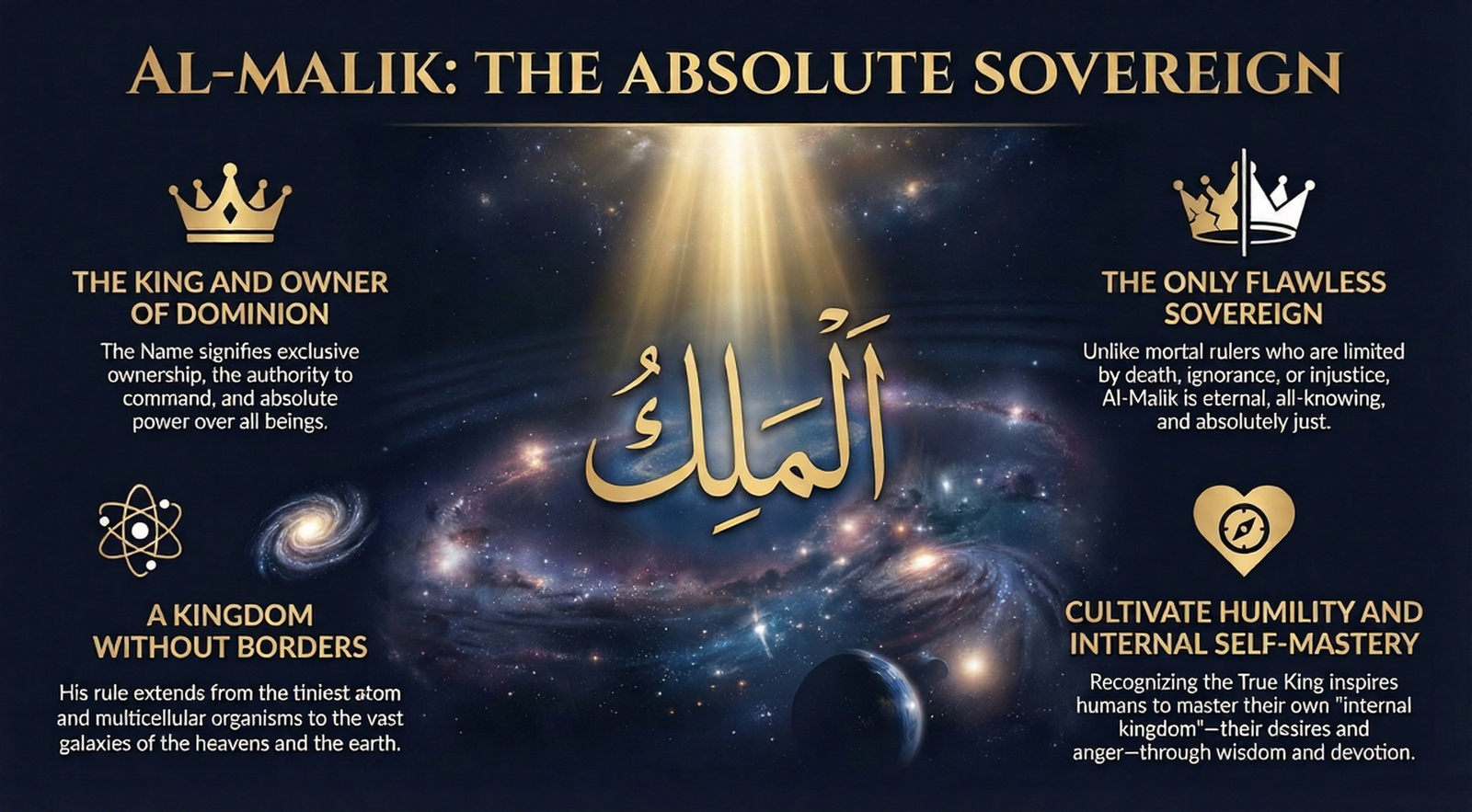
Allah’s Name Al-Malik (ٱلْمَلِكُ) means The Sovereign King, The Absolute Ruler. He is the only Being whose kingdom is endless, whose authority covers all existence, seen and unseen.
Understanding Al-Malik is crucial. It changes how you view power and fear, easing worldly anxiety as you realize your affairs are held by the only true King.
This post is part of our complete guide to the 99 Names of Allah.
What Does Al-Malik Mean?
Al-Malik is written with three Arabic letters: Meem (م), Laam (ل), and Kaaf (ك). In classical calligraphy, particularly the Thuluth script, the name is inscribed with tall, commanding vertical strokes that visually reflect the majesty of a throne room. The Alif-Lam prefix (ٱلْ) marks it as definitive, not just “a king” but The King. The only One who truly deserves the title.
The Arabic Text: ٱلْمَلِكُ
The Name comes from the triliteral Arabic root M-L-K (م ل ك).
This root appears across the Quran in various forms approximately 206 times, which tells you just how central this concept is to the Quranic worldview.
In classical Arabic lexicography, particularly Ibn Manzur’s Lisan al-Arab, the root M-L-K carries the meaning of al-rabt wa al-shadd, the act of tying, binding, and fastening something securely. A true malik (king) is one whose authority holds the affairs of the kingdom together. Without his command, things fall apart.
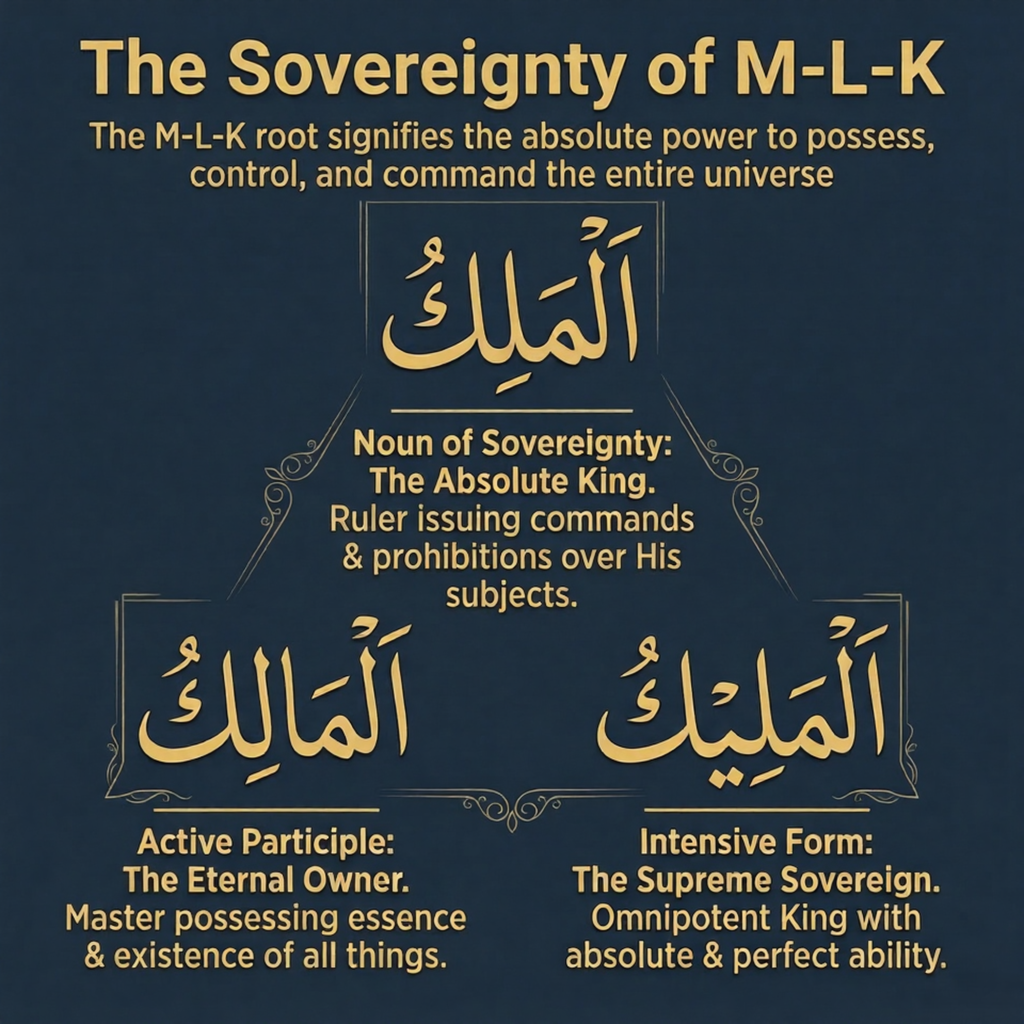
From this one root, Arabic derives three distinct but related terms, each revealing a different dimension of authority:
- Al-Malik (ٱلْمَلِكُ): The King who rules over subjects and issues commands. This is the noun of sovereignty.
- Al-Malik (ٱلْمَالِكُ): The Owner who possesses the very essence of things. This is an active participle.
- Al-Malīk (ٱلْمَلِيكُ): The Intensified Sovereign, whose power is absolute and perfect in its capacity. This is the intensive form.
The difference between a malik and a malik (owner) is profound in Islamic theology. A person can own a house, but they are not its king, because their command over it is limited by natural laws and higher authority. Allah alone is both Owner and King simultaneously. He owns the very fabric of existence, and His command is executed without resistance across every corner of His kingdom.
Mentions of Al-Malik in the Quran and Hadith
Quranic Verse 1: The Sovereign of Purity (Surah Al-Hashr 59:23)
Arabic: هُوَ ٱللَّهُ ٱلَّذِي لَآ إِلَٰهَ إِلَّا هُوَ ٱلْمَلِكُ ٱلْقُدُّوسُ ٱلسَّلَٰمُ ٱلْمُؤْمِنُ ٱلْمُهَيْمِنُ ٱلْعَزِيزُ ٱلْجَبَّارُ ٱلْمُتَكَبِّرُ ۚ سُبْحَٰنَ ٱللَّهِ عَمَّا يُشْرِكُونَ
Transliteration: Huwa Allāhu alladhī lā ilāha illā huwa al-maliku al-quddūsu al-salāmu al-mu’minu al-muhayminu al-ʿazīzu al-jabbāru al-mutakabbir; subḥāna Allāhi ʿammā yushrikūn.
Translation: “He is Allah, other than whom there is no deity, the Sovereign, the Pure, the Perfection, the Bestower of Faith, the Overseer, the Exalted in Might, the Compeller, the Superior. Exalted is Allah above whatever they associate with Him.” (Quran 59:23)
Notice that in this verse, Al-Malik is the first attribute named after the declaration of Tawhid. This is not accidental. The Quran places sovereignty as the primary manifestation of Allah’s presence in the world. Al-Malik is then immediately paired with Al-Quddus (The Holy), reminding the reader that this kingship is completely clear of the greed, corruption, and tyranny we associate with human rulers.
Quranic Verse 2: The King of Truth (Surah Al-Mu’minun 23:116)
Arabic: فَتَعَٰلَى ٱللَّهُ ٱلْمَلِكُ ٱلْحَقُّ ۖ لَآ إِلَٰهَ إِلَّا هُوَ رَبُّ ٱلْعَرْشِ ٱلْكَرِيمِ
Transliteration: Fataʿālā Allāhu al-maliku al-ḥaqqu; lā ilāha illā huwa rabbu al-ʿarshi al-karīm.
Translation: “So exalted is Allah, the Sovereign, the Truth; there is no deity except Him, Lord of the Noble Throne.” (Quran 23:116)
Allah’s sovereignty here is described as Al-Haqq, The Truth, The Reality. Every earthly kingdom is built on temporary consensus, military force, or inherited tradition. All of these are subject to collapse. Allah’s kingship is the only objective and permanent reality in all of existence. When everything else dissolves, His sovereignty remains.
The Hadith: The Day the Only King Stands Revealed
Arabic: «يَقْبِضُ اللَّهُ تَعَالَى الأَرْضَ يَوْمَ الْقِيَامَةِ، وَيَطْوِي السَّمَوَاتِ بِيَمِينِهِ، ثُمَّ يَقُولُ: أَنَا الْمَلِكُ، أَيْنَ مُلُوكُ الأَرْضِ؟»
Transliteration: Yaqbiḍu Allāhu taʿālā al-arḍa yawma al-qiyāmati wa-yaṭwī al-samāwāti bi-yamīnihi thumma yaqūlu: Ana al-Malik, ayna mulūk al-arḍ?
Translation: “Allah will grasp the earth on the Day of Resurrection and fold up the heavens with His Right Hand, then proclaim: ‘I am the King! Where are the kings of the earth?'” (Sahih al-Bukhari 7412, Sahih Muslim 2788)
This Hadith is staggering. Every person who has ever called themselves king, every conqueror who built an empire, every ruler who thought their power was permanent, all of them will stand silent and stripped of everything when Al-Malik makes this proclamation. The contrast could not be sharper or more humbling.
Tafseer Meaning of Al-Malik
Classical scholars spent centuries unpacking Al-Malik because the Name touches the very foundation of Islamic belief. Their insights are more relevant today than ever.
Imam Al-Ghazali: Sovereignty as Complete Self-Sufficiency
In his masterwork Al-Maqsad al-Asna, Imam al-Ghazali makes the case that human kingship is purely metaphorical, a borrowed label that does not reflect true sovereignty. He offers three reasons why.
First, every human king is dependent. He needs subjects for taxes, soldiers for protection, and advisors for knowledge. Allah, as Al-Malik, needs none of this. His dominion would not decrease by even a gnat’s wing if every creature on earth rejected Him.
Second, human authority is limited in scope. A king rules one territory, for a few decades. Allah’s sovereignty covers Al-Mulk (the visible world) and Al-Malakut (the unseen world), without interruption, for eternity.
Third, human rulers cannot control thoughts or hearts. Al-Ghazali calls Allah “the King of hearts”, the One whose authority extends to the internal realities of every being, not just their outward actions.
Ibn Kathir: The Sovereign Who Distributes Authority
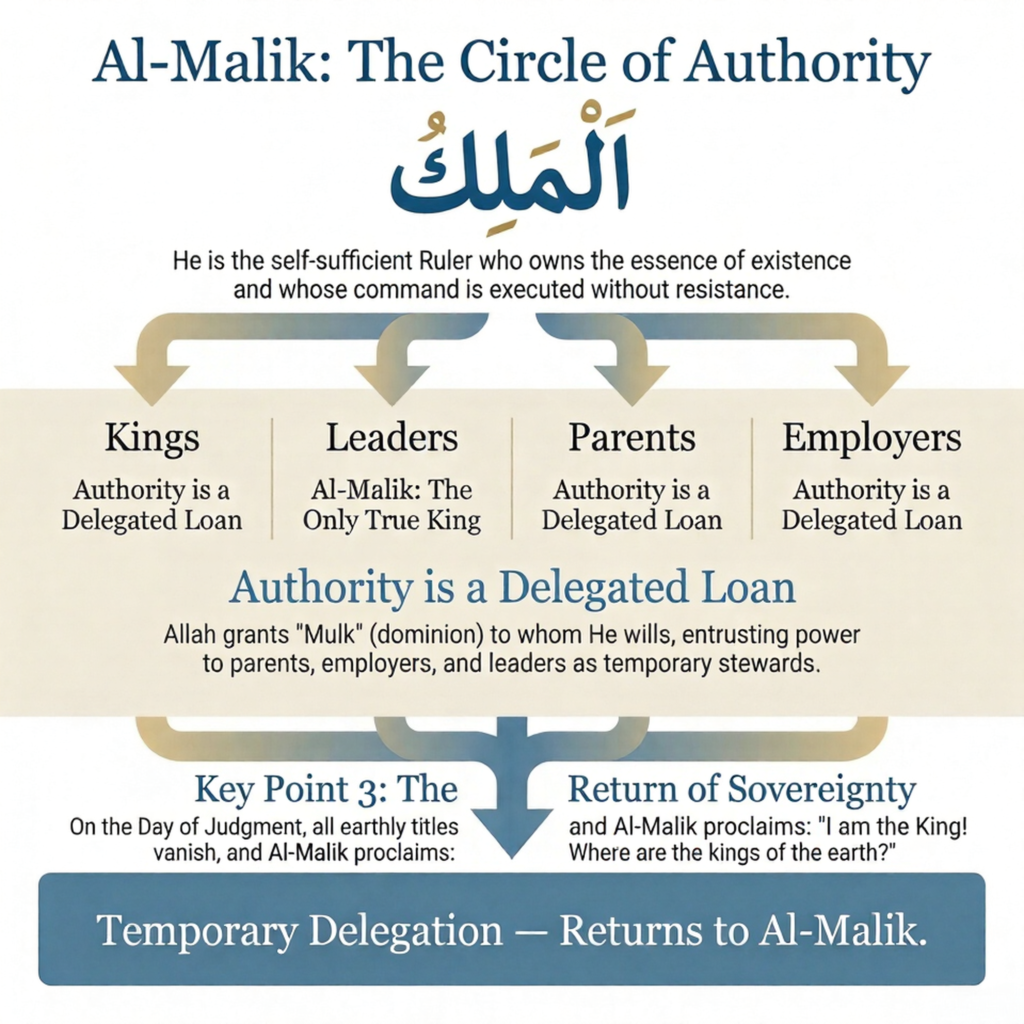
In his Tafseer of Surah Ali Imran (3:26), Ibn Kathir explains that Allah is the source from which all earthly power flows. Any authority a human being holds is a temporary loan. He gives kingdom to whom He wills and withdraws it from whom He wills, based on His Divine Wisdom that we may not always understand in the moment.
This is liberating for the believer. It means no human authority over you is permanent, and no human power is absolute. Every boss, every government, every institution, all are operating on borrowed permission from the only permanent Sovereign.
Sheikh As-Sa’di: The King Whose Power Is Inseparable from Mercy
Sheikh As-Sa’di makes a beautiful observation about the structure of Surah Al-Fatiha. The phrase Maliki Yawm al-Din (Owner of the Day of Judgment) comes directly after Ar-Rahman Ar-Rahim (The Entirely Merciful, The Especially Merciful).
This sequence is intentional and deeply reassuring. You are not meant to meet your King on the Day of Judgment with terror alone. You approach Him knowing that His sovereignty is wrapped in mercy and a genuine desire for the welfare of His subjects. He is a King who loves you and wants to honor you, not one who seeks to crush you.
Duas Using the Name Al-Malik
Dua 1: The Verse of Sovereignty (Quran 3:26)
This Quranic supplication is among the most powerful ever revealed for those seeking dignity, provision, or a way through impossibly difficult circumstances.
Arabic: قُلِ ٱللَّهُمَّ مَٰلِكَ ٱلْمُلْكِ تُؤْتِي ٱلْمُلْكَ مَن تَشَآءُ وَتَنزِعُ ٱلْمُلْكَ مِمَّن تَشَآءُ وَتُعِزُّ مَن تَشَآءُ وَتُذِلُّ مَن تَشَآءُ ۖ بِيَدِكَ ٱلْخَيْرُ ۖ إِنَّكَ عَلَىٰ كُلِّ شَىْءٍۢ قَدِيرٌ
Transliteration: Quli allāhumma mālika al-mulki tu’tī al-mulka man tashā’u wa-tanziʿu al-mulka mimman tashā’u wa-tuʿizzu man tashā’u wa-tudhillu man tashā’u bi-yadika al-khayru innaka ʿalā kulli shay’in qadīr.
Translation: “Say: O Allah, Owner of Sovereignty, You give sovereignty to whom You will and You take sovereignty away from whom You will. You honor whom You will and You humble whom You will. In Your hand is all good. Indeed, You are over all things competent.” (Quran 3:26)
Recite this when you feel powerless, overlooked, or when you are asking for honor and provision in your life.
Dua 2: The Opening of Night Prayer (Tahajjud)
The Prophet ﷺ would begin his night prayer with this acknowledgment of Allah’s Kingship. It is a beautiful way to start any supplication or any early morning.
Arabic: اللَّهُمَّ لَكَ الْحَمْدُ، أَنْتَ نُورُ السَّمَوَاتِ وَالأَرْضِ، وَلَكَ الْحَمْدُ، أَنْتَ مَلِكُ السَّمَوَاتِ وَالأَرْضِ
Transliteration: Allāhumma laka al-ḥamdu, anta nūru al-samāwāti wa-al-arḍ, wa-laka al-ḥamdu, anta maliku al-samāwāti wa-al-arḍ.
Translation: “O Allah! All praise is for You. You are the Light of the Heavens and the Earth. And all praise is for You. You are the King of the Heavens and the Earth.” (Sahih al-Bukhari 1120)
Pair this with the short dhikr the Prophet ﷺ recited after Witr prayer: Subḥāna al-Maliki al-Quddūs, “Glory be to the Sovereign, the Most Holy” (Sunan an-Nasa’i 1699, Sahih). Repeat it three times, elongating the third, as the Prophet ﷺ did.
How to Apply Al-Malik in Your Daily Life
1. Establish Sovereignty Over Yourself
Imam al-Ghazali teaches that your body is a kingdom and your heart is its king. To truly honor the Name Al-Malik, start by ruling your inner world with justice.
Give your intellect the role of trusted advisor. Let reason guide your choices before impulse does. Recognize your anger and desires as forces that must be governed, not suppressed entirely, but channeled and directed with wisdom.
In practice: before reacting to a difficult situation today, pause for three seconds and ask, “Is this a response worthy of a just ruler?” That pause is an act of internal governance. Over time, it reshapes your character.
2. Release the Fear of Worldly Authority
When you genuinely believe that Al-Malik holds all power, the fear of human authority loses its grip on you.
This does not mean becoming reckless or dismissive of your responsibilities. It means you stop losing sleep over things that only Allah can change. A difficult employer, an unfair system, a situation that seems impossible, Al-Malik has the power to overturn all of it in a moment.
In practice: when you feel trapped by a situation, recite the prayer from Quran 3:26 (listed in the Duas section below). Read it slowly, thinking about what each phrase actually means. Let it remind you where real authority sits.
3. Treat Every Role You Hold as a Stewardship
Whether you are a parent, a teacher, a manager, or a community leader, you do not own your authority. You are borrowing it from Al-Malik, and you will be accountable for how you used it.
This shifts the entire posture of leadership. Arrogance becomes difficult to sustain when you remember that your power is a delegation, not a birthright. Justice becomes easier because you know the real King is watching.
In practice: at the start of each day, write down one responsibility you hold, toward your children, your team, your community. Ask yourself: “If Al-Malik reviewed how I handled this yesterday, would I be satisfied with the answer?”
Related Names of Allah
Al-Malik vs. Malik Al-Mulk (Owner of Sovereignty)
These two names sound similar but reveal different dimensions of the same truth.
Al-Malik describes Allah as The King in His very Essence, the Ruler who governs His kingdom and executes His will within it.
Malik Al-Mulk, which appears in Quran 3:26, goes one step further. It means He owns the concept of sovereignty itself. Every human king is borrowing a portion of “mulk” from the only Being who truly owns the capacity to rule. Your employer has authority over you in a workplace setting because Al-Malik allocated a portion of governance to that role. The moment Al-Malik withdraws it, it vanishes.
Al-Malik vs. Al-Qahhar (The Subduer)
Both names relate to Divine dominion, but they emphasize different qualities of power.
Al-Malik is sovereignty based on the right to rule, a majesty that commands loyalty and obedience through wisdom, justice, and divine order.
Al-Qahhar is sovereignty based on irresistible force, the Name that reminds creation that Allah’s will is executed whether His subjects comply willingly or not. Nothing can resist Him.
In short: Al-Malik speaks to the majesty of governance. Al-Qahhar speaks to the invincibility behind it.
How to Teach Al-Malik to Children
Children aged five to ten think in stories and analogies. Abstract theology does not land until it is made concrete and relatable.
The “Super King” Conversation
Start with a question: “Have you ever seen a king or a queen in a story?” Let them tell you about it. Then build from there.
Say: “You know how even the greatest storybook king still has to sleep? And one day he gets old and his palace is left behind? Allah is the Super King who never sleeps. His palace is the whole universe, every star, every ocean, every tiny ant. He doesn’t need anyone to carry His throne or count His gold, but every single thing in the world needs Him to keep working. The sun only rises because Al-Malik says so. Flowers only bloom because Al-Malik allows it.”
Then ask: “If Al-Malik is in charge of everything, do you think He knows about you?” Watch their eyes widen. “He does. And He cares about you more than any king or queen ever cared about their kingdom.”
The Crown of Character Craft Activity
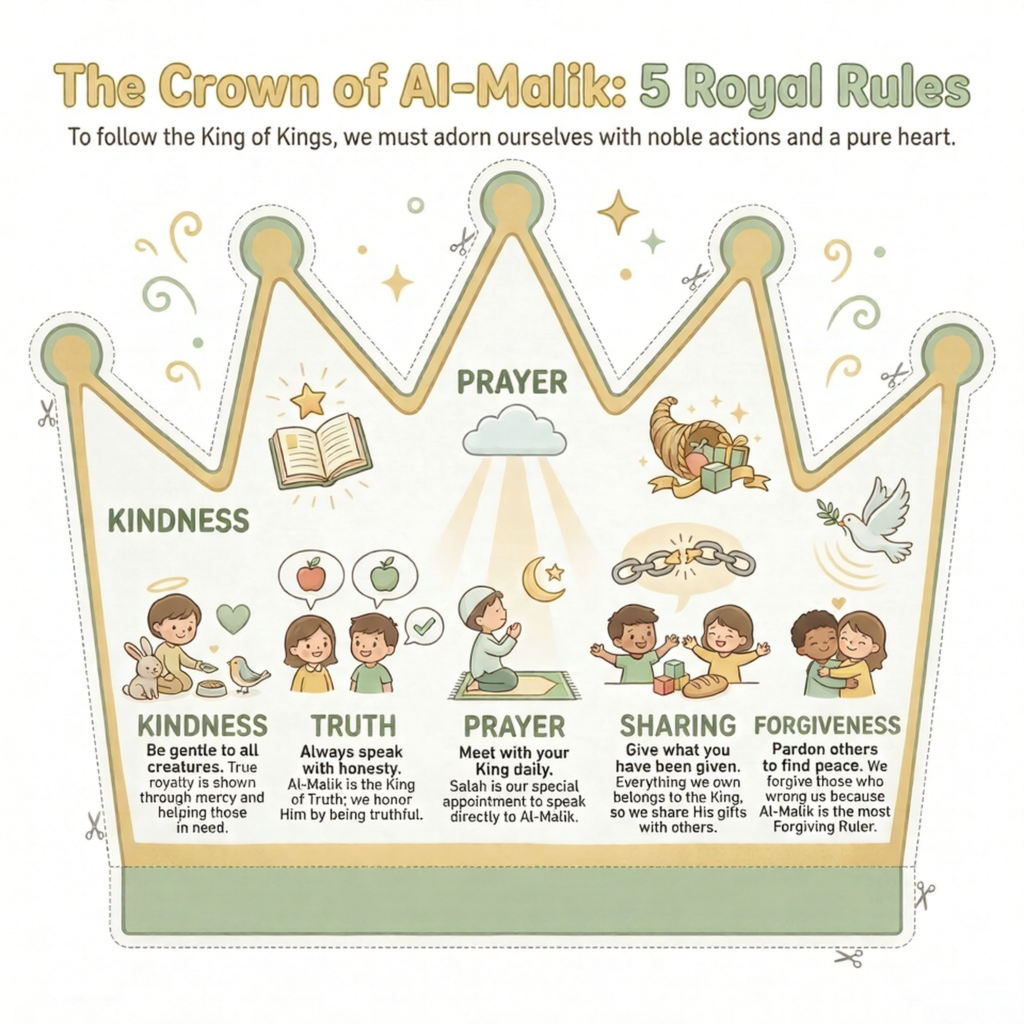
Give your child a piece of cardboard cut into a crown shape. Ask them to decorate each point of the crown with one of Al-Malik’s “royal rules”, being kind, telling the truth, praying, sharing, saying sorry.
Explain: “Al-Malik set these rules not to make your life hard, but because He wants His kingdom to be beautiful. When you follow His rules, you become a little prince or princess in His kingdom.”
This activity gives children a tangible way to connect following good behavior with belonging to something majestic and meaningful.
A Final Thought
Al-Malik (The King) is the true, ultimate anchor in an unstable world where earthly powers fail. Internalizing this Name shifts your security away from fleeting things and fear of humans who lack true authority.
The Prophet ﷺ described the Day of Resurrection, where Allah will ask, “Where are the kings of the earth?” This moment will reveal the undeniable truth: there was always only one King. His kingdom is accessible to you through prayer, justice, surrender, and love.