
For Quran students, poor planning not lack of motivation is the primary barrier to a 7-day Khatm. Many start sessions without clear targets for page counts or duration.
This inconsistency often leads to abandoned goals. This guide provides the necessary daily page targets, Manzil divisions, prophetic evidence, and vocal protection tools for this five-hour daily commitment.
The 7-day Khatm is a 1,400-year-old devotional practice structured by scholars. It remains achievable for any serious reciter using the right method.
What Is a Manzil and Why Is It the Key to a 7-Day Khatm?
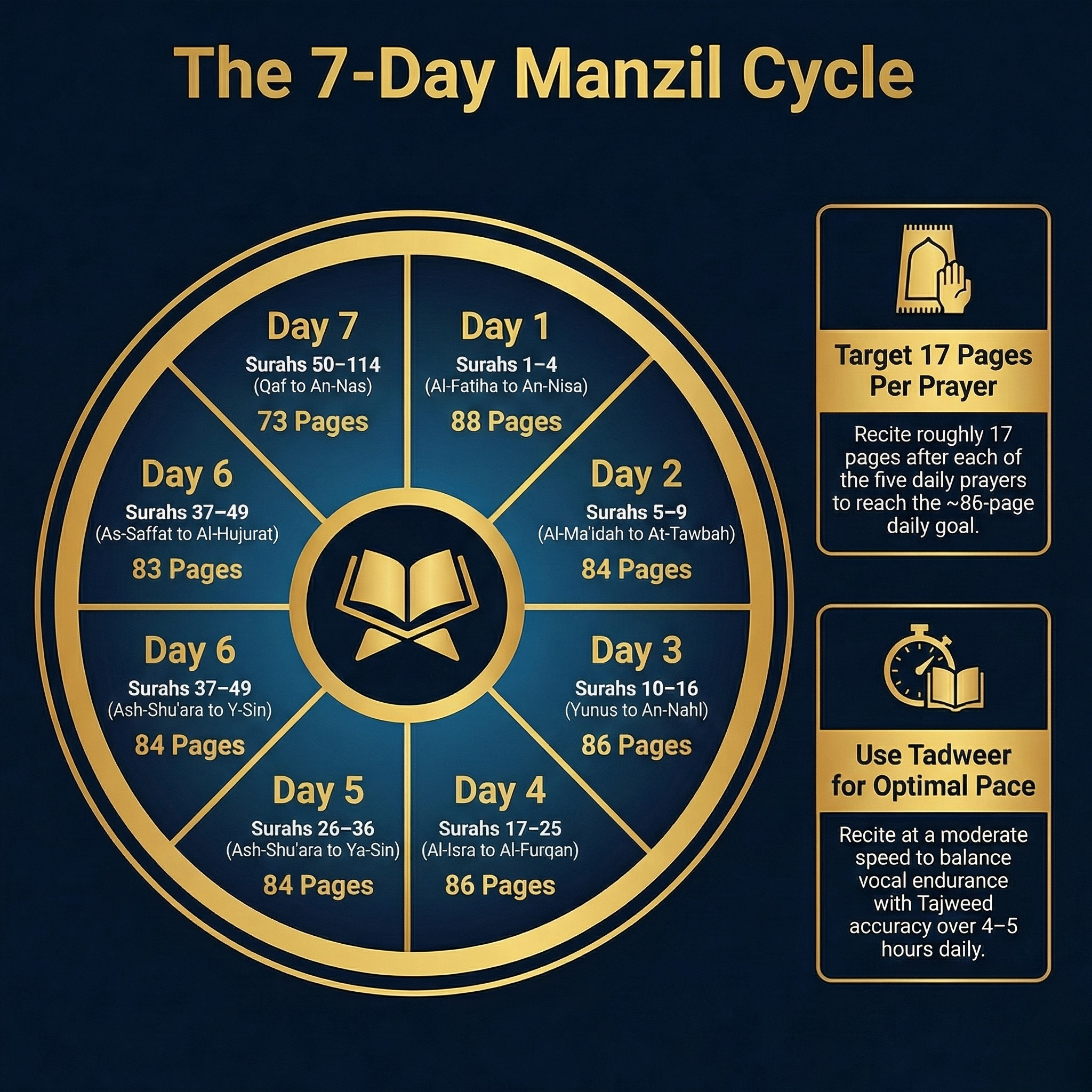
A Manzil is one of seven pre-defined portions of the Quran, each covering roughly 86 pages, designed specifically for weekly completion.
Manzil, meaning “station,” refers to the seven Quranic divisions historically attributed to Hamzah az-Zaiyyat (d. 156 AH). Designed for a weekly completion cycle, it differs from the thirty-part Juz system by focusing on a seven-day cadence rather than a monthly one.
This system serves as a daily compass, providing clear start and end points to eliminate guesswork. To finish the Quran in seven days using the 604-page Madani Mushaf, reciters must complete approximately 86 pages daily, or roughly 17 pages per prayer.
Fluent Arabic reading is a prerequisite for this commitment; those still learning should consult a guide on how to read the Quran first.
How Many Pages Do You Need to Read Each Day to Finish in 7 Days?
To finish the Quran in 7 days using the Madani Mushaf, you need to read approximately 86 pages per day, or about 17 pages per prayer.
The standard global reference is the Madani Mushaf (Medina Script), which contains exactly 604 pages. Dividing 604 by 7 gives a daily target of 86.28 pages.
| Metric | Daily Target |
| Total pages (Madani Mushaf) | 604 pages |
| Pages per day | ~86 pages |
| Pages per prayer (5 prayers) | ~17 pages |
| Juz per day | ~4.3 Juz |
| Verses per day | ~891 verses |
| Estimated daily recitation time | 4 to 5 hours |
Using the Indo-Pak (Nasta’liq) script? That edition spans 850 pages, requiring 121 pages per day to finish in 7 days. The words are identical. Only the layout differs. The Madani script is the more efficient choice for a timed completion goal.
The Complete 7-Day Manzil Schedule (Day by Day Breakdown)
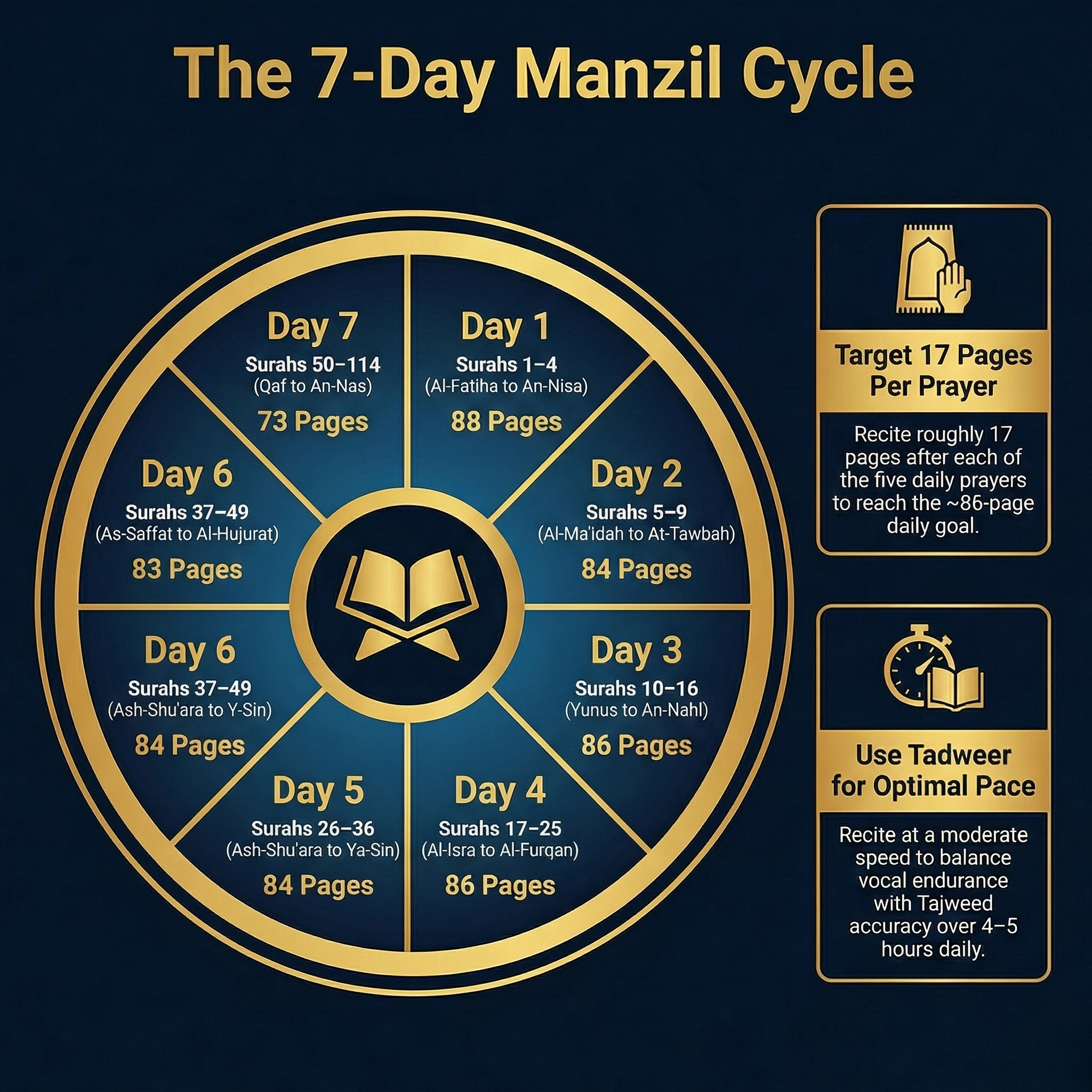
The 7-day Manzil schedule divides the Quran from Al-Fatiha to An-Nas across seven daily portions, each covering specific Surah ranges.
Two classical systems exist for the seven-day division. The most widely followed is the Hamzah az-Zaiyyat system, which groups chapters by approximate length balance. The second is the Sahaba (Companion) system, which groups chapters numerically in the sequence 3-5-7-9-11-13-Mufassal.
The Hamzah az-Zaiyyat System (Recommended)
| Day | Surah Range | Key Themes | Approx. Pages |
| Day 1 | Al-Fatiha (1) to An-Nisa (4) | Foundations of faith, law, and social justice | ~88 pages |
| Day 2 | Al-Ma’idah (5) to At-Tawbah (9) | Covenantal ethics, dietary laws, historical struggles | ~84 pages |
| Day 3 | Yunus (10) to An-Nahl (16) | Prophetic narratives, signs in nature | ~86 pages |
| Day 4 | Al-Isra (17) to Al-Furqan (25) | Spiritual journeys, the nature of revelation | ~86 pages |
| Day 5 | Ash-Shu’ara (26) to Ya-Sin (36) | Poetic majesty, warnings to nations | ~84 pages |
| Day 6 | As-Saffat (37) to Al-Hujurat (49) | Celestial ranks, divine oneness, community etiquette | ~83 pages |
| Day 7 | Qaf (50) to An-Nas (114) | Eschatology, short surahs, protection from evil | ~73 pages |
Day 7 covers the Mufassal — the final section of the Quran characterized by shorter, faster chapters. This natural acceleration makes the last day feel lighter despite covering sixty-five Surahs.
What Did the Prophet Say About Completing the Quran in 7 Days?
The Prophet approved the 7-day completion for Abdullah ibn Amr, saying “complete it in seven days and do not go beyond that” — recorded in Bukhari and Muslim.
Arabic: «اقْرَأِ الْقُرْآنَ فِي سَبْعٍ وَلاَ تَزِدْ عَلَى ذَلِكَ»
Translation: “Read the Quran in seven days, and do not go beyond that.”
Sahih al-Bukhari, No. 5054 | Sahih Muslim, No. 1159
The context of this hadith matters. Abdullah ibn Amr came to the Prophet asking to complete the Quran faster than the Prophet’s initial recommendation of one month. After several exchanges, the Prophet settled on seven days as the minimum sustainable cycle for those with the dedication and capacity.
Arabic: «لَا يَفْقَهُ مَنْ قَرَأَ الْقُرْآنَ فِي أَقَلَّ مِنْ ثَلَاثٍ»
Translation: “No one properly understands who reads the Quran in less than three days.”
Abu Dawud, No. 1394 | Tirmidhi, No. 2949
This second hadith establishes the lower boundary. Scholars classify completing the Quran in less than three days as discouraged (Makrooh) for regular practice, because the speed prevents meaningful reflection. The seven-day cycle sits within the approved range: fast enough to be a meaningful devotional challenge, slow enough to preserve understanding.
What Is the Best Recitation Speed for a 7-Day Completion
Tadweer — the moderate recitation speed — is the most practical choice for a 7-day Khatm, balancing pace with Tajweed accuracy and vocal endurance.
Islamic recitation science defines four distinct speeds, each with its own purpose. Understanding which one serves your 7-day goal protects both your voice and the linguistic integrity of your recitation.
1. Tahqiq: Extremely slow, used for teaching letter articulation and Makhraj (points of origin for each Arabic letter). Not practical for a 7-day goal. To understand how Arabic letters are correctly articulated, read this guide on Arabic alphabet pronunciation.
2. Tarteel: Slow, measured recitation commanded in the Quran (73:4). Ideal for reflection but takes 7 to 9 hours daily for 86 pages. Too slow for a 7-day cycle unless you have no other commitments.
3. Tadweer: Moderate speed. The most common mode for personal daily recitation. Covers one Juz (20 pages) in 45 to 60 minutes. Daily commitment: 4 to 5 hours. This is the recommended default.
4. Hadr: Fast recitation used for review of memorized text. Covers one Juz in 25 to 35 minutes. Daily commitment: 3 to 3.5 hours. Only suitable for those with advanced fluency.
Tadweer is the recommended default. A Hadr-pace recitation across 5+ hours without proper training leads to letter merging, dropped Ghunnah sounds, and vocal strain. These errors are not minor. Scholars describe unchecked speed as producing “babbling” where Arabic letters lose their distinctive characteristics.
The rule is simple: speed must never cause you to swallow a letter or shorten a Madd beyond its permissible minimum.
For a solid grounding in the rules that govern all four recitation speeds, enroll in the Tajweed Course at Rayhaan School.
How to Distribute Your Daily Reading Across the 5 Prayers
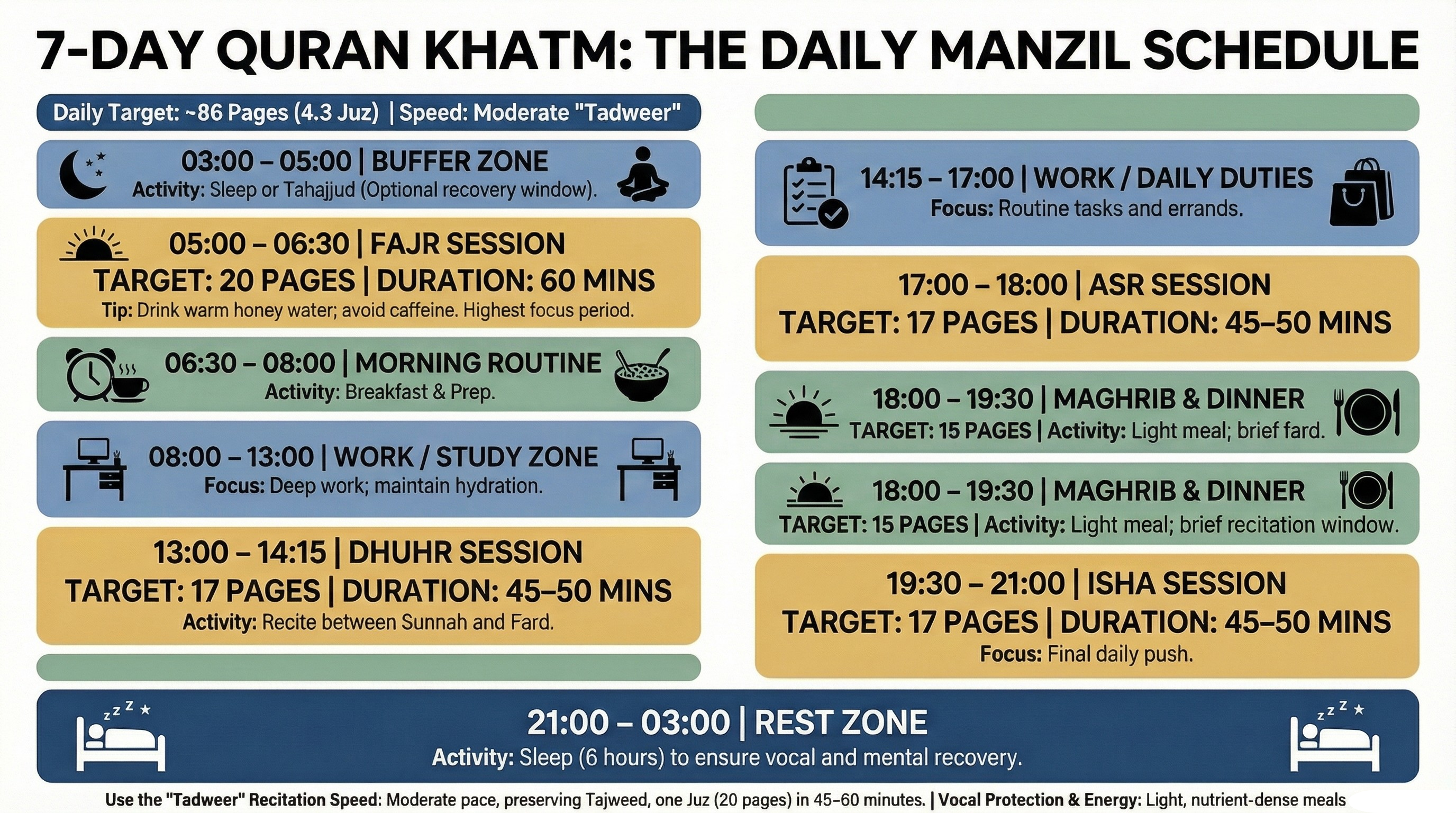
Split 86 daily pages across five prayers: 18 to 20 pages after Fajr, 17 each after Dhuhr and Asr, and 17 each after Maghrib and Isha.
The most sustainable approach to 86 pages per day is anchoring recitation to the five daily prayers. This “habit stacking” method prevents the mental exhaustion of a single long session and distributes vocal load throughout the day.
| Prayer | Pages | Notes |
| Fajr | 20 pages | Best mental clarity of the day |
| Dhuhr | 17 pages | Use time between Sunnah and Fard |
| Asr | 17 pages | Afternoon review session |
| Maghrib | 15 pages | Shorter gap, lighter load |
| Isha | 17 pages | Second peak focus period |
The Fajr session is the most valuable. Pre-dawn recitation benefits from absolute silence, a fresh mental state, and the spiritual significance of the Fajr time, which the Quran itself describes as “witnessed” (Mashhud).
In our experience teaching the weekly Khatm program at Rayhaan School, students who protect their Fajr session complete the week at over 90% success rate. Students who skip it rarely finish.
For those who can wake for Tahajjud around 3:00 AM, the pre-dawn window of silence adds a two-hour bonus session. Use this to extend the Fajr portion or as a recovery buffer for busy weekdays.
What Are the Most Common Mistakes People Make During a 7-Day Khatm
The top mistakes are Tajweed degradation from rushing, skipping the Fajr session, neglecting vocal hydration, and confusing the structural Manzil with the protective Manzil dua.
Mistake 1: Sacrificing Tajweed for Speed
The most damaging error in high-speed recitation is losing the Sifat (characteristics) of Arabic letters. Specifically, the Ghunnah (nasalization) and Madd (elongations) are the first casualties of rushed recitation.
These are not optional stylistic features. They are phonological requirements that distinguish meaning in Arabic. A reciter who consistently merges letters or drops the Ghunnah has not completed a Khatm. They have recited a phonological approximation of the text.
The Hadiths about Tajweed make clear that reciting without proper pronunciation is a matter of serious concern in Islamic scholarship — not merely an aesthetic preference.
For a full breakdown of the rules you must maintain even at speed, this Tajweed guide for beginners covers all 17 core Tajweed rules with examples.
Mistake 2: Confusing the Two Meanings of “Manzil”
Important distinction: The “Manzil” for weekly Quran completion (7 structural portions) is completely different from the “Manzil Dua” — a compilation of 33 protective verses recited for spiritual protection from the evil eye and harm. These are two separate concepts sharing the same name.
Mistake 3: Neglecting Familial and Work Duties
Classical scholarship is clear on this point. The Quran should be a source of life, not a reason to neglect life’s essential duties. If the seven-day cycle causes irritability with family members or consistent absence from work responsibilities, the wiser choice is to return to the monthly Juz cycle and build up gradually.
Mistake 4: Silent Eye-Reading and Calling It Recitation
In Islamic jurisprudence, reading the Quran with the eyes alone is classified as contemplation, not recitation (Tilawah). For the recitation to count as a Khatm, the tongue and lips must move and the sound must be audible at minimum to the reciter themselves.
This is not a technicality. It reflects the oral nature of the Quranic tradition, which has always been transmitted through voice.
Does Listening to the Quran Count as a Khatm
No. Listening to a Quran recitation or reading a translation does not jurisprudentially constitute a Khatm. A Khatm requires vocalized recitation of the Arabic text.
Listening to a recitation carries its own significant reward and is highly encouraged as a devotional practice. Reading a translation deepens understanding and is a valuable act of engagement with the text.
Neither activity, by the consensus of Islamic scholars, fulfills the technical definition of a Khatm. The completion must be achieved through the vocalization of the Arabic text, letter by letter, in sequence from Al-Fatiha to An-Nas.
How to Protect Your Voice During 5 Hours of Daily Recitation
Protect your voice by drinking warm water with honey, using diaphragmatic breathing, avoiding caffeine, and warming up the larynx before the Fajr session.
Five hours of daily recitation puts measurable stress on the vocal folds. Without proper care, dryness and inflammation develop by Day 3 or 4, causing hoarseness and forcing reciters to either stop or continue with degraded sound quality.
- Warm water with honey: Drink a cup before the Fajr session. Honey has natural anti-inflammatory properties that coat and protect the vocal folds. This is the standard practice among Huffaz and professional reciters worldwide.
- Diaphragmatic breathing: Recite from the core, not the throat. Deep abdominal breathing allows for longer Madd elongations without straining the larynx. If the throat feels tight after a long verse, the breathing technique needs correction.
- Vocal warm-up before Fajr: Spend two minutes on gentle humming or a slow siren exercise before the session begins. This increases blood flow to the laryngeal mechanism and prevents cold-start strain.
- Avoid caffeine and spicy foods: Caffeine dehydrates the vocal folds. Spicy food can cause acid reflux that irritates the larynx. Both lead to hoarseness within 24 to 48 hours of sustained recitation.
- Light, nutrient-dense meals: Heavy digestion diverts blood from the brain, causing mental fog during recitation. Soups, fruits, and light proteins keep the mind alert across long sessions.
Ergonomics matter too. Hold the Mushaf at chest level or use a wooden stand (Rehal). Looking down at a floor-level book compresses the diaphragm and throat. Sit against a wall or pillar for back support to prevent the slouching that forces shallow breathing.
What Tools and Apps Help You Track a 7-Day Completion
Apps like Tarteel AI, IqraPlan, and Muslim Pro offer 7-day Khatm tracking modes with streak management, AI error correction, and customizable daily page targets.
Digital tools have changed how modern reciters manage their weekly Khatm. Three stand out:
- Rayhaan Quran AI: Uses voice recognition to identify mistakes in real-time. Functions as a digital teacher for reciters who do not have access to a live tutor during their 7-day retreat.
- IqraPlan: Offers a “Strict Mode” for disciplined daily scheduling and a “Habit Mode” for streak tracking. Sends push notifications when the daily target is unmet.
- Muslim Pro: Includes a Quran completion tracker that can be customized to an 18-page-per-session rule for 7-day reciters.
The physical Mushaf retains clear advantages for long sessions. Paper causes significantly less eye strain than a backlit screen across four to five hours of reading. The 16-line Madani edition is particularly preferred because verses frequently end at the page edge, reducing mid-verse page turns.
How Is the 7-Day Manzil System Different from the 30-Day Juz System
The 30-day Juz system requires 20 minutes per prayer and suits busy adults. The 7-day Manzil system requires 60 to 80 minutes per prayer and suits dedicated students or those in spiritual retreat.
| Feature | 30-Day Juz System | 7-Day Manzil System |
| Daily volume | 1 Juz (20 pages) | 4.3 Juz (86 pages) |
| Time per prayer | 15 to 20 minutes | 60 to 80 minutes |
| Total daily time | ~1 hour | 4 to 5 hours |
| Target user | Working professionals | Students, Huffaz, retreat |
| Vocal strain | Low | High (requires active care) |
| Prophetic endorsement | Recommended baseline | Approved for those with capacity |
The 7-day cycle is not superior to the 30-day cycle. It is a different mode of engagement for a different season of life. The last ten nights of Ramadan, a period of spiritual retreat, or a dedicated week of leave are natural contexts for it.
For students who memorize the Quran — Huffaz — the weekly Manzil cycle doubles as a memorization revision tool, keeping all thirty Juz fresh in active memory. Explore the structured Hifz Program at Rayhaan School if you want to combine memorization with systematic revision.
For those interested in going deeper than completion into understanding meaning, the Tafsir Course for Adults develops the Tadabbur (reflection) capacity that the Prophet described as the purpose of Quranic engagement.
Conclusion
The seven-day Khatm is a synthesis of mathematical precision and spiritual endurance. The Manzil system gives structure. The five-prayer distribution makes it sustainable. Vocal care makes it repeatable.
Speed is the mechanism. Tajweed is the prerequisite. Tadabbur — reflection — is the actual destination.
By cycling through the Quran’s foundational laws on Day 1, its prophetic narratives on Days 3 to 5, and its eschatological warnings on Day 7, the entire divine message stays active in the mind and heart throughout the week. That is the design of the Manzil system.
Not a race through 604 pages. A structured inhabitation of the Quranic worldview, seven days at a time.
Start with one week. Protect the Fajr session. Drink your honey water. And trust the system that scholars have used for fourteen centuries.