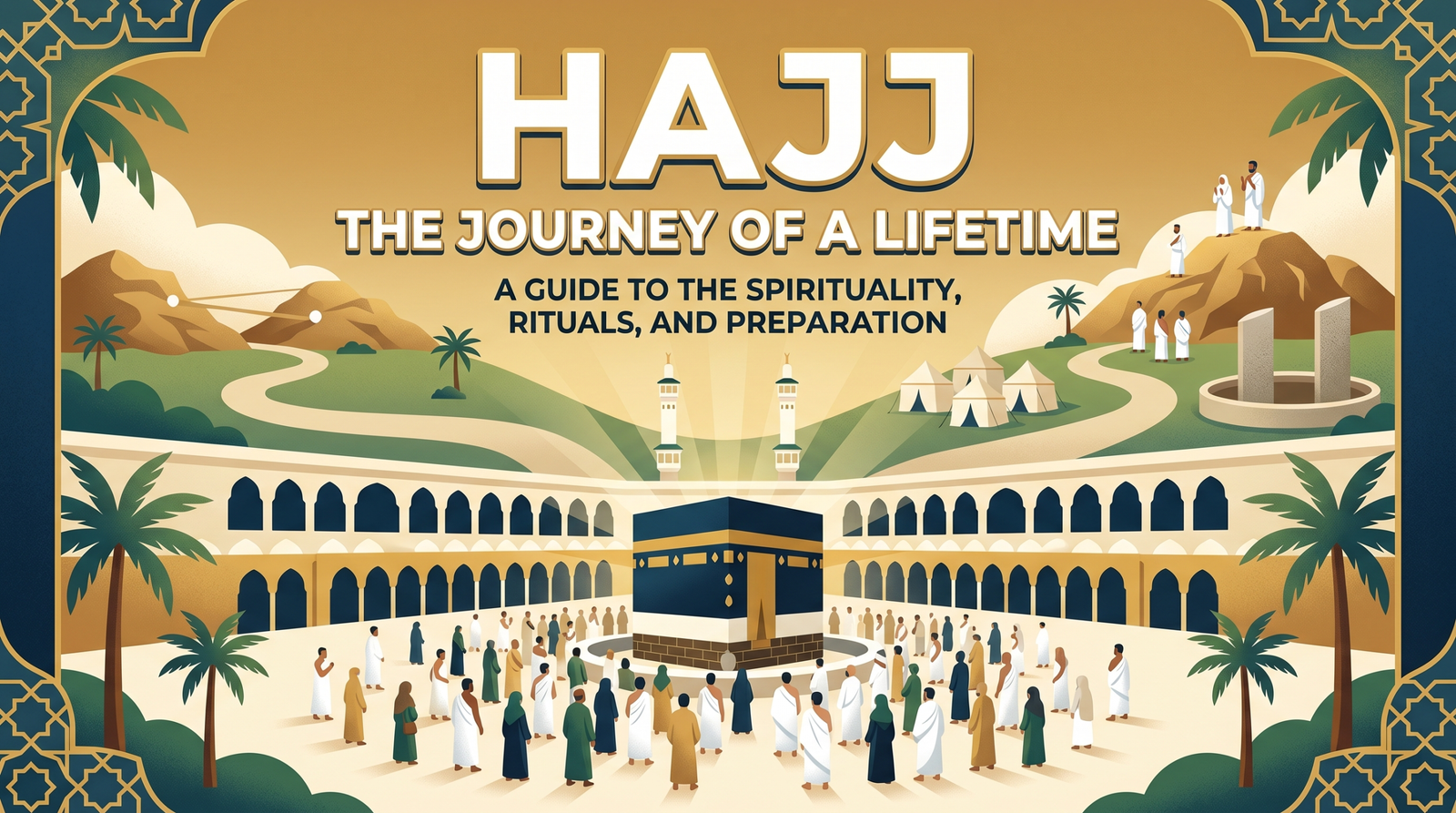
Standing at the plain of Arafat surrounded by 1.83 million people, all dressed in identical white cloth, all facing one direction , that image alone answers a lot about what Hajj is.
No other gathering on Earth looks like this. No other annual event brings together people from 171 countries, speaking dozens of languages, united by a single purpose: submission to God.
Hajj is not simply a trip. It is a complete spiritual transformation, a physical challenge, and a living act of faith , all compressed into five unforgettable days.
This guide covers everything you need to know about Hajj. You will learn its definition, its Abrahamic roots, who must perform it, the rituals in order, and how to prepare for it properly. At Rayhaan School, we have seen students go from knowing almost nothing about Hajj to understanding it deeply enough to teach others , and this article is designed to do the same for you.
What is the Hajj?
Hajj is the fifth pillar of Islam. It is a mandatory pilgrimage to Makkah that every capable adult Muslim must perform at least once in their lifetime.
The word “Hajj” comes from an Arabic root meaning “to intend a journey toward a place of greatness.” In formal Islamic law (fiqh), Hajj refers to a specific set of rituals performed in and around Makkah, Saudi Arabia, during the first ten days of Dhu al-Hijjah , the final month of the Islamic lunar calendar.
Allah commanded Hajj in the Quran directly:
“وَلِلَّهِ عَلَى النَّاسِ حِجُّ الْبَيْتِ مَنِ اسْتَطَاعَ إِلَيْهِ سَبِيلًا” “And pilgrimage to the House is a duty owed to Allah by all who can make their way there.” (Surah Al-Imran 3:97)
Unlike Salah (prayer) or Sawm (fasting), which happen daily or annually, Hajj is a once-in-a-lifetime obligation. A person who fulfills it correctly earns a complete reset of their spiritual record.
The Prophet Muhammad (peace be upon him) confirmed this in a hadith recorded by Bukhari and Muslim:
“مَنْ حَجَّ فَلَمْ يَرْفُثْ وَلَمْ يَفْسُقْ رَجَعَ كَيَوْمِ وَلَدَتْهُ أُمُّهُ” “Whoever performs Hajj and does not commit any obscenity or transgression will return as pure as the day his mother gave birth to him.” (Bukhari, Muslim)
That is the weight of Hajj. It is a spiritual rebirth , built into the very structure of Islam.
Why Does Hajj Exist? The Abrahamic Roots
Hajj commemorates the trials of Prophet Ibrahim, his wife Hajar, and their son Ismail. Every Hajj ritual traces back to their story of faith and sacrifice.
Hajj is not a modern invention. Scholars trace its origins back thousands of years to the time of Prophet Ibrahim (Abraham). The story is direct: Ibrahim was commanded to leave Hajar and the infant Ismail in the barren valley of Makkah. With no water and no people around them, Hajar ran frantically between two hills, Safa and Marwah, searching for help. Water miraculously appeared at Ismail’s feet from the spring now known as Zamzam.
Every time a pilgrim walks between Safa and Marwah today, they reenact her search. Not as a ritual detached from meaning, but as a lived reminder that desperation, trust in God, and perseverance lead to provision.
Years later, Ibrahim was commanded to build the Kaaba , the cubic structure at the center of the Grand Mosque , as a house of worship for the one God. He was then commanded to call all of humanity to pilgrimage.
The Quran records this call:
“وَأَذِّن فِي النَّاسِ بِالْحَجِّ يَأْتُوكَ رِجَالًا وَعَلَى كُلِّ ضَامِرٍ” “And proclaim the pilgrimage among men. They will come to you on foot and on every lean camel.” (Surah Al-Hajj 22:27)
Muslims believe that call is still being answered. Every year, millions respond to it.
The Prophet Muhammad (peace be upon him) performed Hajj once in his lifetime, in the year 10 AH (632 CE). This is known as the Farewell Pilgrimage (Hajjat al-Wada). During this pilgrimage, he delivered his famous Farewell Sermon and demonstrated the final, correct form of each ritual. Everything pilgrims do today is traced back to that demonstration.
Who Must Perform Hajj? Understanding Istita’ah
Hajj is obligatory for every adult Muslim who is physically healthy, financially able, and can safely make the journey. This condition is called Istita’ah.
The scholars of all four major legal schools agree on five core conditions that make Hajj obligatory:
- Islam: The person must be Muslim.
- Adulthood (Bulugh): The person must have reached puberty.
- Sanity (Aql): The person must be of sound mind.
- Physical ability: The person must be healthy enough to complete the journey.
- Financial ability: The person must be able to cover all costs without incurring debt, and must be able to provide for their dependents while away.
In the modern era, a sixth condition effectively applies: a valid Hajj permit from the Saudi government. The Kingdom manages capacity through a quota system , roughly one pilgrim per 1,000 Muslims in a given country. Performing Hajj without a registered permit can lead to immediate deportation, a fine, and a 10-year entry ban.
A common myth to address: many Muslims believe they should delay Hajj until old age, hoping to arrive with a “clean slate” before death. Islamic scholars consistently reject this reasoning. The obligation arises as soon as the criteria are met. Delaying without cause is itself a religious deficiency.
For those who are permanently ill or have passed away without performing Hajj, Islamic law permits Badal Hajj , a proxy pilgrimage. A qualified individual who has already completed their own Hajj can perform it on someone else’s behalf. The intention must explicitly name the person being represented.
What Are the Three Types of Hajj?
There are three valid forms of Hajj: Tamattu’ (most common for international pilgrims), Qiran (one continuous Ihram), and Ifrad (Hajj only, no Umrah).
The Prophet established three distinct modes, offering flexibility based on a pilgrim’s origin and circumstances.
1. Hajj al-Tamattu’
This is the most popular form for international pilgrims, and the one that Islamic scholars most commonly recommend for travelers from outside Saudi Arabia.
The pilgrim performs Umrah first, exits the state of Ihram, and rests. Then, on the 8th of Dhu al-Hijjah, they re-enter Ihram specifically for Hajj. The break allows the body to recover before the most demanding five days begin.
An animal sacrifice is mandatory at the end.
2. Hajj al-Qiran
The pilgrim enters a single state of Ihram and maintains it for both Umrah and Hajj, without any break. This is the most physically demanding mode and is considered superior in the Hanafi legal school.
An animal sacrifice is also mandatory here.
3. Hajj al-Ifrad
The pilgrim performs Hajj only, with no Umrah attached. This is the preferred mode for residents of Makkah or those who live within the Miqat boundaries. The Shafi’i and Maliki schools consider this form to be the most meritorious because it singles out Hajj with full focus.
No obligatory sacrifice is required for Ifrad.
What Are the Hajj Rituals? A Day-by-Day Guide
Hajj spans five core days (8th to 12th Dhu al-Hijjah) and consists of specific acts that must be performed in sequence. Missing the key ritual of Arafat invalidates the entire pilgrimage.
Here is the full sequence, as established by the Prophet’s Farewell Pilgrimage.
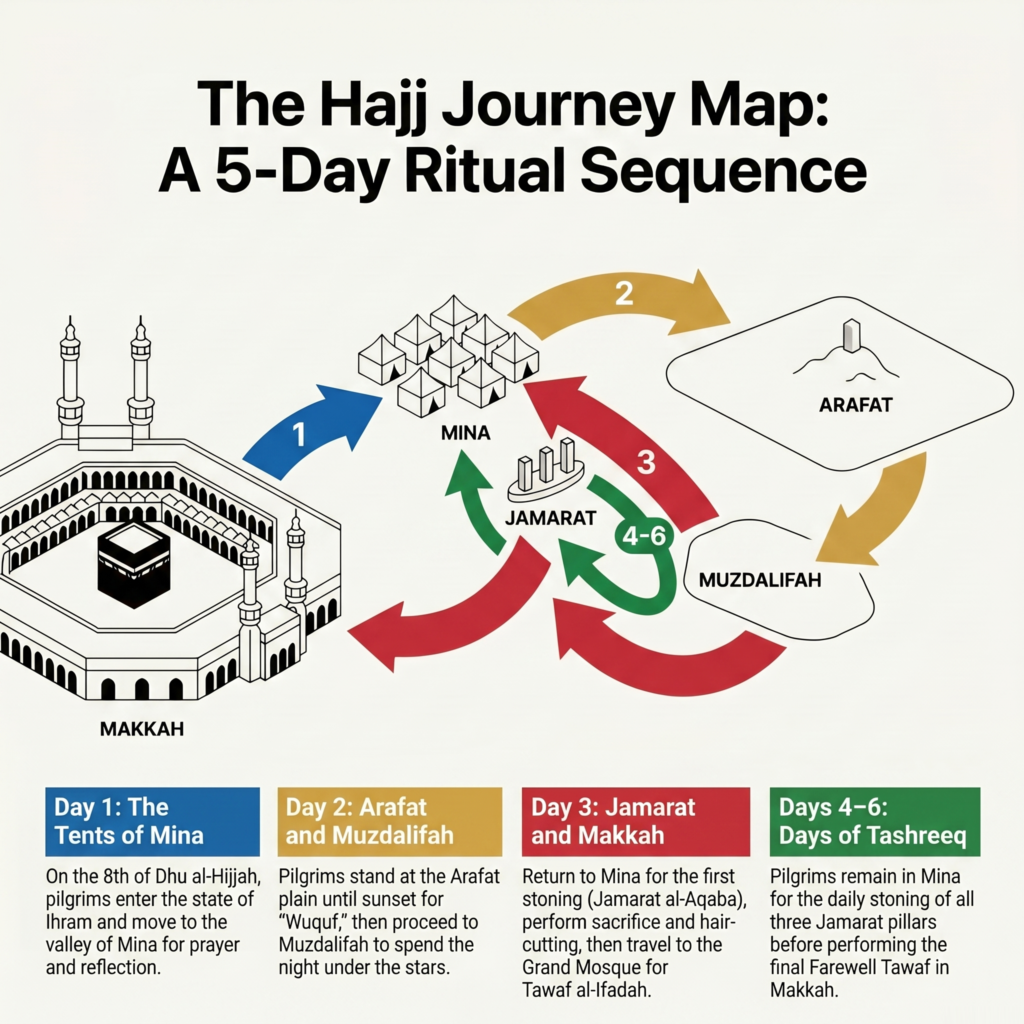
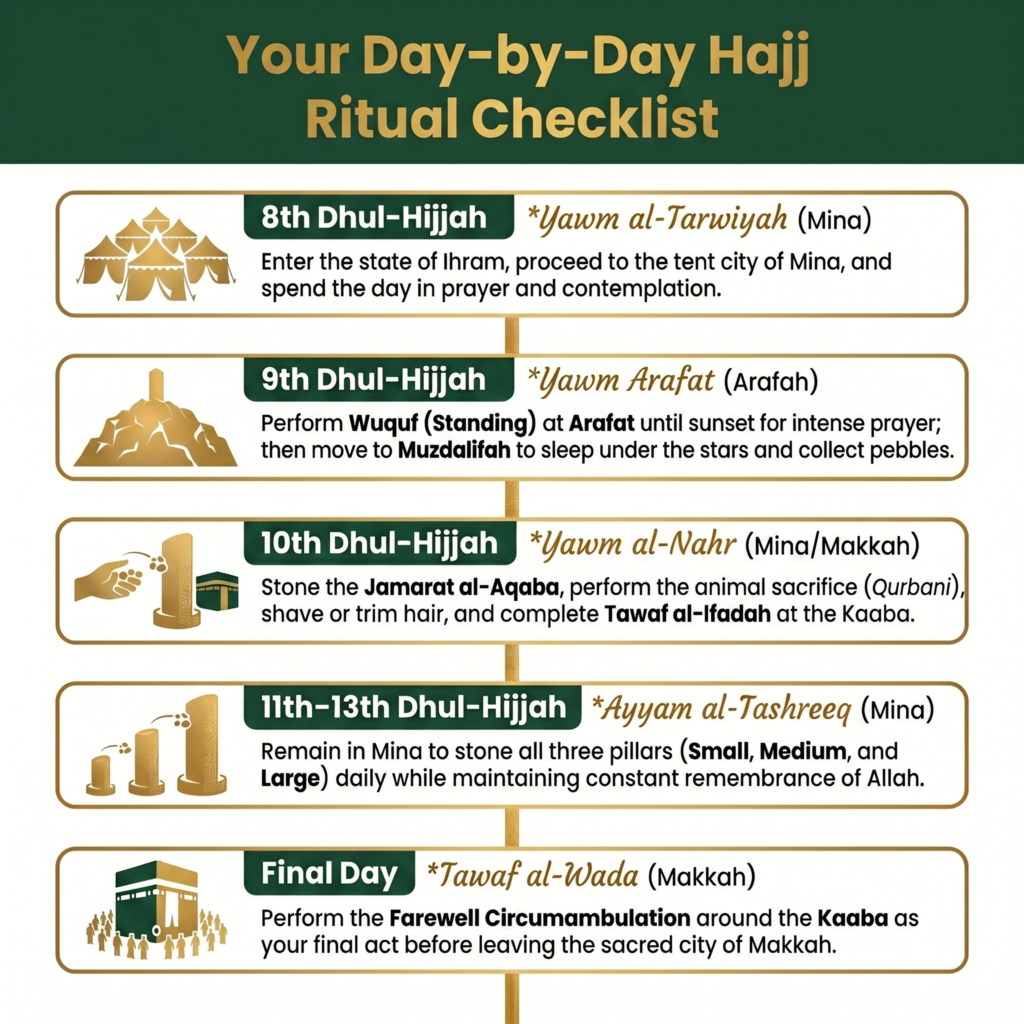
Day 1: The 8th of Dhu al-Hijjah (Yawm al-Tarwiyah)
The pilgrim enters the state of Ihram. For men, this means wearing two white, unstitched sheets. For women, it means modest, non-ornamental clothing with the face and hands left uncovered.
Before entering Ihram, the pilgrim performs a ritual bath (Ghusl), cuts nails, and removes scented products. The moment the intention (Niyyah) is declared, the pilgrim begins reciting the Talbiyah:
“لَبَّيْكَ اللَّهُمَّ لَبَّيْكَ، لَبَّيْكَ لَا شَرِيكَ لَكَ لَبَّيْكَ، إِنَّ الْحَمْدَ وَالنِّعْمَةَ لَكَ وَالْمُلْكَ، لَا شَرِيكَ لَكَ” “Here I am, O Allah, here I am. Here I am, You have no partner, here I am. Verily all praise, grace, and sovereignty belong to You. You have no partner.”
This chant is repeated continuously. It is a declaration of presence before God , a verbal surrender of identity and status.
Pilgrims travel to Mina, a tent city east of Makkah. They spend the day and night there, performing the five daily prayers in shortened form (Qasr) but not combined.
Day 2: The 9th of Dhu al-Hijjah (Yawm Arafat)
This is the most important day of the entire pilgrimage.
After sunrise, pilgrims move from Mina to the plain of Arafat, approximately 20 kilometers east of Makkah. From midday (Dhuhr) until sunset, they perform Wuquf , the standing. They pray, supplicate, weep, and remember God.
The Prophet said:
“الْحَجُّ عَرَفَةُ” “Hajj is Arafat.” (Tirmidhi, Ibn Majah)
Missing the standing at Arafat is not a minor error. Missing it entirely means the Hajj is invalid. It cannot be compensated for by any sacrifice or act of worship.
After sunset, pilgrims move to Muzdalifah, an open plain between Arafat and Mina. Here they combine the Maghrib and Isha prayers, sleep under the open sky, and collect small pebbles for the following day’s stoning ritual.
Day 3: The 10th of Dhu al-Hijjah (Yawm al-Nahr)
The three major acts of this day occur in sequence:
1. Stoning (Ramy al-Jamarat): Pilgrims return to Mina and throw seven small pebbles at the largest pillar, Jamrat al-Aqaba. Each pebble is thrown one at a time with the words “Allahu Akbar.” This act symbolizes the rejection of the devil’s whispers , mirroring Ibrahim’s rejection of Shaytan when commanded to sacrifice his son.
2. Animal Sacrifice (Qurbani/Hady): An animal is slaughtered in commemoration of Ibrahim’s willingness to sacrifice Ismail. This is mandatory for Tamattu’ and Qiran pilgrims. Today, most pilgrims authorize this digitally through the Nusuk platform.
3. Shaving or Trimming Hair (Halq or Taqsir): Men shave the entire head or trim it short. Women cut a small portion (fingertip length) from their hair. This act marks the First Release (Tahallul Awwal) , most Ihram restrictions are lifted.
After these three acts, pilgrims travel to the Grand Mosque in Makkah for:
4. Tawaf al-Ifadah: Circumambulating the Kaaba seven times, counter-clockwise, beginning and ending at the Hajar al-Aswad (Black Stone). This is one of the obligatory pillars of Hajj.
5. Sa’i: Walking or running seven times between the hills of Safa and Marwah, commemorating Hajar’s search for water.
Days 4 to 6: The 11th to 13th (Ayyam al-Tashreeq)
Pilgrims return to Mina and spend the night there. On each of these days, they stone all three Jamarat pillars (small, medium, and large) with seven pebbles each, in that order.
A pilgrim may leave Mina after the stoning on the 12th , this is the early departure (Nafr Awwal). Staying until the 13th earns greater spiritual reward.
Final Act: Tawaf al-Wada (The Farewell Tawaf)
Before leaving Makkah to return home, every pilgrim performs one final circumambulation of the Kaaba. This is the formal farewell to the Sacred House.
Scholars consider this obligatory. Leaving Makkah without it requires a Damm (sacrifice) as compensation, unless the pilgrim is menstruating, in which case they are excused.
What Are the Key Hajj Terms You Need to Know?
Hajj has its own vocabulary. Knowing these terms before arriving prevents confusion and helps you follow guidance from scholars and group leaders on the ground.
Here is a clean reference:
- Ihram: The sacred state of consecration entered before Hajj or Umrah. It applies to both men and women, though their dress requirements differ.
- Miqat: Geographic stations where pilgrims must enter Ihram before proceeding to Makkah. There are five major Miqats. Crossing one without Ihram requires a Damm penalty.
- Tawaf: Circumambulating the Kaaba seven times counter-clockwise. It reflects the believer’s centering of life around God.
- Sa’i: The seven-circuit walk between Safa and Marwah, commemorating Hajar’s desperate search for water.
- Wuquf: The “standing” at Arafat on the 9th of Dhu al-Hijjah. The single most essential ritual of Hajj.
- Jamarat: Three stone pillars in Mina representing the devil. Pilgrims stone them to symbolize the rejection of temptation.
- Talbiyah: The chant of submission recited from the moment of Ihram.
- Hajar al-Aswad: The Black Stone set into the eastern corner of the Kaaba. It marks the starting and ending point of each Tawaf circuit. Touching or kissing it is a Sunnah , pointing from a distance is a fully valid and safer alternative in large crowds.
- Damm: A penalty , typically the slaughter of a sheep , required when a mandatory ritual is omitted or an Ihram prohibition is violated.
What is the Difference Between Hajj and Umrah?
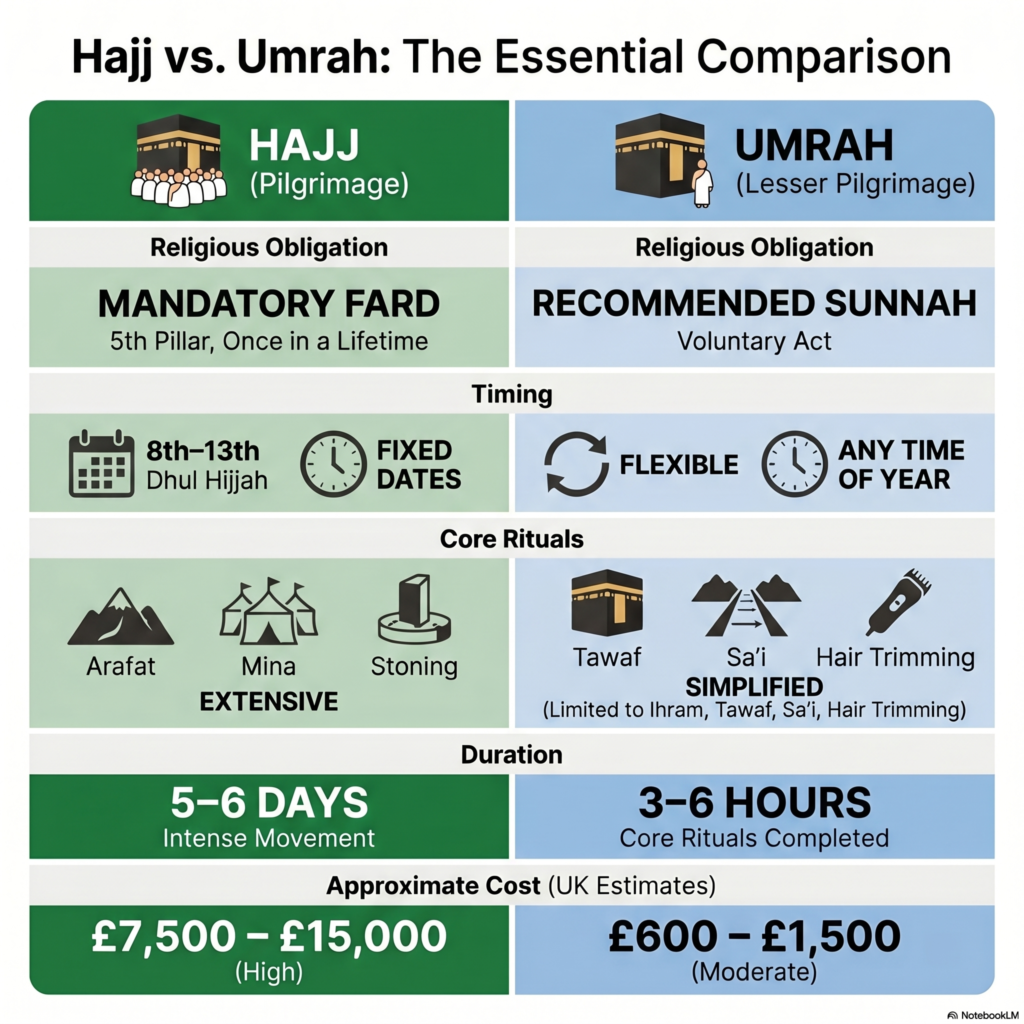
Hajj is a mandatory pilgrimage with fixed dates and over a dozen specific rituals. Umrah is a voluntary, shorter pilgrimage that can be performed at any time of year.
The two share some rituals , Ihram, Tawaf, Sa’i, and hair trimming , but Hajj includes Arafat, Muzdalifah, Mina, and the Jamarat stoning. Those additional rites make Hajj dramatically more demanding in time, cost, and physical effort.
A key misconception: performing Umrah multiple times does not substitute for Hajj. Many Muslims perform Umrah annually, sometimes during Ramadan when the Prophet indicated its reward approaches that of Hajj. The reward is real. The obligation remains separate.
| Feature | Hajj | Umrah |
| Pillar of Islam | Yes (5th Pillar) | No |
| Obligation | Mandatory (once) | Voluntary |
| Timing | Fixed (Dhu al-Hijjah) | Year-round |
| Duration | 5 to 6 days | 3 to 6 hours |
| Cost (approximate) | £7,500 to £15,000 | £600 to £1,500 |
| Includes Arafat | Yes | No |
What Are the Most Common Hajj Mistakes?
The most frequent Hajj violations include entering Ihram after crossing the Miqat, using scented products in Ihram, and misunderstanding the correct way to stone the Jamarat.
Here are the mistakes scholars and experienced guides consistently flag:
- Crossing the Miqat without Ihram: Many international pilgrims land in Jeddah, then put on their Ihram garments. The Miqat boundary, however, is typically crossed while the plane is still in the air. Scholars from all schools agree: this is a violation requiring a Damm penalty. The solution is simple , wear the Ihram before boarding, and make the intention when the pilot announces the Miqat boundary is approaching.
- Using scented products in Ihram: Scented soap, deodorant, and perfumed sunscreen are all prohibited while in Ihram. Even inadvertent use requires expiation. Pilgrims should switch to unscented versions of all toiletries before entering the sacred state.
- Throwing incorrect objects at the Jamarat: The Sunnah is to throw seven small pebbles, one at a time, while saying “Allahu Akbar” with each throw. Some pilgrims throw large rocks, shoes, or multiple pebbles at once. None of these are valid, and they cause safety hazards for the two million people at the site.
- Pushing to touch the Black Stone: Kissing or touching the Hajar al-Aswad is a Sunnah , a recommended act, not an obligation. Pushing, shoving, or injuring another Muslim to reach it is a sin. Pointing toward it from a distance fulfills the Sunnah.
- Misunderstanding women’s Ihram: A common myth is that women must wear white or black. In reality, any modest clothing is acceptable. The face and hands remain uncovered in the Ihram state.
- Excessive phone use: Scholars increasingly warn about digital distraction during Hajj. Documenting every moment for social media weakens the spiritual focus (Khushu) that makes the pilgrimage meaningful. Some scholars classify it as a spiritual violation of the spirit of Ihram, even if it is not a juridical one.
How Has Hajj Changed in the Modern Era?
Modern Hajj blends 1,400 years of tradition with AI-powered crowd management, digital visas, and billion-dollar infrastructure , all aimed at safely hosting up to 5 million pilgrims by 2030.
The numbers from the 2024 season illustrate the scale: 1.83 million pilgrims, 171 countries represented, 47.7% female pilgrims. The Saudi Ministry of Hajj managed this through a combination of technology and diplomacy that would have been unimaginable even two decades ago.
The Nusuk Platform is the official digital gateway for all international pilgrims. Through it, a pilgrim can register, upload documents, select a package, pay, and receive a digital visa , without ever visiting an embassy. The platform is targeted to reach 30 million users by 2025.
The Nusuk Card is a mandatory identity card carried by all pilgrims. It stores health data, travel details, and accommodation information, and is required for access to transportation between Makkah, Mina, and Arafat.
AI Crowd Management: The “Baseer” system uses computer vision to monitor worshipper density in real-time at the Jamarat bridge and other high-risk zones. It predicts and flags bottlenecks before they become dangerous , a direct response to the tragic stampede incidents of past decades.
Smart Tents: Thousands of IoT-enabled tents in Mina monitor internal temperature, humidity, and occupancy. The Grand Mosque runs the world’s largest cooling system, maintaining 22 to 24 degrees Celsius even when outdoor temperatures exceed 45 degrees.
Vision 2030 targets: Saudi Arabia’s national transformation plan aims to increase annual pilgrims to 5 million. The Hajj and Umrah tourism industry was valued at approximately 171.4 billion USD in 2024, with projections reaching 343.5 billion USD by 2034.
How Do You Prepare for Hajj?
Prepare at least three months before Hajj: begin a daily 3-5 km walking routine, study the full ritual sequence, arrange unscented toiletries, and ensure all medical conditions are documented.
Physical preparation is non-negotiable. On the Day of Arafat alone, pilgrims can walk up to 25 kilometers. Under direct sun, with temperatures regularly exceeding 45 degrees Celsius, that is genuinely demanding. A student at Rayhaan School who prepared with daily 4-kilometer walks said it was the single most practical thing they did before departure. Their peers who did not prepare struggled significantly with blisters and fatigue on Day 2.
Follow these preparation steps:
- Physical conditioning: Walk 3 to 5 kilometers daily starting at least 8 to 12 weeks before travel. Wear the sandals you plan to bring , never wear brand-new footwear for the first time in Mina.
- Hydration strategy: Drink water continuously throughout the day, even when you do not feel thirsty. Dehydration develops silently in desert heat. Carry a small spray bottle for cooling the face.
- Medical preparation: Get the required Meningitis vaccine (mandatory by Saudi law). Bring enough prescription medication for the full trip, with a doctor’s note. Travel health insurance is strongly advised.
- Documentation: Always carry a digital and printed copy of your Nusuk card, Hajj permit, and passport. These are required for all movement between the holy sites.
- Study the rituals: Do not rely on following the crowd. Crowds make mistakes. Study the day-by-day sequence before you leave. At Rayhaan School, pre-Hajj educational courses have helped hundreds of students perform their rituals with confidence and precision.
- Emergency plan: Agree on two fixed meeting points at each site with your group. Ensure everyone has a local Saudi SIM card and the group leader’s number saved.
Does Hajj Forgive All Sins?
A correctly performed Hajj called Hajj Mabrur is described in the hadith as wiping away all previous sins, leaving the pilgrim spiritually reborn.
The Prophet Muhammad (peace be upon him) said:
“الْعُمْرَةُ إِلَى الْعُمْرَةِ كَفَّارَةٌ لِمَا بَيْنَهُمَا، وَالْحَجُّ الْمَبْرُورُ لَيْسَ لَهُ جَزَاءٌ إِلَّا الْجَنَّةُ” “From one Umrah to the next is an expiation for what comes between them, and a Hajj Mabrur has no reward other than Paradise.” (Bukhari, Muslim)
Hajj Mabrur means a pilgrimage performed correctly: with proper intention, following the prescribed sequence, maintaining the state of Ihram, avoiding its prohibitions, and conducting oneself with patience and good character throughout.
It is not a mechanical checklist. The spiritual dimension matters. A pilgrim who rushes through rituals while arguing, complaining, and ignoring their fellow worshippers has technically performed Hajj , but scholars debate whether such a performance reaches the level of Mabrur.
The bar is high. The reward matches it.
Conclusion
Hajj is five days. It is also a lifetime.
The standing at Arafat strips away every identity a person carries , nationality, profession, wealth, status , and replaces it with one: a servant of God. That is the theological point. That is what the identical white cloth communicates at a glance to two million people sharing the same plain.
At Rayhaan School, this is why Hajj education forms a core part of Islamic studies. Understanding Hajj is not just about knowing the steps. It is about understanding what Islam says the human being is, what the purpose of life is, and how a single act of worship can answer both.
Study it before you go. Teach it when you return.