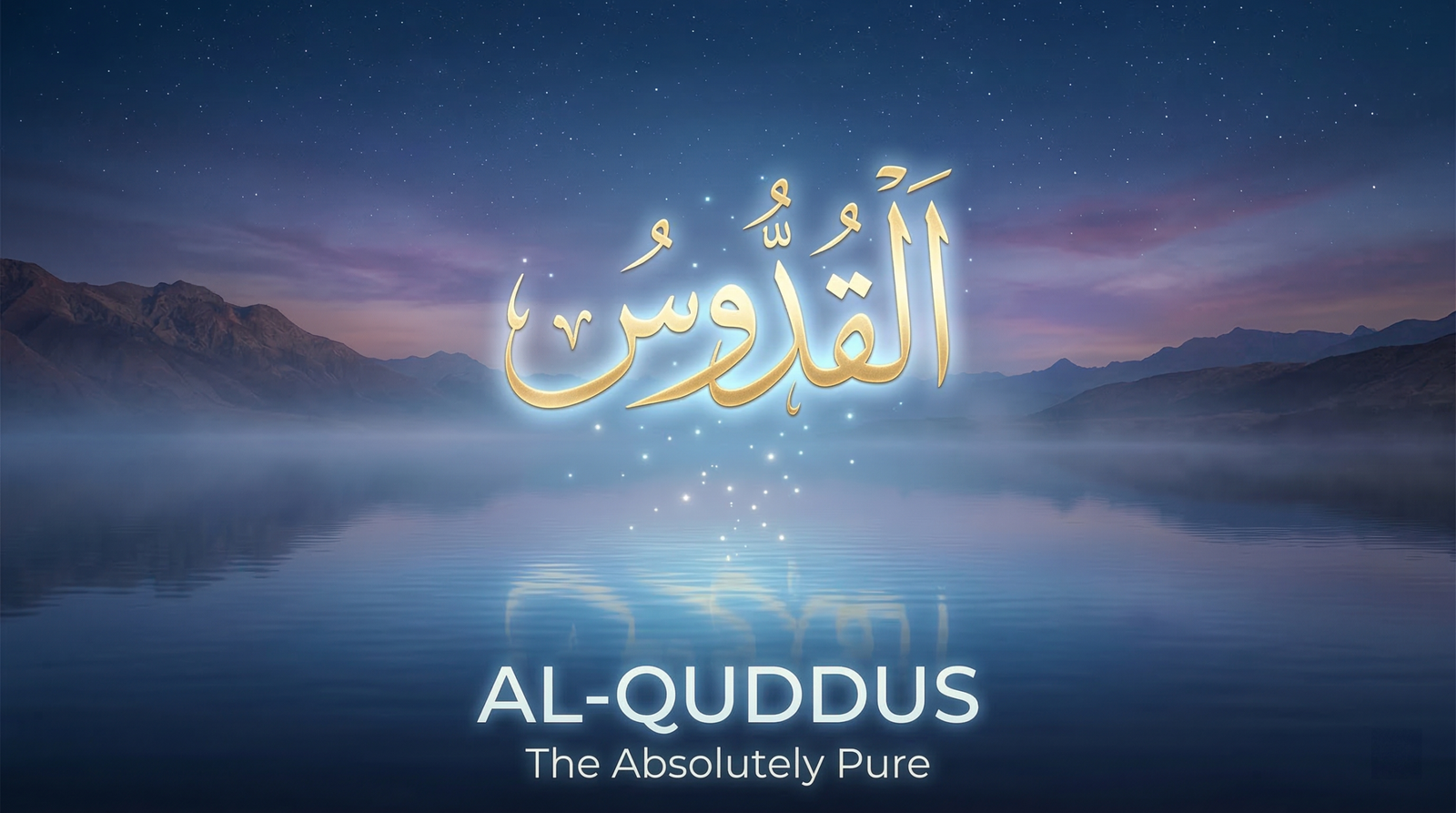
Among the 99 Names of Allah, Al-Quddus (ٱلْقُدُّوسُ) is profound, describing Allah’s fundamental essence rather than just a quality.
It answers the heart’s search for true perfection, representing a reality untouched by error or corruption.
This entry, part of the 99 Names of Allah, provides a scholarly and spiritual exploration of Al-Quddus.
What Does Al-Quddus Mean?
The name Al-Quddus comes from the triliteral Arabic root Q-D-S, which carries two overlapping meanings in classical Arabic: cleanliness (ṭahārah) and distancing (buʿd). Together, these two concepts form the foundation of what holiness means in Islam. Allah is pure, and He is distanced from every form of defect, weakness, or imperfection.
Arabic Text: ٱلْقُدُّوسُ
Root Letters: Qāf – Dāl – Sīn (ق د س)
Translation: The Absolutely Pure. The Most Holy. The All-Sacred.
Linguistically, Al-Quddus follows the Arabic morphological pattern of fuʿʿūl (فُعُّول). This is the most intensive grammatical form in Arabic. It signals the superlative degree of an attribute. So Al-Quddus is not simply “pure.” He is the most pure, the absolutely pure, the One whose sanctity has no ceiling and no comparison.
The root Q-D-S shares ancestry with the Hebrew word Kadosh, used in the Torah to mean “set apart” or “other.” This cross-Semitic heritage reveals something profound. The core concept of holiness, across the ancient Abrahamic world, always pointed to the same idea: God is qualitatively different from everything else that exists.
Even the physical origins of the word carry meaning. The classical Arabic verb qadasa was historically associated with the movement of a water bucket used for purification. The act of washing the body became the linguistic template for the spiritual concept of divine sanctification. Clean. Set apart. Wholly other.
Key Derivatives of Q-D-S:
- Quds (قُدْس) – holiness; freedom from blemish
- Taqdis (تَقْدِيس) – the act of glorifying and sanctifying Allah
- Muqaddas (مُقَدَّس) – that which has been made sacred
- Al-Arḍ al-Muqaddasah – the Holy Land, purified from polytheism
- Rūḥ al-Quddus (رُوحُ ٱلْقُدُسِ) – the Holy Spirit, referring to the Angel Jibreel
Mentions of Al-Quddus in the Quran and Hadith
Quranic Verse 1: Surah Al-Hashr (59:23)
Arabic Text:
هُوَ ٱللَّهُ ٱلَّذِي لَآ إِلَٰهَ إِلَّا هُوَ ٱلْمَلِكُ ٱلْقُدُّوسُ ٱلسَّلَٰمُ ٱلْمُؤْمِنُ ٱلْمُهَيْمِنُ ٱلْعَزِيزُ ٱلْجَبَّارُ ٱلْمُتَكَبِّرُ ۚ سُبْحَٰنَ ٱللَّهِ عَمَّا يُشْرِكُونَ
Reference: Quran 59:23
Translation (Sahih International): “He is Allah, other than whom there is no deity, the Sovereign, the Pure, the Perfection, the Bestower of Faith, the Overseer, the Exalted in Might, the Compeller, the Superior. Exalted is Allah above whatever they associate with Him.”
Notice the sequence here. Al-Malik (The Sovereign King) comes first, then Al-Quddus (The Pure). Classical scholars of tafseer point out this pairing deliberately. Human kings carry power, but their power is always stained. By greed. By fear. By mortality. Allah is Al-Malik and Al-Quddus, a King whose sovereignty is completely untouched by any of those stains.
Quranic Verse 2: Surah Al-Jumu’ah (62:1)
Arabic Text:
يُسَبِّحُ لِلَّهِ مَا فِي ٱلسَّمَٰوَٰتِ وَمَا فِي ٱلْأَرْضِ ٱلْمَلِكِ ٱلْقُدُّوسِ ٱلْعَزِيزِ ٱلْحَكِيمِ
Reference: Quran 62:1
Translation (Sahih International): “Whatever is in the heavens and whatever is on the earth is exalting Allah, the Sovereign, the Pure, the Exalted in Might, the Wise.”
Every single thing in creation, the stars, the stones, the oceans, the cells inside your body, is in a state of continuous glorification of Al-Quddus. Creation does not just exist. It recognizes. And what it recognizes, at every moment, is the absolute sanctity of its Creator.
Hadith: Sahih Muslim (487a)
Arabic Text:
سُبُّوحٌ قُدُّوسٌ، رَبُّ الْمَلَائِكَةِ وَالرُّوحِ
Translation: “All Glorious, All Holy, Lord of the Angels and the Spirit.”
Reference: Sahih Muslim 487a
The Prophet ﷺ would recite this during his bowing (rukūʿ) and prostration (sujūd). The pairing of Subbūḥ with Quddūs is significant. Subbūḥ means Allah is free from any deficiency that words might describe. Quddūs means He is holy in a way that goes even beyond what words can describe. Together, they form a complete statement of divine transcendence.
Theological Meaning (Tafseer)
Al-Ghazali: Beyond the Limits of the Imagination
Imam Al-Ghazali, in his Al-Maqṣad al-Asnā, defines Al-Quddus as the One who is “sanctified from every attribute that a sense might perceive, or imagination may conceive.” This is a striking definition. Al-Ghazali is not saying Allah is free from bad qualities only. He is saying Allah transcends the categories through which the human mind processes reality.
When you think of perfection, your mind draws on human experiences of knowledge, strength, or beauty. Al-Ghazali argues that Allah is Al-Quddus because He is beyond even those frameworks. His perfection is not a better version of what you know. It is something else entirely.
Ibn Kathir: The Rejection of All False Attributes
Ibn Kathir focuses on the doctrinal dimension. He defines Al-Quddus as the One who is “free from having any son or partner” and “sanctified from what does not befit Him.” For Ibn Kathir, this name is a direct rejection of every distortion ever attributed to Allah. No physical form. No needs. No offspring. No equal. Al-Quddus cuts through every false description with absolute clarity.
Sheikh As-Sa’di: Perfection of Every Attribute
Sheikh Abdur-Rahman As-Sa’di offers perhaps the most accessible reading. He describes Al-Quddus as the Being who is “free from all kinds of defect, deficiency, and imperfection.” He then draws out a beautiful implication. Because Allah is Al-Quddus, every one of His attributes is itself perfect. His mercy is not weak or conditional. His power does not grow tired. His justice contains no shadow of oppression. The holiness of His essence purifies every attribute He possesses.
| Scholar | Core Focus | Key Link to Al-Quddus |
| Al-Ghazali | Transcendence beyond thought | Divine otherness (tanzīh) |
| Ibn Kathir | Freedom from partners and human-like needs | Absolute oneness (tawḥīd) |
| As-Sa’di | Perfection of all attributes | Completeness (kamāl) |
How to Apply Al-Quddus in Your Daily Life?
Understanding Al-Quddus is not an academic exercise. It is a call to live differently.
1. Audit Your Intentions Before Every Action
The Prophet ﷺ said: “Indeed, Allah is Pure (Ṭayyib) and He only accepts that which is pure.” This hadith connects directly to Al-Quddus. Because Allah is absolutely holy, what you bring to Him must be as clean as you can make it.
Before starting a new project, before making a dua, before giving in charity, take thirty seconds. Ask yourself: why am I really doing this? Call out to Allah: Yā Quddūs, purify my intention. Strip away the desire for praise. Remove the performance. Make the act solely for Him.
Over time, this habit trains the heart to seek sincerity as a default state, not an occasional achievement.
2. Seek Halal Income as an Act of Worship
Living under the name Al-Quddus means holding your livelihood to a high standard. Income that comes from deception, interest, exploitation, or dishonesty carries a spiritual “stain.” Scholars point to the tradition of Aisha (RA) who would perfume the coins she gave in charity, understanding that even material gifts presented to Allah should carry a quality of cleanliness.
Check your income sources. Ask Allah to guide you toward provision that is halāl, clean, and free from the blemish of injustice. This is not just financial planning. It is spiritual purification.
3. Let Al-Quddus Anchor You During Anxiety
When the world feels messy and broken, and it often does, remember who Al-Quddus is. He is untouched by the chaos. His plans are not derailed. His knowledge has no gaps. His care for you has no cracks in it.
Reciting Subbūḥun Quddūsun, Rabbul-malāʾikati wa-r-Rūḥ in your sujūd is not just repetition. It is a deliberate act of reorienting your heart. You are pressing your forehead to the ground and declaring: above all of this imperfection, there is a Reality that is absolutely, eternally, completely pure.
That declaration is one of the most powerful tools available to a Muslim for building inner peace.
Duas Using the Name Al-Quddus
Dua 1: For Heart Purification
Arabic Text:
اللَّهُمَّ يَا قُدُّوسُ، طَهِّرْ قَلْبِي وَعَمَلِي وَنِيَّتِي، وَاجْعَلْنِي مِنْ عِبَادِكَ الصَّالِحِينَ
Translation: “O Allah, O Al-Quddus, purify my heart, my actions, and my intentions, and make me among Your righteous servants.”
Use this dua when you feel spiritually heavy, when sin has piled up, or when you notice your intentions becoming mixed with showing off or selfishness.
Dua 2: The Prophetic Witr Supplication
Arabic Text:
سُبْحَانَ الْمَلِكِ الْقُدُّوسِ
Translation: “Glory be to the Sovereign, the Most Holy.”
Reference: Sunan an-Nasa’i 1699
The Prophet ﷺ would repeat this three times at the end of his Witr prayer, raising his voice on the third repetition. Begin incorporating this into your nightly Witr. Let it be your final statement before sleep. A declaration that whatever the day held, your Lord remains perfect, untouched, and absolutely holy.
Related Names of Allah
Al-Quddus and As-Salam (The Source of Peace)
These two names appear side by side in Surah Al-Hashr 59:23, and the proximity is intentional. Al-Quddus establishes that Allah is internally pure, free from all defect in His own essence. As-Salam then turns outward, describing how Allah interacts with creation in a way that grants peace and security to those who trust Him.
Think of it this way. Al-Quddus is about what Allah is. As-Salam is about what Allah gives. His holiness is the source; the peace He offers His servants is the outcome.
Al-Quddus and Al-Muta’ali (The Supremely Exalted)
Al-Muta’ali describes Allah as being elevated far above the false ideas and misconceptions people hold about Him. It emphasizes altitude and exaltation. Al-Quddus emphasizes cleanliness and purity. Both names protect the integrity of Tawhid, but Al-Quddus focuses on what Allah is free from, while Al-Muta’ali focuses on how far above those things He is. They are complementary lenses on the same divine reality.
How to Teach Al-Quddus to Children?
The Pure Water Experiment (Ages 5-10)
This is a simple and memorable activity that takes about five minutes.
Fill a glass with completely clear, clean water. Hold it up and tell your child: “This is like Allah’s knowledge and care for us. It is perfectly pure. Not a single mistake in it.”
Then take a dropper and add one tiny drop of red food coloring. Watch it spread through the entire glass.
Ask your child: “Is it still perfectly pure water?” The child will say no. Then explain: “Even one tiny drop of forgetting or weakness would change everything. But Allah is Al-Quddus. He never has even one drop of weakness, forgetfulness, or mistake. He is always, completely, perfectly pure.”
Children remember this experiment because they see it. It moves from abstract theology to something they can watch with their own eyes.
The Heart-Warming Connection
After the activity, make it personal. Tell your child: “Because Allah is Al-Quddus, He will never forget you. He never makes mistakes in how He takes care of you. Everything He plans for you is perfect, even when it is hard to understand.”
Encourage children to say Yā Quddūs before they sleep as a way of asking Allah to keep their hearts clean and “full of light.” This builds a warm, trusting relationship with Allah grounded in His perfection, not fear.
Final Reflection
Al-Quddus is the name that stands as a guardian of Tawhid. It draws the clearest possible line between the Creator and everything He created. Nothing in this world is absolutely pure. Every human being carries weakness. Every created thing carries limitations. But above all of that, untouched and unchanging, is Al-Quddus.
Living with this name means reaching for a higher standard, not because perfection is achievable for us, but because the One we love is perfect. The purity of our intentions, our income, our hearts, and our relationships becomes an act of love and reverence toward the One who is Absolutely Holy.