
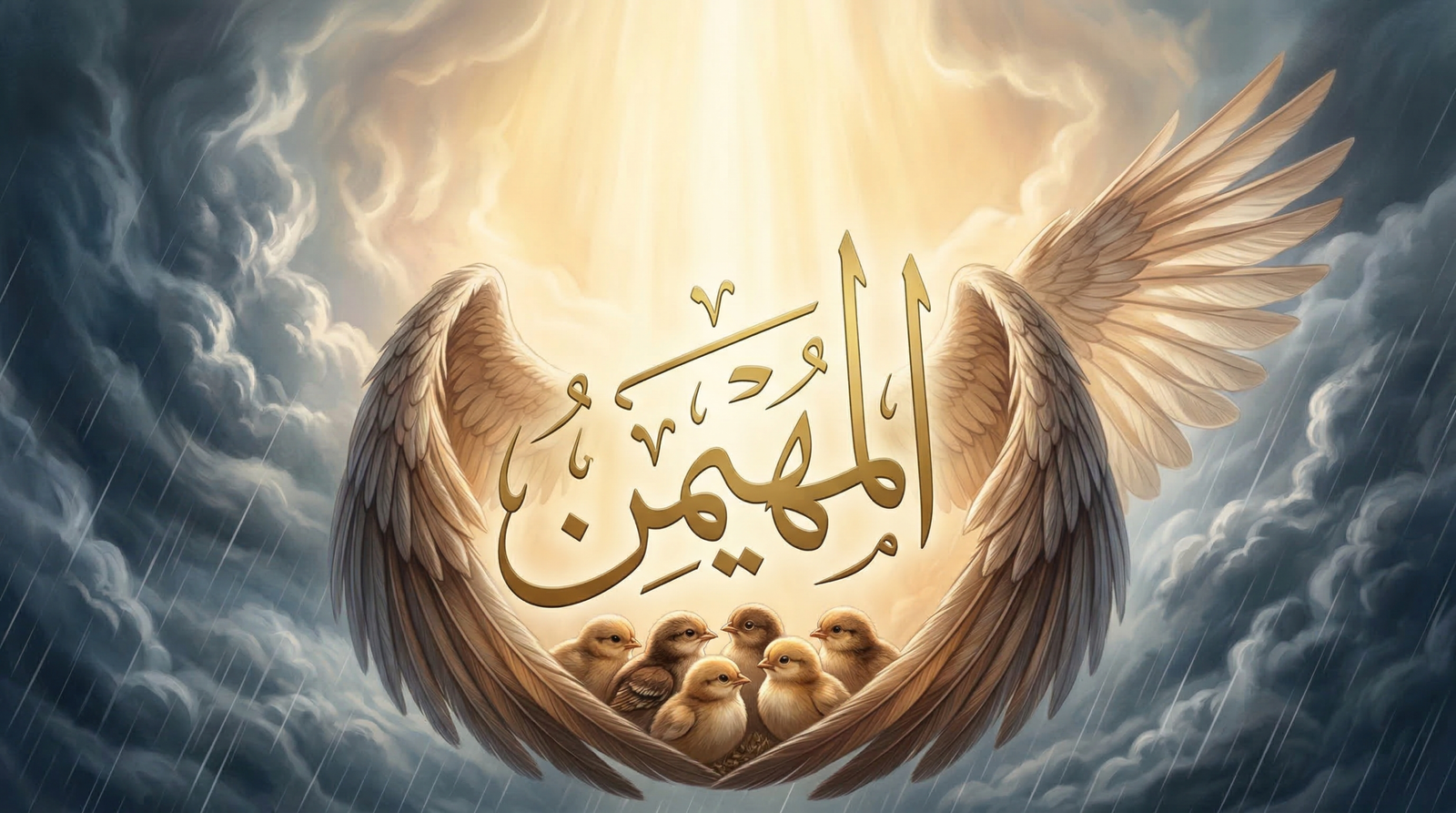
Among Allah’s 99 Names, Al-Muhaymin (ٱلْمُهَيْمِنُ) offers profound comfort by shifting our perspective on life. More than a distant observer, this name represents a tireless guardian whose care mirrors a mother bird shielding her chicks from a storm.
As one of the most spiritually layered names, Al-Muhaymin serves as a vital guide to Divine protection and theological depth. This exploration is part of our core resource on the 99 Names of Allah.
What Does Al-Muhaymin Mean?
In Thuluth calligraphy, the name (ٱلْمُهَيْمِنُ) is written with dramatic, elongated vertical strokes on the Alif and Lam. These tall strokes visually represent Divine oversight descending from the heavens.
The curved letters Meem and Nun wrap around the form like arms, reflecting the enveloping, protective quality of the name itself. In the Diwani style, the letters intertwine in dense, circular formations, symbolizing the hidden layers of the human heart that Allah perpetually oversees.
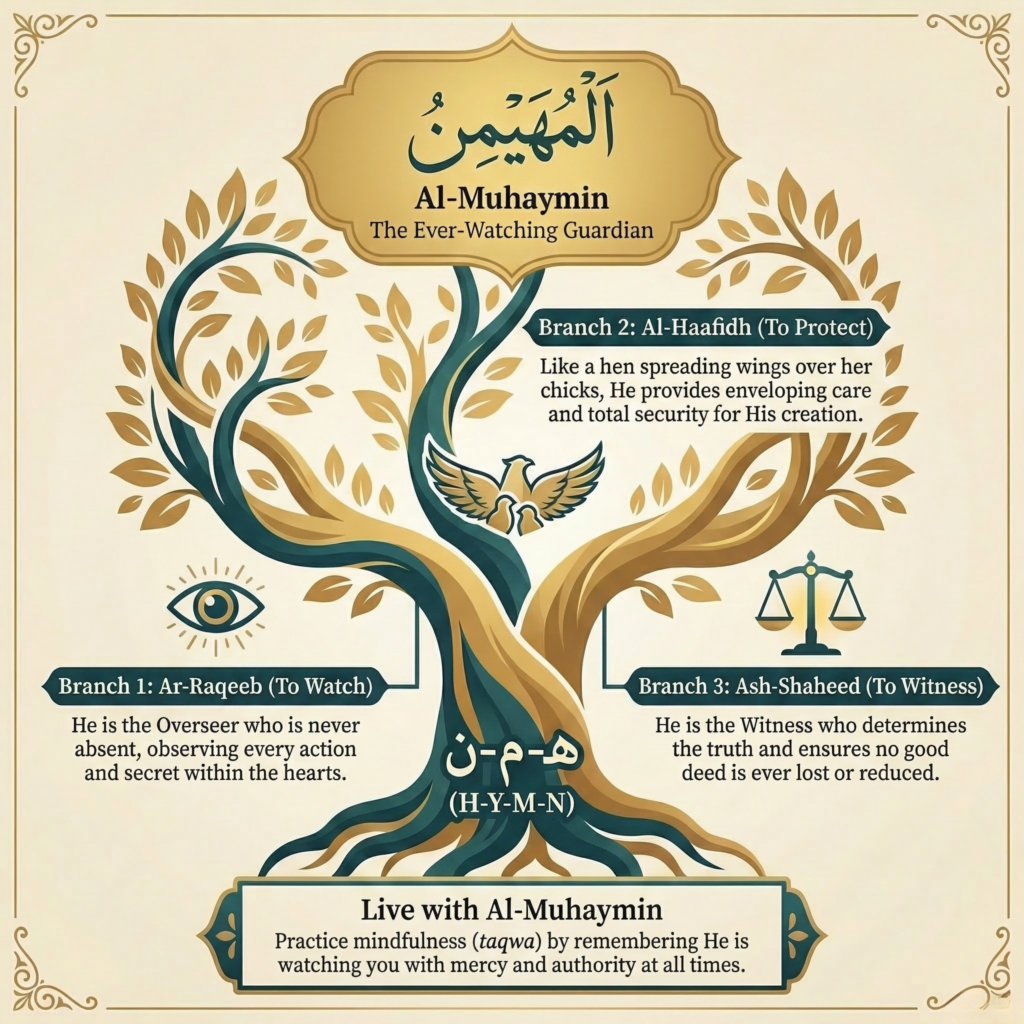
Al-Muhaymin derives from the classical Arabic root H-Y-M-N (هـ-م-ن).
Classical Arabic lexicographers list several simultaneous meanings packed into this root:
- To watch over
- To oversee
- To protect
- To guard
- To bear witness
- To offer peace and safety
The most powerful linguistic key to understanding this root is the expression:
هَيْمَنَ الطَّائِرُ عَلَى فِرَاخِهِ Haymana al-tāʾiru ʿalā firākhihi
This phrase describes a mother bird extending and spreading her wings to completely cover, warm, and protect her chicks. That image is not decorative. It is the very soul of the word. Divine guardianship is not surveillance. It is a warm, enveloping, nurturing protection.
Some classical philologists trace a secondary linguistic path: the root H-Y-M-N evolved from A-M-N (أ-م-ن), the same root as Al-Muʾmin (The Giver of Security).
The hamza (ء) morphed into a ha (ه) over time. This linguistic connection tells you something important theologically. Al-Muʾmin grants security as a gift. Al-Muhaymin actively maintains and perpetually guarantees that security through vigorous, unrelenting oversight.
Mentions of Al-Muhaymin in the Quran and Hadith
Quran: Surah Al-Hashr (59:23)
This is the verse where Allah explicitly names Himself Al-Muhaymin, placed among His most majestic attributes.
Arabic: هُوَ ٱللَّهُ ٱلَّذِي لَآ إِلَٰهَ إِلَّا هُوَ ٱلْمَلِكُ ٱلْقُدُّوسُ ٱلسَّلَٰمُ ٱلْمُؤْمِنُ ٱلْمُهَيْمِنُ ٱلْعَزِيزُ ٱلْجَبَّارُ ٱلْمُتَكَبِّرُ ۚ سُبْحَٰنَ ٱللَّهِ عَمَّا يُشْرِكُونَ
Translation (Sahih International): “He is Allah, other than whom there is no deity, the Sovereign, the Pure, the Perfection, the Bestower of Faith, the Overseer, the Exalted in Might, the Compeller, the Superior. Exalted is Allah above whatever they associate with Him.”
Notice the sequence. Al-Muʾmin (The Bestower of Faith) comes directly before Al-Muhaymin (The Overseer). The Quran places them side by side intentionally. He first gives faith, then He guards it.
Quran: Surah Al-Maʾidah (5:48)
This verse uses the word muhayminan to describe the Quran itself, showing the function of this attribute as a guardian criterion over all previous scriptures.
Arabic: وَأَنزَلْنَا إِلَيْكَ ٱلْكِتَابَ بِٱلْحَقِّ مُصَدِّقًا لِّمَا بَيْنَ يَدَيْهِ مِنَ ٱلْكِتَابِ وَمُهَيْمِنًا عَلَيْهِ
Translation (Sahih International): “And We have revealed to you, the Book in truth, confirming that which preceded it of the Scripture and as a criterion over it.”
Allah gave the Quran the quality of muhaymin over all prior books. This tells you the depth of the attribute: it is the quality of being the final, authoritative, protecting overseer of truth.
Authentic Hadith
1. Sunan Ibn Majah 3861:
إِنَّ لِلَّهِ تِسْعَةً وَتِسْعِينَ اسْمًا مِائَةً إِلَّا وَاحِدًا مَنْ أَحْصَاهَا دَخَلَ الْجَنَّةَ
Inna lillāhi tisʿatan wa-tisʿīna isman, miʾatan illā wāḥidan, man aḥṣāhā dakhala al-jannah.
“Indeed, Allah has ninety-nine names, one hundred less one. Whoever preserves them will enter Paradise.”
Al-Muhaymin is explicitly listed in this narration. Knowing the name is the first step. Internalizing its meaning is the spiritual work.
2. Jamiʿ at-Tirmidhi 2516:
احْفَظْ اللَّهَ يَحْفَظْكَ، احْفَظْ اللَّهَ تَجِدْهُ تُجَاهَكَ
Iḥfaẓ Allāha yaḥfaẓka, iḥfaẓ Allāha tajid-hu tujāhaka.
“Be mindful of Allah, and Allah will protect you. Be mindful of Allah, and you will find Him in front of you.”
This Hadith captures the reciprocal nature of Al-Muhaymin’s guardianship. Your mindfulness of Him activates His protective presence in your life.
Tafseer Meaning Of Al-Muhaymin
Classical scholars agree that Al-Muhaymin is one of the most comprehensive Divine attributes in Islamic theology. It does not describe a single action. It describes an entire mode of Divine engagement with creation.
Imam Ibn Kathir
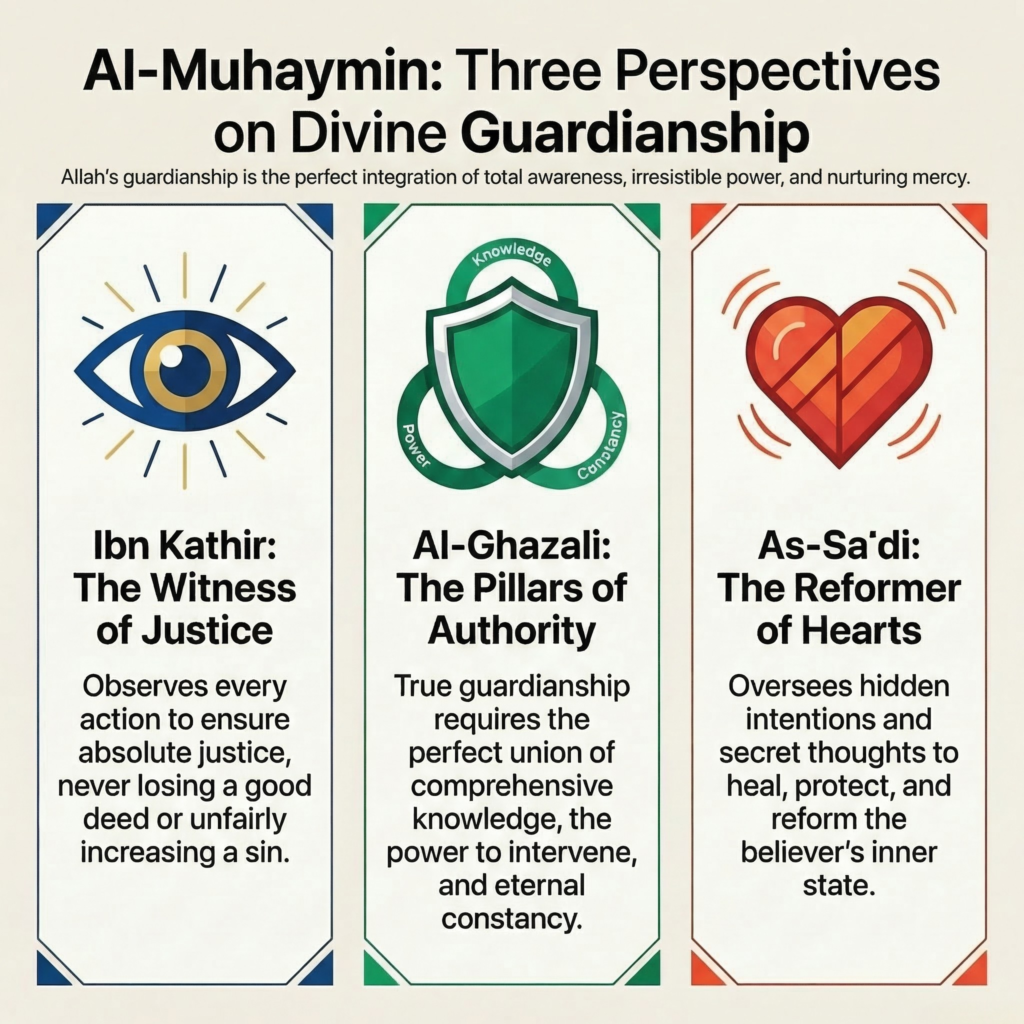
Ibn Kathir focuses on the Shahid dimension of Al-Muhaymin, meaning Allah as the ever-present Witness over every action of His creation. This Witness is not passive. Ibn Kathir explains that Al-Muhaymin guarantees absolute justice.
He observes every soul, every intention, and every deed. No good act is ever reduced. No sin is unjustly multiplied. The Divine Witness is simultaneously the Divine Guarantor of perfect accountability.
Imam Al-Ghazali
In his foundational work Al-Maqsad al-Asna, Al-Ghazali builds a precise theological framework for understanding true guardianship. He argues that perfect guardianship requires three absolute pillars:
- Comprehensive Knowledge of the guarded object, including its hidden states
- Absolute Ability (Qudra) to protect it against any threat
- Perpetuity (Dawam), meaning the guardian is never distracted, never sleeps, never fatigued
Al-Ghazali is direct in his conclusion: no human being can be a true guardian in this sense. Human guardianship is always metaphorical, always limited.
Only Allah embodies Al-Muhaymin perfectly. Al-Ghazali also points to the spiritual dimension, stating that Allah oversees the hearts and souls of His servants, guiding them away from moral decay before they even recognize the danger themselves.
Imam As-Saʿdi
As-Saʿdi focuses on the internal, personal dimension of this attribute. He defines Al-Muhaymin as the One who sees the hidden matters and everything the hearts conceal. His insight is that this Divine gaze into the “turnings of the heart” is an act of mercy, not punishment. Allah’s oversight of your inner world functions like a spiritual wing that heals and reforms the believer’s inner states. He is not watching to condemn. He is watching to guide.
How to Apply Al-Muhaymin in Your Daily Life
1. Practice Muraqaba: The Awareness of Being Seen
Muraqaba is the Islamic spiritual discipline of cultivating awareness that Allah perpetually watches over you. Start with a simple daily practice. Each morning, before checking your phone, spend two minutes in stillness and say: “Al-Muhaymin is aware of my heart right now.”
This is not about fear. It is about alignment. When you know the Guardian is watching your thoughts, arrogant thoughts and destructive inner narratives lose their grip faster.
In our experience working with students at Rayhaanschool.com, those who build this morning awareness practice report a measurable shift in how they handle frustration and temptation throughout the day.
2. Trade Anxiety for Tawakkul
Anxiety is largely the feeling of being unprotected and unobserved by a powerful force. Al-Muhaymin is the direct theological answer to that feeling. The One overseeing your life is All-Powerful and All-Merciful simultaneously.
When a situation feels out of control, practice replacing the thought “no one is watching this” with “Al-Muhaymin is overseeing this completely.” That single cognitive shift is what the scholars called Rida, contentment under Divine decree.
3. Become a Guardian in Your Own Sphere
Allah’s attributes are meant to be reflected in the believer’s character at a human scale. Al-Muhaymin watches over and protects. You can live this attribute by protecting the rights of those in your care, honoring every trust (Amanah) given to you, and offering emotional safety to people who feel exposed and vulnerable.
This does not require a grand gesture. It requires consistent, small acts of reliable protection: keeping a secret, showing up when promised, standing up for someone being treated unjustly.
Duas Using the Name Al-Muhaymin
Dua 1: For Comprehensive Protection
Arabic: اَللّٰهُمَّ يَا مُهَيْمِنُ، احْفَظْنِي وَاحْرُسْنِي مِنْ كُلِّ سُوءٍ وَمِنْ شَرِّ الشَّيْطَانِ
Translation: “O Allah, O Al-Muhaymin, protect me and guard me from every harm and from the evil of Shaytan.”
Read this dua at the start of your day or before entering any situation that feels unsafe, unfamiliar, or spiritually challenging.
Dua 2: For Tranquility and Contentment
Arabic: يَا مُهَيْمِنُ، أَنْزِلِ السَّكِينَةَ فِي قَلْبِي وَاجْعَلْنِي قَانِعًا بِقَضَائِكَ
Translation: “O Al-Muhaymin, send down tranquility into my heart and make me content with Your decree.”
This dua is particularly powerful during periods of grief, waiting, or uncertainty. Pair it with slow, intentional breathing.
Dua 3: For Guidance and Righteous Choices
Arabic: اَللّٰهُمَّ يَا مُهَيْمِنُ، وَجِّهْنِي لِمَا يُرْضِيكَ وَأَعِنِّي عَلَى طَاعَتِكَ
Translation: “O Allah, O Al-Muhaymin, guide me to what pleases You and help me to be obedient to You.”
Read this before making any significant decision, from career choices to how you respond in a difficult conversation.
Related Names of Allah
Understanding Al-Muhaymin becomes even clearer when you place it beside two closely related names.
Al-Muhaymin vs. Ar-Raqeeb (ٱلرَّقِيبُ, The Watcher)
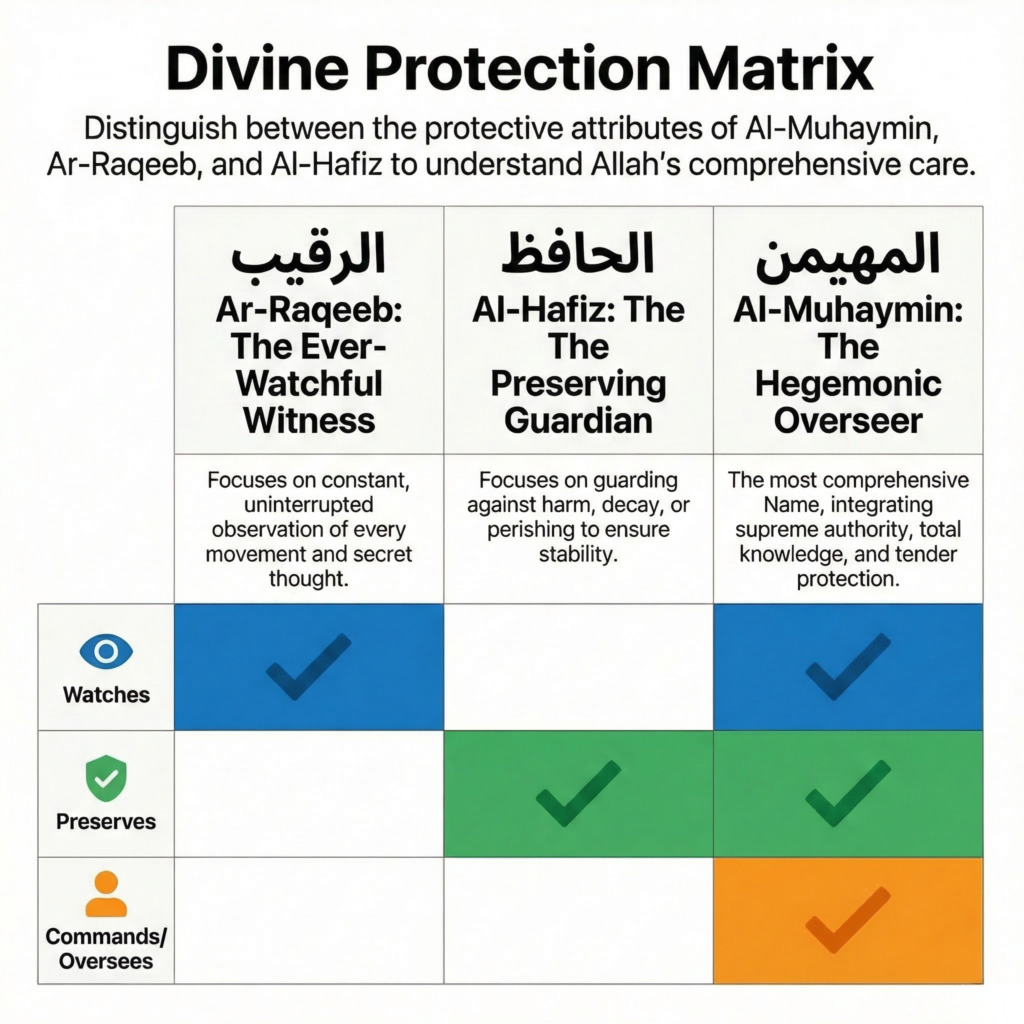
Ar-Raqeeb describes the constant, silent gaze of Allah that never leaves its target. It is the attribute of perpetual monitoring.
Al-Muhaymin contains this watching, but it goes further. Al-Muhaymin adds sovereign authority and active, proactive protection to the act of watching. Ar-Raqeeb sees. Al-Muhaymin sees, commands, and shields.
Al-Muhaymin vs. Al-Hafiz (ٱلْحَفِيظُ, The Preserver)
Al-Hafiz is the strong shield that guards Allah’s creation against loss, damage, and perishing. It is a preserving force. Al-Muhaymin encompasses this preservation but adds the dimension of bearing witness and exercising supreme command over all of creation. Al-Hafiz protects what exists. Al-Muhaymin governs the entire reality within which things exist.
A useful mental map: Ar-Raqeeb watches, Al-Hafiz preserves, and Al-Muhaymin does both while remaining the absolute, sovereign authority over everything.
How to Teach Al-Muhaymin to Children?
Children between the ages of 5 and 10 are highly concrete thinkers. Abstract words like “overseer” or “sovereign guardian” mean very little to them. The key is to anchor the concept to a physical sensation they already love: warmth and safety.
The Mother Bird Story
Tell your child to imagine a tiny baby chick caught in a big, loud thunderstorm. The rain is heavy, the thunder is scary, and the chick is alone and terrified.
Then the mother bird arrives. She does not just stand nearby. She opens her huge, warm wings and completely tucks the baby underneath her. Inside, it is dark, but wonderfully cozy. The storm is still raging outside, but the chick feels perfectly safe. Nothing can reach it.
Tell your child: “Allah is Al-Muhaymin. He is like those protective wings, except His care does not just cover one chick. His care covers the whole universe, including you, right now, wherever you are.”
This removes the misunderstanding that Al-Muhaymin is a strict enforcer catching mistakes. It reframes the attribute as love in action.
The Blanket Activity
After telling the story, ask your child to go get their softest, favorite blanket. Have them wrap it tightly around their shoulders.
Then say to them: “Feel how warm and safe that is? Now know this: Allah’s care for you is even closer and warmer than that blanket. He is Al-Muhaymin, your special Guardian who never sleeps and always watches out for you. Every time you feel scared, remember His wings are already around you.”
This creates a physical anchor. The next time your child feels afraid or alone, the blanket becomes a tangible reminder of Divine guardianship.
Final Reflection
Al-Muhaymin is a name that asks something of you.
It asks you to stop pretending you are alone. It asks you to stop performing for the world while hiding your true self, because the One who matters already sees everything and loves you anyway. It asks you to extend that same protective, witnessing care to the people around you.
The scholars spent lifetimes on this name and kept finding more inside it. Start with one small step. Learn the name. Say the dua. Wrap the blanket around your child’s shoulders and tell them the story.
That is how the Names of Allah move from information into transformation.